It's more like the other way around. I used to know lots of people with Nokia phones, both feature phones and smartphones. Now there are only iPhones and Androids, I don't think I've seen a phone with Windows except in a store.
Besides, Nokia had great reputation as a quality brand. Some of their phones were unbreakable. They've lost their reputation since their deal with MS.
They lost their reputation long before they went to MS. Symbian had over 3000 developers yet their interface was very confusing, and full of bugs. The N95 was a decent phone in 2007 besting the iPhone in many ways (fast CPU/GPU, 3.5G, full GPS, good display, 5MP camera with good optics) but it did not have touch. I was fine with it and owned one and loved it.
So Nokia then came out with the N97 and it was clear that they did not have the ability anymore to design software or pick a strategy. Their 'app store' switched from MoSH to Ovi and it just simply did not work. All the while Android and iOS were moving very fast. People were very unhappy with the N97 flagship and the rest of the offerings were not very clear. They had dozens of models. E series was supposed to be the business series and N series for "media". It was confusing marketing. From 2009-2012 they were losing double digit marketshare every year. Even strongholds like India and Asia were starting to view Nokia as a company that lost their direction. So yes people did have fond memories of their unbreakable candybar phones but they also associated Nokia with the old days of phones as they could not produce a modern, coherent UI. (until MeeGo where it was too late)
I'd like to see them continue on the path that the Lumia 1020 set - premium camera smartphone. I think there's a good niche for them there that is very hard for Apple to get into due to asthetics (a Lumia can have a bump on the back for a large fast lens that would be very unusual for an iPhone).
Case in point: The Lumia 1020 is using Nokia's relatively old technology. The Nokia 808 PureView was released in Feb 2012, yet received very little recognition.
All of a sudden, a year later, the Lumia 1020 seems like a "fresh, new" idea. When in fact, Nokia has been marketing this EXACT SAME IDEA for over a year. For better or for worse, the "Windows Phone" brand turns heads. Lumia1020 is sticking with people a lot more than "PureView 808"
I remember the press going crazy for the 808, with one exception: it ran Symbian. That was the only thing the press didn't like, and that fact kept anyone from seriously recommending it. It was a tech demo, it was a great camera attached to a phone that cost Nokia nothing to build (unlike the Lumia 1020). The 1020 was the real-world version of the 808, the version Nokia wanted people to buy.
He canned their best phone (N9) and OS (Meego), only to pursue a clearly inferior business strategy, drive the stock price down, and enable a Microsoft takeover...
I was an owner of a N9 and really enjoyed the OS. Most of the employees that developed Maemo and MeeGo are carrying on at jolla.com. They still have not shipped a phone yet and I have been following them for nearly 2 years now.
As much as I love the close to open source atmosphere and very good UI of the N9, Elop is right. Android turned making phones into a commodity. The only place where money can be made is by providing an ecosystem. Customers demand an ecosystem too. Nokia was losing market share so fast that as Elop said they were on a "burning platform". I am not sure they had the might anymore to create a MeeGo/Maemo ecosystem in time to save them.
I really wish that Nokia would have continued MeeGo development but I understand the decision to can it too. Nokia for many years was offering contradictory statements and making half assed partnerships. So they had to say we are going all in and all of our resources are behind Windows Phone. Developers got burnt several times. Even with Maemo they suddenly partnered with Intel's mobile OS and had to spend a year porting stuff with no apparent gain to customers. So I wish Jolla well, but Nokia did what they had to do.
"Android turned making phones into a commodity. The only place where money can be made is by providing an ecosystem."
I agree with that. Having an ecosystem is the root of value in mobile device companies. Elop was correct to identify an ecosystem as the most important thing. Where it gets controversial is the subsequent MSFT decision, which could be interpreted as saying "Now that we have determined ecosystems are the most valuable thing a company can have, we are torching ours and outsourcing that part of the company to Microsoft"
The more logical thing would have been "now that we have determined ecosystems are the most valuable thing a company can have, we are all-in with Qt and MeeGo."
Of course, it ultimately boils down to whether Elop and Nokia's leadership had more faith in Microsoft than in themselves to build that ecosystem. In terms of execution, neither company had been firing on all cylinders for quite some time...
Best phone and OS according to who? The same folks who cheered on the OpenMoko? As Elop said, the market has turned from a battle of devices into a war of ecosystems. Meego would've ended up like BB10 running on QNX(remember how many folks on here salivated about a QNX based mobile OS?), critically appreciated but with no apps and sales.
Nokia recently became the fourth largest OEM in the US market.
http://pocketnow.com/2013/11/01/nokia-smartphone-sales
I doubt that given Nokia never really had a brand in the US for smartphones, it could've done so without Microsoft's support.
According to everyone who saw it and touched it. I was watching their unveiling of the phone, trading their stock and listening to market opinion, and I remember that very day. Everyone in the market agreed that Meego could have been huge (it was also open-source like Android, and in many ways a better OS), and it was only Elop's allegiance to Microsoft which killed it.
Meego was good enough that Jolla picked it up, and Intel spun it into Tizen. At the time of the N9 unveiling, it was better than Android.
Speaking of ecosystems, fast forward a few years, if Nokia had indeed attempted to push Meego and failed, Android would have been the logical choice. Now they're settling for scraps with Windows Phone, when they were once THE leader worldwide in smartphones...
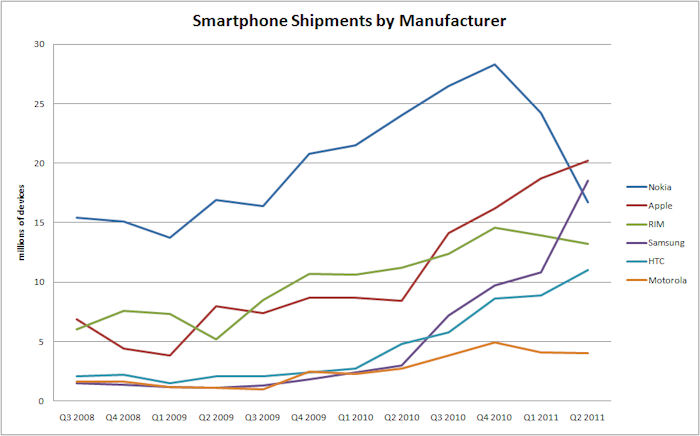
Edit - by the way, Nokia was the smartphone market share leader as recently as 2011... In fact, it was during Elop's tenure that Nokia lost most of its market share, although they were on the way out for awhile before then. But had Meego had better traction, it could have been very different. Nokia had an ecosystem, and had mindshare...
Another problem is that the final (and truly brilliant) UI of the N9 didn't exist at the time Elop made the decision to kill it. At the time, the Swipe UI was not done, and was actually the 3rd "let's start over" initiative with the MeeGo UI at the time (so you can see why there was skepticism on it).
But man, they really knocked it out of the park. It was (and still is) the best smartphone UI ever made.
> (it was also open-source like Android, and in many ways a better OS).
Open source is not a very big selling point to the masses. WebOS was open source and better than Android at the time, had good reviews, but it flopped miserably.
>Speaking of ecosystems, fast forward a few years, if Nokia had indeed attempted to push Meego and failed, Android would have been the logical choice
You're assuming that Nokia would not be dead from all the losses in the meantime. Microsoft was pumping $250M into them per quarter to ease the transition. If Nokia went alone, it may not have survived the big transition to Meego.
>and it was only Elop's allegiance to Microsoft which killed it.
No, it was Nokia's board that hired him in the first place and approved all his big decisions.
> You do know that a company's board can fire the CEO at any time right?
Oh really?
> Open source is not a very big selling point to the masses.
No, but it enables other manufacturers to hop on board and create an ecosystem. Nokia had Intel and others in their corner...
> WebOS was open source and better than Android at the time, had good reviews, but it flopped miserably.
It wasn't open source until it had already failed. Plus it never felt as though HP really cared all that much about mobile devices, they were a huge monolithic entity making too much money on desktops, servers, etc...
Contrast this with Nokia, the world leader in phones (including smartphones) for quite some time.
Also, at one point Symbian held 70+ percent of smartphone market share, Nokia obviously did know how to create an ecosystem.
> No, it was Nokia's board that hired him in the first place and approved all his big decisions.
Obviously a mistake on their part. Corporate boards don't always make the best decisions, though in theory they should.
Also, at one point Symbian held 70+ percent of smartphone market share, Nokia obviously did know how to create an ecosystem.
That data point actually proves the exact opposite: Nokia knew how to sell mobile phones, but they had no idea how to create an ecosystem.
Despite Symbian's huge marketshare, the market for 3rd party Symbian apps was in shambles. There had been an initial enthusiasm for Symbian app development in 2002-2004, but that was slowly killed by Symbian's obtuse certification processes and SDKs that kept growing in complexity and crappiness.
When the iPhone was introduced, Nokia was marketing their Symbian phones with the slogan: "This is what computers have become." But almost nobody was doing computer-like things on Symbian phones. The browser sucked, even though it was WebKit-based (Nokia had forked the code and left it to linger). There was no channel for selling apps to ordinary consumers.
A few geeks installed weird stuff like Quake ports on their N95 phones, but the average Symbian user just did phone calls, SMS and occasional photos.
I agree with your points, but as a quibble, webOS was not open source at the time. The decision to open-source webOS didn't come until the end of 2011.
4th at 4.1%. Beating Motorola (which was stagnating, even after the Google buy) and ZTE (which didn't have much US brand recognition anyway) wasn't super difficult.
Also, Meego Harmattan (released with the N9) got pretty stellar reviews all round. See for your self:
N9 had more apps at the time than Windows Phone today. Nokia had a large developer base and the Qt development environment for N9 was really good. There was nothing to stop it gaining market share as it was overall a really decent platform/ecosystem.
Only thing that killed it was Elop who decided to limit sales to just 23 small countries, and left big markets for their WP launch device, which was horrible at the time (Lumia 800). Of course the whole MeeGo strategy was killed earlier which made the device DOA.. And it still sold 10x more than the Lumia 800.
As someone who loves the N9, I still feel compelled to point out that it is simply false that the N9 had more apps at the time than Windows Phone has today.
There were a lot of Qt developers (still are) and I definitely agree that the N9 was set up to not succeed, and that had a negative effect on the ecosystem.
Although even before feb 11, when Nokia was all-in with Symbian+Qt+Meego, developer interest was lagging behind iOS, Android, and even Windows Phone which was vaporware at the time. Here's one from mid-2010: http://www.appcelerator.com/assets/appcelerator-mobile-devel...
The long and short of it: he bet everything on Windows Phone.
I think you can envision a successful strategy that would have included Windows Phone, potentially even as the only platform they offered, but Elop killed off everything else in a very visible way before WP was really ready. When it became the only offering, they alienated existing customers and left them with no obvious migration path.
WP sales have started to recover, but IIRC they're still lagging behind what Symbian was doing at the time Elop took over. Conceptually WP may have been a reasonable long term choice, but there were certainly ways to get there that didn't cost them so many existing customers so quickly.
While both your statement and my response are gross oversimplifications, I would point out that when Elop took over, more people were buying Nokias than they are now.
Q3 2010 (when Elop took over): 110.4 million Nokias sold
Q3 2013: 64.4 million Nokias sold
Parsing your statement, if when you said "no one was buying Nokia phones" you means "no one [in developed economies] was buying [Nokia high end smartphones]" you'd then be correct.
And how does that compare with Symbian sales before Elop? I have not looked at a comparison, but it would not surprise me if Windows Phone has not yet caught up.
Don't get me wrong, I am not a Symbian fanboy and I think Nokia held onto it for too long, but the notion that "no one was buying Nokia phones" is not the whole story. It probably resonates with the average HN reader, who is relatively young, lives in the US and carries an iPhone or Android device. It probably also accurately represents where the Symbian market was going long term. But it's not the whole story.
"And how does that compare with Symbian sales before Elop? I have not looked at a comparison, but it would not surprise me if Windows Phone has not yet caught up."
I don't think you understood my point. I was saying I would not be surprised if Symbian in 2011 was selling more units than Windows Phone in 2013.
For example, just from press reports that I can find on Google, Nokia sold 20 million Symbian phones in Q4 2011, and 4.4 million Windows Phones in Q4 2012.
Besides, Nokia had great reputation as a quality brand. Some of their phones were unbreakable. They've lost their reputation since their deal with MS.