“Half the money I spend on advertising is wasted; the trouble is I don't know which half.” -John Wanamaker
This applies even more strongly to model choosing. I know for a fact that majority of my work doesn't require a very strong model, but separating the trivial and non-trivial tasks is a famously hard problem (if at all decidable).
Exactly. I haven't reached the "let 1000 agents bloom" mode yet, so currently I'm spending real headspace managing agents doing work, and that work is all important, so why "settle" for sub-frontier models for that work? Maybe I'll get there for non-coding work.
> Starting today, GPT‑5.6 Luna, our fastest and most affordable model, will cost 80% less,
I don't have the words.
I genuinely thought we were in a stage where we were plateauing and going in for 5-10% improvements over months. Seeing spikes like this makes me question about where the floor really is.
When model intelligence reliably hits 90%-95% of current day knowledge worker tasks, they are going to burn those weight to silicon and we will see another 10X improvement in price/performance frontier.
The dynamic GPU clusters will be used for the 5% of tasks, and pushing out the frontier. Also there will be a set of knowledge tasks that are not done today (because they are too difficult for most knowledge workers), that will start being done in the future.
Burning the weights into silicon would be many orders of magnitude increase, not just 10x. It's kind of crazy that this hockey stick the AI hype bros talk about seems more and more every day like it might be real
https://taalas.com/ has done it already for a wildly obsolete model. 14000 tokens per second.
https://chatjimmy.ai/ is their interactive. Tiny context, very dumb, but absurdly fast. Imagine this as a tool call for claude code for trivial changes - the tool call from the harness takes longer than the execution.
To be fair we don't really know in terms of prices what's real and what's just investor subsidised attempts at market capture at this point. It could well be OpenAI's attempt to drown Anthropic while they've got the halo product if they feel they've got deeper pockets.
I wouldn't be surprised if they still had some margins since cheaper models are much harder to nail the accurate sizes off, and you still pay 2x for 1M context window.
But if this is even at 400B size it's insanity those inference prices, maybe 10-20% margins, if it's higher I would like to know is it their own ships or maybe they have accurately sized the model to fit on exactly a B300?
Could be a lot of magical things we can only speculate, but from here there likely isn't another 60-70% margin, like I have heard people claim, I would definitely be willing to bet on that.
Could still be a healthy 10-30% margin. Especially with Terra.
Hard to believe numbers. I don't mean that as a critique, but literally I am so impressed. Even if the model is a few percent lower for performance but is 80+% cheaper than competitors and is a US company hosted on US based hyperscaler clouds this is kind of a no brainer. Hard for most businesses to justify otherwise.
High-performing open weight models being released recently, and your customers looking into working with multiple providers as a result, are a great reason to drop prices on your non-frontier offerings.
Although I'm sure there are some efficiency gains, the technology is too new and labs are scrambling to release too quickly to think that the low-hanging optimization fruit has been picked already.
Let's suppose each models was subsidized at 70%, so that we only pay 30% of the cost. They would loose much more money per token on the more powerful models. It's in their interest to encourage the use of the less expensive models. Let's say they increase Luna subsidies at 90%. They would still "save" relative to the use of the more expensive models.
They have no (other) equivalent to nano, so it makes sense that it’s much cheaper now. It may have been better, but it was also hell of a lot more expensive.
Vera Rubin will be hitting racks very soon, and this is purported to have a 10x improvement in token throughput per megawatt. Of course, old chips don't get replaced with new chips overnight, but I don't think we're anywhere near the floor yet.
By benchmarks, which sadly is a poor measure. Yes Luna is a good model under certain circumstances. Whether it is great for general usage is another story. Sonnet is definitely better when prompts are more vague and it needs to decide things. Luna generally sticks to things very strictly and goes off in bad ways.
Yes but there is a big, big market for subagents to consume lots of tokens cheaply and condense information up to parent agents. Luna would not be my choice for planning. But an explorer to comb through a codebase to find relevant parts? Or for enterprise retrieval, where it needs to search across many different types of data to see where to focus efforts for a smarter model? Or to wake up periodically to evaluate some conditions and determine if a bigger model should be spun up? Definitely.
I've previously found flash (for all the hate it gets) to be good for these kinds of things. Haiku was fine but it's ancient.
Sonnet and Haiku were already in an awkward spot, likely by design.
Anthropic's big marketing push this year has been entirely focused on getting people to use Opus via a Claude Code subscription, to the point that Sonnet is almost viewed as the poor man's alternative, and from what I've seen, almost nobody uses it.
Actually, here's an interesting project for all the vibe coders looking for their next front page post: scrape a ton of commits from GitHub with Co-Authored-By: Claude and figure out what the percentage split between Opus/Fable/Sonnet is. I'm willing to bet it's less than 10% Sonnet.
>figure out what the percentage split between Opus/Fable/Sonnet is.
This may be misleading, since I suspect many are using a blend through sub-agents. I tend to bias for Fable to orchestrate and Opus for implementation via sub-agents.
Opus 5 is not strong enough as the top-of-stack model, and feels idiotic after a week or two of heavy Fable usage, to the point where I'm paying for Usage Credits to keep using Fable rather than having to slum it with Opus.
I don't see how this follows. The cost of nails has fallen by 95% over the last century. It's because the cost of manufacturing has fallen. Not because they are selling the information of nail consumers.
Tokens are not normal software, because they have marginal cost, and I think people who are used to software economics really struggle with this. With token generation there really can be manufacturing cost efficiencies where one producer is just straight up better at serving product at a lower marginal cost.
That’s ridiculous. Every major AI lab is compute constrained. That’s exactly why nvidia is worth trillions today. If OpenAI had a single extra GPU they’d be using it to run another training cycle or experiment for their next model.
sama literally just said they wish they had bought more. the price drops are almost certainly due to good old fashioned hardware innovation (wafer scale with cerebras) and optimizing hardware development based on model architecture and inference costs. other inference providers will try to do the same if they can.
Making Luna, which was already very cheap and extremely capable, 5x cheaper is crazy. I use Sol at work but Luna at home, and while there's definitely a difference, it doesn't feel like night-and-day. After a year of ever-increasing prices it suddenly feels (between this, Kimi K3, GLM 5.2) that prices are falling again.
It's cheaper currently on many of the inference providers.
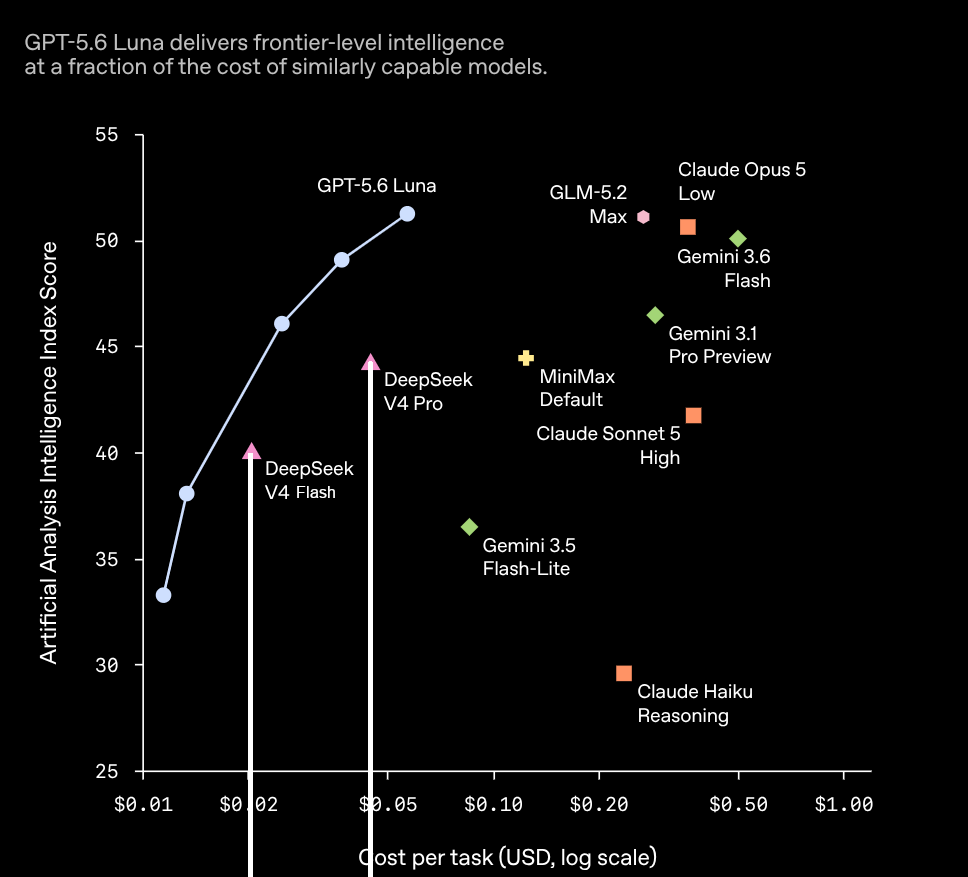
Personally, I'm having surprisingly good results with DeepSeek 4 Pro at home, which is very good value for money: it's not as good as Claude / GPT 5.6 (I have Co-pilot license at work), but it's still really useful for code reviews, validating thoughts, and especially designing / writing unit tests for new (and old before refactoring) functionality.
And it's very cheap per task. (Flash is even cheaper, but I've had issues with that on more complex tasks where it starts forgetting things and arguing with itself "but wait, let me read the function again").
> The kernel work helped reduce the end-to-end cost of serving the model by 20%, while its experiments increased token-generation efficiency by more than 15%.
If the cost of serving GPT-5.6 just dropped by 20%, does that add up to literally billions of dollars in savings per month?
We know Anthropic spend $1.25 billion renting inference capacity from SpaceX (in two Colossus datacenters) from the SpaceX IPO, but we don't know how much of Anthropic's inference capacity that is (presumably a small fraction, since they were operating on top of AWS and other providers before the SpaceX deal.)
I've not seen any numbers that hint at OpenAI's per-month inference bill, but surely that has to be in the multiple billions of dollars as well.
lots of places, actually. not everyone wants to be attached to the Silicon Valley culture, and that line alone will guarantee practically any workplace. that person is going to find out what work-life balance is :)
In this case, and I don't mean this critically, I guess it would technically be, "Instructed model to find efficiencies... reducing inference cost by 20% saving company x billion dollars per month."
I have no doubt that further work was required to enable this, but it's still very cool to be possible to say that.
This feels like the dialup->broadband transition to me.
I was already a huge proponent of Luna for things like deep research. Being able to run 5x more for the same cost is simply bananas. We are already running 10 parallel agents for hypothesis generation. I cannot imagine 50. The statistics become much more interesting & powerful when you can run so many samples of the exact same prompt+model without breaking the bank.
Very interesting. Can you share more about your hypothesis/research pipeline? I have been using Sol for those types of task because I figured you'd need more reasoning for getting good ideas, but maybe quantity > quality at a certain point?
Anything related to reading and interpreting the environment seems to always benefit from the addition of more agents to the search party, assuming you have some rational way to synthesize their results.
Taking actions that mutate the environment is a different story. I think this is where you run into diminishing returns very quickly. You generally want one strong agent to act given the results of all the searching that was done. If the plan is clear, you don't need a genius model to execute it.
Smaller models are great if you are doing targeted changes in existing codebases. Don’t expect to use it for creating complex architecture from scratch or do major refactors. The larger the context, the greater the drop off will be.
This is one of the things OpenAI has been focused on for an year or so that led to the doomed autoswitcher in ChatGPT .com (switching models based on estimated task complexity) that was quickly reverted
Whereas Google with Gemini 3.x, Anthropic with Fable etc are happy to just go for 'big model with dense params'
It's hard to guess from the outside of course but just this kind of talking points focus on GPU efficacy is what we see from OpenAI and Chinese open source labs more often than from Anthropic or Google Deepmind and this benchmark chart seems to concur
Didn't expect that. Luna pricing is crazy now. I don't think there is anything on the market that competes at this price-performance point.
For our production app, OpenAI clearly is the best provider now. Their API is very reliable and has many nice features. The price-performance of the model lineup is incredible. We used open weights model via Fireworks for a long time (e.g. Kimi K2.5). Fireworks is a great provider but we still ran into issues here and there (Same with Anthropic and Google). OpenAI just works, is fast and in my view has a better price-performance ratio across almost all levels of intelligence.
80% less for Luna is absolutely crazy, in my opinion we may reach a point in the next year where powerful models on the API could potentially be cheaper than subscriptions. Compute just keeps decreasing in price.
What are your use case for these? I’m manly interested in coding where more capability is better - give me a 10x model at 10x the price and I’ll take it. A worse model at very low cost has no appeal to me. At-least not for coding. Translation maybe? OCR?
While I can't deny this is a huge technological result, and it's laudable they reduced the price because of it, 80% is really a lot. I can't help but wonder, is this because of the model's capabilities, or was the initial system just really sloppy? The public will probably never know the details
I would pay significantly more to use these models if there was a legal contract that guaranteed they weren't ever terfing them and some way to prove that.
Might just resub. Will experiment with Luna next sessions.
5 h window is not working very well for me. But if I can drop down to Luna at 20-30 % left and comfortably ride out the wave then.. that might just work.
This is awesome. I’ve recently set up my opencode to use 5.6 terra for my main agent, who delegates work to a 5.6 Luna coder agent. So far it seems to work well, and reduce costs a lot. With this price reduction, it will work a whole lot better. Perhaps I can get my github copilot quota to last the whole month now.
Seems like they're working to destroy the local LLM argument. Right now Haiku is $1/$5 in/out. You can grind out $12,000 worth of haiku (or arguably, sonnet) class tokens in about 5 months on a Blackwell RTX 6000 96GB especially if using concurrency. BUT, but, if you use a g6e.xlarge on aws it's now more expensive than buying tokens from OpenAI @ $0.20/$1.20. It also destroys "the Mac Mini argument", pushing the ROI to ~4 years.
Experienced similar between 5.4-mini vs 5.6-luna in our own pipelines but after spending some time on prompt optimization and testing out various reasoning effort levels 5.6-luna was well worth it. Did you just replace model selection while keeping everything else in place or spend some time on evaling with newer prompts etc?
No we kept prompts as is, just swapped model. The prompt is already quite optimized for the task.
How would updating it possibly make a more intelligent model spend less tokens than a less intelligent model? Care to elaborate?
With this new price change, Terra does look pretty Pareto’ed by Luna.
On agentic coding, pairing Sol Medium for architecting with Luna High for coding does kinda make sense. But beware that architecting can be very read-heavy, and Sol is a bit read-pricey compared to Terra.
> GPT‑5.6 Luna, our fastest and most affordable model, will cost 80% less
Looks like the Chinese models are really making a dent. Having 3 different price categories with the "most affordable" one still costing more than GLM 5.2 never made sense.
I thought the chinese models were cheaper per token, but about the same or more expensive on tasks because they used more tokens for reasoning. Cutting even further, seems like a really big leap.
It all comes back to electricity cost. China has cheaper electricity so as long as China keeps pace there is no way for American companies to undercut them. Each boolean operation in China is cheaper than the one in America.
> China: Household rates average around $0.08 / kWh (¥0.53/kWh).
vs
> US: Household rates average around $0.16 / kWh, though regional variation is massive—ranging from ~$0.10/kWh in low-cost states (like Washington or Louisiana) to $0.30–$0.45+/kWh in high-cost areas like California or Hawaii.
Model segmentation & distillation like this that asks the consumers to pick exactly which version of the algorithm will solve their problem is evidence for lack of intelligence instead of its presence.
You really really don’t need to pick. Just use Sol on high. That’s my daily driver and I don’t touch the model picker at all.
Now, if cost is your concern, then that’s a problem in all of computing. Hence why I’m sending you short plain text messages using an iPhone with a many-core CPU and gigabytes of RAM.
it is really hard to know upfront if you have fuzzy task. sometimes i would choose a cheaper model and it will spin and spin with bad outputs ending up costing more had i chosen a more capable model.
This applies even more strongly to model choosing. I know for a fact that majority of my work doesn't require a very strong model, but separating the trivial and non-trivial tasks is a famously hard problem (if at all decidable).