Hacker News new | ask | show | jobs
by LUmBULtERA 1 hour ago
>3. We're massively overusing SOTA models. As long as you're on a subsidized subscription, you can use Claude Opus 4.8 high to write blog article meta descriptions. If you paid by token, you wouldn't do that.

This idea that the subscriptions are subsidized is repeated over and over, but I've never seen any proof of this. It seems to be entirely based on the inferred API cost the subscription usage could give you, but there are a lot of assumptions needed for that to follow.

3 comments

> This idea that the subscriptions are subsidized is repeated over and over, but I've never seen any proof of this. It seems to be entirely based on the inferred API cost the subscription usage could give you, but there are a lot of assumptions needed for that to follow.

My claude code environment shows me cost per token used in that session, according to API costs. It regularly exceeds $200. I pay $200 a month for my claude subscription. That's fairly obviously subsidised, unless you genuinely believe their unit costs are 100x less than what they're charging.

The API inference cost to customers is not the actual cost of providing inference, and the cost of providing API inference need not be the cost of providing subscriber inference.
But they also determine the token prices. What you describe could also be true if they take a 5x profit margin on api tokens and 2x margin on subscriptions.
That's what they want to charge you. Not the actual cost. The actual cost is a gpu that's probably already paid off and about $2 of electricity
Most prices, like GPUs, are amortized over several years, when doing the calculus. Maybe they're already paid off, maybe they aren't. I would lean toward "aren't".
They are subsidized by the huge losses incurred by the AI companies.
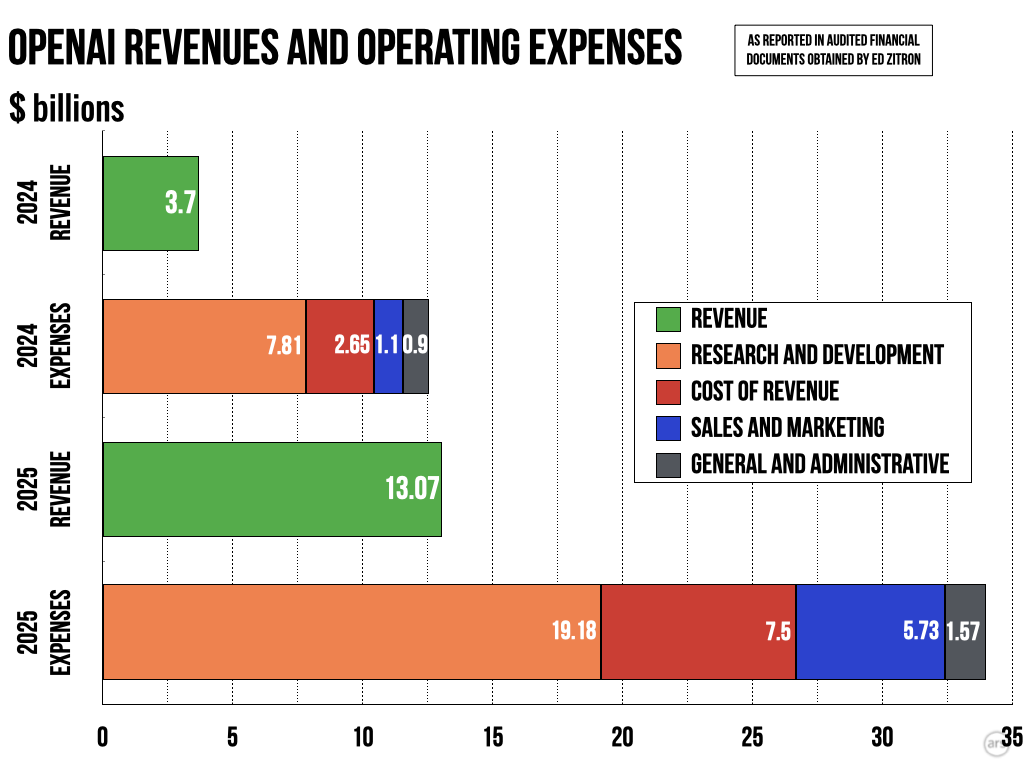
Data from OpenAI shows their 2025 inference revenue exceeded their cost of inference by a good margin (https://cdn.arstechnica.net/wp-content/uploads/2026/06/opena...). Saying this is being subsidized is like saying any investment in future productive assets is "subsidized".
Anthropic have claimed they expect their first profitable quarter this year. As far as we can infer their current API prices have decent margins.
Anyone can claim they are profitable, simply by reclassifying their expenses as some other thing or shuffling them to separate corporate structure. Until we will real financial audit, the CEOs claims are just a hot air.
Only if those losses are coming from subscriptions, instead of capex and training, which is not at all clear.
this argument assumes that capex and training costs will go down over time. but theyll have to keep up with one another and stay on top of latest knowledge so Im not sure if thats true
I don't understand this argument. How does it make the subscription any less subsidised if the losses are only because developing the product is just so darn expensive?

Feels like arguing that it's not clear if Bugatti's losses came from selling the Veyron instead of designing and developing the Veyron.

The equivalent is when Amazon was running a loss because they were spending all their money on building warehouses. It exactly make sense, but that's the argument.
From the article:

> What is happening here is that leading AI labs are charging not only for inference but also for research in model architecture, training data collection and curation, model training cost (which can be tens or even hundreds of millions of dollars), paying their employees and recovering the marketing costs.

That's what's being subsidized.

You are saying it as if those costs were not necessary to provide the service.
OpenAI inference revenue exceeds its cost of inference by a good margin in 2025 (https://cdn.arstechnica.net/wp-content/uploads/2026/06/opena...)
Is this supposed to be some sort of gotcha? Apart from research and marketing, that's operational costs. I mean, every product could be cheaper, if you didn't have to pay for employees and means of production.
What assumptions are needed for inferring cost based on api pricing?
The API inference cost to customers is not the actual cost of providing inference, and the cost of providing API inference need not be the cost of providing subscriber inference.
That API pricing isn't massively inflated.