Hacker News new | ask | show | jobs
by furyman 29 days ago
Mario Savio said a few lines when the industrial revolution peaked:

There's a time when the operation of the machine becomes so odious Makes you so sick at heart that you can't take part, you can't even passively take part And you've got to put your bodies upon the gears and upon the wheels Upon the levers, upon all the apparatus and you've got to make it stop And you've got to indicate to the people who run it, to the people who own it That unless you're free, the machine will be prevented from working at all

Even then we have machines doing it all and yet we all function well. I think eventually this would be a tool usage which will take human intelligence to another pinnacle.

9 comments

> take human intelligence to another pinnacle

I see no indication that current human intelligence is at anything close to a historical pinnacle. Human knowledge, yes, but intelligence? No. Collectively, we're dumb and trending dumber, and the tendency towards lazy thoughtlessness which AI engenders will accelerate that trend.

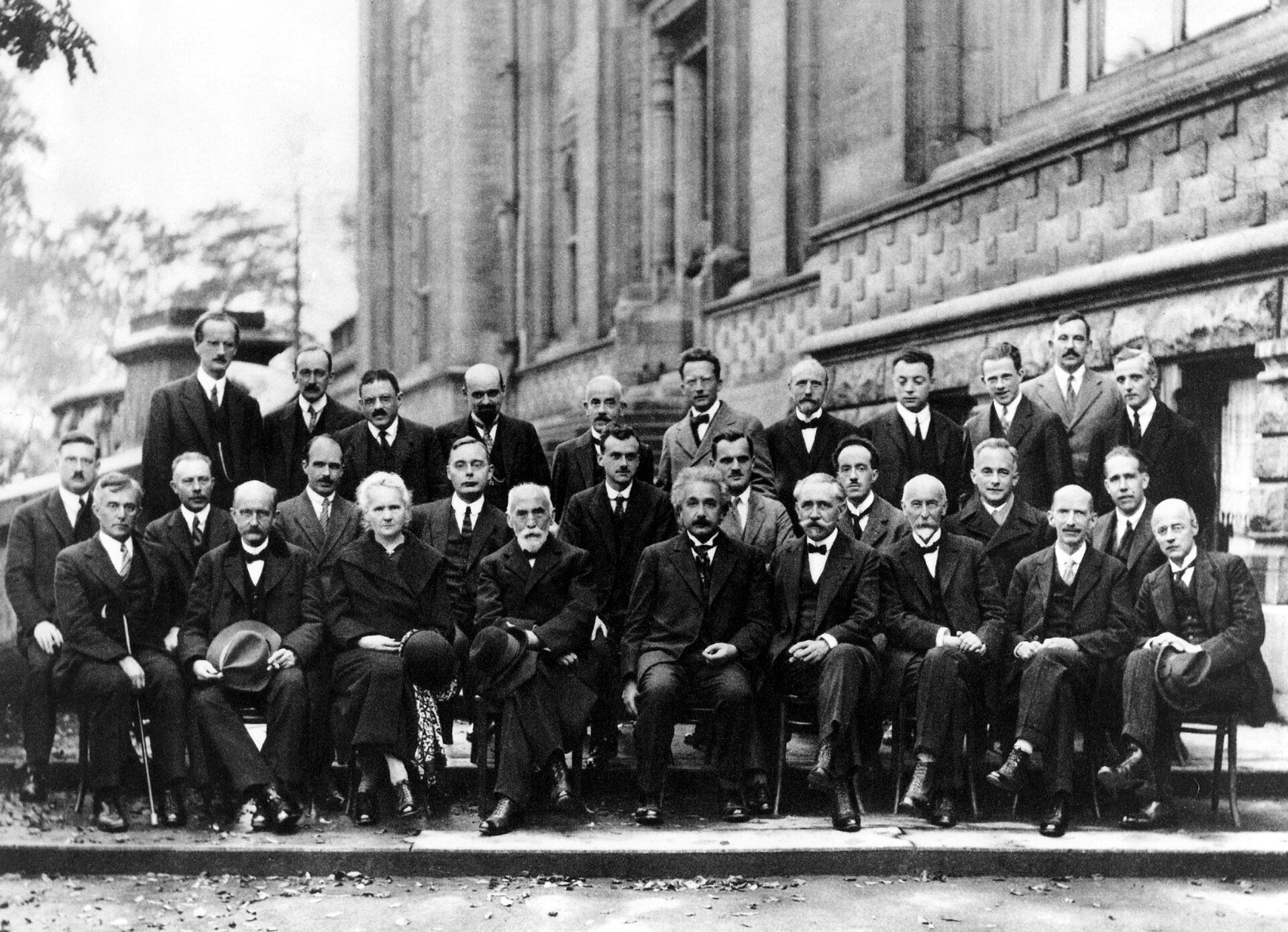
Whenever this topic comes up I am reminded of the black and white picture of all the scientist of 19th century together. Each individual in that photo had contributed something to human knowledge. It feels like in 19th century we believed in our scientists and advancing our knowledge. I feel today celebrities are given more importance than our scientists. The best minds of our century are focused on extracting value from rest of the population.
You probably mean the Solvay conference. I just wanted to append this link to your comment: https://upload.wikimedia.org/wikipedia/commons/thumb/6/6e/So...

It really is a remarkable picture, but I'd like to note that it's all physicists, not scientists in general. It was the golden era of physics.

I know it's a typo but it's Solvay, not Solay.
Yes this is the one.
The era of scientists being celebrities is done for the simple reason that it's not possible for a single human to advance our knowledge. Breakthrough papers are published by large groups who build on knowledge created by even larger groups.

Also, science used to directly correlate with improvements in life standards. Nowadays we see advancements in science (AI, psychology) used to actively reduce the standard of life.

Perhaps you are thinking of the 1927 Solvay Conference? https://en.wikipedia.org/wiki/File:Solvay_conference_1927.jp...
I assume you are here talking about political choices, social media influences, life style choices and so on.

While all those are true they are not reflecting the level of intelligence of people: intelligent people take personal stupid decisions because while intelligence is a function of let's say the more "abstract brain", decisions are emotionally driven and influenced by the "ancient, threat focused, pleasure driven brain".

Here is a quick way to think about this: some intelligent people are obease, some others don't exercise, and others don't take their health seriously while also working on the most amazing problems we ever solved. You know what's the biggest paradox here: they all have the capacity to understand fully the impact of their lifestyle on their health but still making a life style change is hard due to not being driven by knowledge and logic.

Neither intelligence nor knowledge, if you mean us average people.

But that shouldn't be any surprise. We're already at more than a hundred years of deliberate dumbing down of the population through schooling and mass media. These effects are exponential through generations.

> I see no indication that current human intelligence is at anything close to a historical pinnacle. Human knowledge, yes, but intelligence? No. Collectively, we're dumb and trending dumber

We are at a peak in absolute terms, though the decline is coming quickly:

https://x.com/jonatanpallesen/status/2034755779501105321

But in relative terms intelligence has indeed been declining for a long time:

https://x.com/jonatanpallesen/status/2034912319256330729

What do you mean by intelligence? And by your definition of it, can intelligence be improved intentionally or it happens as it happens like for evolution? If it happens by intention then why we have not pushed it at its maximium yet?
Let's start by using strength as an analogy. A human is strong when they develop their physical body to its potential. That means developing muscles, cardio, lung capacity, flexibility, etc. A human is weak when they fail to develop their physical body to its potential (we don't actually care how strong humans are compared to each other, only to themselves). We can then judge human populations based on, say, the strength of the median person.

Intelligence is the same but for mental faculties. A human is intelligent when they develop their critical thinking, memory, focus, logical reasoning, etc. A human is unintelligent when they fail to develop these things to their personal potential. And when I look around me I see a culture of inustrial-strength distraction that has robbed people of their ability to focus, I see encyclopedias in everyone's pockets that have robbed them of any incentive to remember, I see a society of comfortable complacency that has shielded them from any consequence of poor logical reasoning, and with LLMs I see a mass surrender of the need to exercise critical thinking in exchange for the warm embrace of thoughtlessness.

There's no reason that things need to be this way. The human hardware hasn't fundamentally changed in 100,000 years, and we have so many more resources today that it's easy to imagine that we could all be, collectively, more intelligent than ever if we could somehow inspire people to care. Sadly, we don't seem to be able to.

Human nature is also hasn't fundamentally changed in 100,000 years. We'll mostly take the easy path, if it is made available to us.
“Pinnacle” just means “highest point” here. They are saying that AI might take human intelligence to a higher point than was previously reached. That’s debatable, of course, but isn’t what you seem to be arguing against.
They know what pinnacle means, their point is intelligence is not knowledge. But I find that rather nitpicky as it's clear the top level comment just used one as a synonym for the other, not actually caring about the difference.
They wrote “I see no indication that current human intelligence is at anything close to a historical pinnacle.” That can only be the case if the highest point of human intelligence was in the past and they are opining that the current level of human intelligence isn’t anywhere close to that past high point. However, that assessment wouldn’t contradict what OP wrote, so it’s more likely that they take “pinnacle” to mean something else.
Maybe peak human intelligence is like peak oil - it only goes down from here.

Like renewables were on track to bring us peak oil, maybe AI will bring us peak human intelligence.

Are you implying that all the scientific achievements of the last hundred years don't count somehow?
Did you perhaps miss this part:

> Human knowledge, yes, but intelligence?

of the post you responded to?

Proving the point, if anything.
If we train AI on human works and humans only do what the AI says, we're at a maximum.
When was the historical pinnacle in your opinion?
Yeah, we peaked somewhere near the end of XIX century IMO. Before the transition to mass society.
we have more intelligent people than ever, but this also means we have more stupid people than ever

  > I see no indication that current human intelligence is at anything close to a historical pinnacle. Human knowledge, yes, but intelligence? No. Collectively, we're dumb and trending dumber
Just mathematically speaking, collectively we're at peak population levels, so the total collective intelligence (sum of all individual human intelligences) is likely at peak as well, even accounting for individual dumbing down?

Also, I think we (non-scientists) might be overestimating the average historical intelligence - see Flynn Effect [1] - perhaps because of a bias in our perception of the past levels based on who published books and thoughts - basically more intelligent members of our species.

  > and the tendency towards lazy thoughtlessness which AI engenders
May I suggest these historical references [2][3][4][5][6][7] as a counterpoint to AI driving lazy thoughtlessness, which rather seems to be innate to humans as a group.

----------------

[1] https://en.wikipedia.org/wiki/Flynn_effect

[2] Thucydides, History of the Peloponnesian War, 1.20 — 5th c. BCE Greece. “So little pains do the vulgar take in the investigation of truth, accepting readily the first story that comes to hand.”

[3] Aristotle, Rhetoric, 1.2 — 4th c. BCE Greece. https://kairos.technorhetoric.net/stasis/2017/honeycutt/aris.... Aristotle treats public persuasion as necessary partly because ordinary audiences cannot easily follow complex chains of reasoning. He says rhetoric addresses deliberative matters before people “who cannot take in at a glance a complicated argument, or follow a long chain of reasoning.”

[4] Plato, Republic, Book V — 4th c. BCE Greece. https://topostext.org/work/768. Plato distinguishes philosophers from the many “lovers of sights and sounds,” who enjoy appearances but do not apprehend deeper truth. The text says their thought is “incapable” of grasping the underlying form or nature of beauty, and that few attain that deeper vision.

[5] Confucius, Analects, Book 2 — 5th c. BCE China. https://www.chinastory.cn/ywdbk/english/v1/detail/20190722/1.... "Learning without thought is pointless, Thought without learning is dangerous".

[6] Buddhist tradition, Dhammapada, Appamāda-vagga. https://suttacentral.net/dhp21-32/en/sujato. Dhammapada contrasts heedfulness with heedlessness, treating heedlessness as a central human failing. In one translation: “Heedfulness is the state free of death; heedlessness is the state of death. The heedful do not die, while the heedless are like the dead.”

[7] Francis Bacon, Novum Organum, “Idols of the Mind” — 1620. https://history.hanover.edu/texts/bacon/novorg.html. Bacon argues that the “Idols of the Tribe” are rooted in human nature itself, and that human understanding distorts reality like a false mirror.

Is a room with 300 morons and 1 genius more intelligent than a room with 10 morons and 1 genius? In my model, there is negative intelligence, so the 300 morons would actually be less intelligent. We do have more stupidity degrees of freedom, that’s for sure. That is, the domain of human stupidity is greatly expanded. Smart people can be stupid in an ever increasing number of ways. So a very bright person 100 years ago might appear very stupid if they were time machined into the now.
In a mathematical model of collective intelligence I think we need to also include a "productive use" factor. The total brain power of our species might be higher than in the past based on a summation, but how much per-capita intelligence is being utilized for productive/adaptive ends versus being being distracted from such ends? What's our distraction rate offset?
> In a mathematical model of collective intelligence I think we need to also include a "productive use" factor. The total brain power of our species might be higher than in the past based on a summation, but how much per-capita intelligence is being utilized for productive/adaptive ends versus being being distracted from such ends? What's our distraction rate offset?

Excellent question. Global GDP estimates going back to 1 CE are here [1][2]. I would argue that GDP is a good proxy for an estimate of the summation of per-capita intelligence being used for "productive" ends, by definition.

But, the global average GDP per capita is [3] with a similar hockey-stick curve, and it is unclear whether the per-capita intelligence used for "productive" ends has also been increasing similarly, because the confounding factor is the effect of tools as force-multipliers (impact on productivity). The Flynn Effect is the strongest indicator that yes, average intelligence has been rising as measured in certain populations where cultural differences do not wreck the applicability of IQ tests.

[1] https://ourworldindata.org/grapher/global-gdp-over-the-long-...

[2] https://web.archive.org/web/20260525015042/https://ourworldi...

[3] https://ourworldindata.org/grapher/global-average-gdp-per-ca...

Why do we need to promote intelligence? If we are all “intelligent”, what is the difference? At best, we have about 50 healthy years on this rock. I do think myself “intelligent”, relatively, but also that the notion is overrated. I want to be dumb and carefree, I’d rather bike, shoot some arrows at the sky, eat some escargot and die in my sleep when it’s time. Instead, we must toil and research nursing homes.
Did the previous tools, which freed us from physical work, take human physique to another pinnacle?
I think probably actually. The fittest people back then probably weren't as fit as people today with specialized diets and medical science, and surely those findings were a result of better equipment, which were a result of better tooling to manufacture that equipment.

Introducing a machine to a manufacturing role obviously makes the manufacturer less fit, but it enables society to break through fitness barriers in general

If your point is that it's not orders of magnitude fitter, that's a good one. I don't think people will be much more intelligent in the future than they are today but they'll probably just be more specialized and have deeper knowledge

I am no expert, just a guy reading the Internet. And it seems like there are two opposing factors. The increased access to nutritious food has dramatically increased health, shown in the increased average height. The exception to this is the first 50 years, 1830-1880 when widespread dietary deprivation and severe inequality caused a decrease in height (take this as a warning I guess).

The other factor is that we all get significantly less physical activity than before, and obesity is a increasing problem.

And while the first effect is a effect of the machines, it is the latter effect I think most easily maps onto today's situation.

Personally I am quite certain that if you could teleport 100 random 20-year old from 1820 they would be better than 100 random 20-year old today at most physical tests, especially if you gave them food first.

But what about average person, not a professional athlete? In past people suffered from malnourishment, but today they suffer from obesity.

We also know that testosterone levels (which are connected with muscle mass, recovery etc.) are lower today than even few decades back.

It definitely doesn’t hold true for the average person, I was only thinking of the fittest today.

I’m not sure what it means if we want the average person to be fitter, it seems like we’d have to reinstitute manual labour if that was the goal.

Which is maybe a good analogy for not using AI in the classroom and forcing kids to use their minds

Considering developed societies with access to those specialized diets and medical science, the median person is definitely not stronger than the median person from a pre-industrial society, even taking malnutrition and injury into account. It seems you've never tried to arm-wrestle a farmer before.
Have you tried to arm-wrestle a subsistence farmer who saw multiple bad harvests growing up?
I've arm-wrestled office workers; I stand by my assertion.
it wasn't about industrialization, but about not being complicit, the machine was the metaphor for the system (this was the 1960s)
Who is "we"? Do you operate a machine in a factory? Do you know how someone operating a machine felt in 1900?

Mechanical replacement cannot be compared with thought replacement anyway, but the most thoughtless pro-AI comment tends to be at the top.

A slop fork machine is way different though, I dont know why authors never thought about this but imagine a machine that can detect the features and replicate whatever it sees, show it how to make bread once and it can do it infinitely, make it listen to a song and its able to find why it sounds the way it does and just spam variations, even if it doesnt make anything original it demotivates any attempt to push the boundaries or make anything new
Really? I'm more motivated than ever to make stuff at the moment. I have a long list of projects I've always wanted to make, but I never had time. The barrier is so low now.

For example, I want to make:

- A mini OS on top of SeL4

- A UI framework based on SolidJS, for native apps, in rust.

- My own photo manager (which can do backups & sync across all my devices). And a gallery to share photos with friends

- A local first data store, built on top of CRDTs

- My own programming language

And lots more.

Each of these projects on their own would take months of time. If LLMs can speed up development, that's great! I don't care if nobody else uses what I make. I want a personal computer full of my own software.

I feel the same way as you. But was unfortunately not surprised to see the replies you are getting here.

There are a ton of opportunities available right now to make new things. And make them better, more customizable, and more sovereign.

To the replies: be the change you want to see in the world, guys. That may be trite but focusing only on the negative will just make your own life shitty.

Leisure projects for me at least are about the personal challenge and achievement. If the LLM does it, you achieved nothing.
I'm glad that you find achievement in the personal challenge. At home, I'm just getting things done. Small things, bigger things, and best of all I get to pet the dog more while it works in the background.
Yeah so don't bother. I don't write code at home. What's the point? I go on holiday once a month!
So, you don't even work on personal projects? But you want to lecture everyone else about how to do them correctly (according to you)? What a waste of time.
Are you assuming that "using a LLM" automatically means "vibe coding"?

Is it not engineering anymore even if you micromanage and relegate the machine to a better typist, following patterns and doing research around?

> If the LLM does it, you achieved nothing.

Oh get off your high horse.

You may as well say "If the compiler compiles your code, you achieved nothing". Its the same argument.

I love meaty algorithmic challenges. And I enjoy the design challenge of making a piece of software. But I don't write CSS for fun. Debugging styling issues on mobile? I hate it.

LLMs let me work on the parts that I find enjoyable and satisfying. Like UI design, or figuring out the data model. And then I can delegate the parts I don't like to Claude. It seems very happy to bang away at CSS.

That's a great deal. If you want to personally write every line of code, good for you. But don't police my leisure projects.

I support this take especially since you added the "I don't care if nobody else uses what I make", but you should at least acknowledge what you're talking about is pretty unrelated to the article, as the author's entire context seems to be making something for other people to use and building it together with other people.

Since you said you want to make those things that you list, I assume none of these things have been built yet. If so, I would encourage you to consider how excited you will be to constantly maintain those things you build. But even if the maintainence cycle won't be as exciting, since you are the sole user you have the advantage of being able to proceed at a leisurely pace even while doing maintainence work.

In a professional setting, the dopamine hit of being able to build something quickly that works in an area that you have little to no knowledge in makes you more dependent on the AI in the maintaince cycle as you want to chase that dopamine high by maintaining the same development speed. This in turn leads to a bigger burnout crash after that peak dopamine hit. Maintainence is a phase of diminishing returns even without AI, but when your coding agents are introducing new bugs at record pace with their bugfixes with no new features to write home about you are in a special place in Hell.

I'm all for using AI to build ambitious projects. I have yet to see a person/company/organization continuously release huge software endeavours in a stable professional manner day in and day out with a coding agent harem in tow.

If something like the Ladybird browser, or any browser that is "built by scratch", achieved Chrome parity in six months and consistently maintained the same level of stability with continuous releases then I would see that as proof that this approach has become professionaly sustainable.

The reason people are getting away with so much using AI is because of the open secret in most enterprise engineering practices: the customer cares more about the response time for fixes they report than they do about overall or longterm product quality.

> I would encourage you to consider how excited you will be to constantly maintain those things you build.

Why should I consider that?

Its funny how the default with programming is that the piece of software exists forever. I've been learning to play the piano lately. The default with piano is that every piece is ephemeral. If I don't go out of my way to record something I play, after the notes have run out, the piece is gone forever. The same is true of cooking - except you can't record a meal at all. Once you eat it, its gone. Lots of art forms are like this - theatre. Dance. The circus. They're no less beautiful for being ephemeral.

Why do we assume software has to be maintained indefinitely? Why even think about that right now? Maybe I'll work on these projects for awhile, maintain them as long as I want, and then in a few years someone will make something way better and I'll use that instead? Would that make the effort I put in pointless? I don't think so. I think it would make programming more like playing the piano. How lovely.

> I'm all for using AI to build ambitious projects. I have yet to see a person/company/organization continuously release huge software endeavours in a stable professional manner day in and day out with a coding agent harem in tow.

Yes, I've burned through enough claude tokens now that I find myself agreeing with you. I wouldn't use an LLM to make and maintain google chrome. But I wasn't planning on doing that anyway. There are also a lot more options than (1) write everything yourself and (2) vibe code the whole thing.

LLMs are good at small-to-medium scope tasks right now. Fine. I'll use them - or not use them - with their limitations in mind.

>Why would I consider [maintainence]...Its funny how the default with programming is that the piece of software exists forever.

By all means don't consider it if you don't plan on using them for a considerable amount of time, but there's a lot of of distance between a decent amount of time and "forever". You listed a mini OS and a UI toolkit among your projects, I hope you can forgive me for assuming you were planning to use those things to build more things, which would in turn often entail improving and maintaining these building blocks while they are actively used.

Ah fair. When you say “maintenance”, my mind goes to handling pull requests and keeping on top of filed issues on GitHub. If the software has an audience of 1, a lot of that work goes away.

Adding the features I have a need for over time is the fun part as far as I’m concerned.

The issue is maintenance. If you want to use these projects for important things, you need to maintain them. If you don't want to maintain them, I can't see myself using them for anything important.

I actually want less software for myself. Less things to maintain. I've become a "digital minimalist" in that I use very few software, only ones maintained by others who can afford and are willing to keep them working.

Some people find freedom in building their own house. Some people find freedom in living in a serviced apartment.

Some people find joy in home cooked meals. To others, wealth is never needing to cook again.

To each their own.

As for maintenance, I think LLMs are actually very well suited for small maintenance tasks. The expensive part of programming is loading and unloading context into my head. "Oh dear, what is all this code doing? Oh no, coffeescript? And some ancient version of express JS? How does any of this work?". LLMs can bomb in, fix a compilation error and bomb out. "This program isn't compiling any more on macos X.Y.Z. Read the patch notes. Figure out why and fix the problem." Perfect.

*Make anything "new"
Everything I want to make is new. I don't understand the objection.

For example, the photo backup system I want to make will let me manage my ~400gb photo library. I want my library backed up on a couple devices, running linux and freebsd. I want my mac and iphone to have a local mirror of all the favorited photos, and when I'm at home, I want to be able to browse all photos from those devices by streaming them over the local network. I want native macos & ios app interfaces to view and manage all that.

I don't know any existing software that meets my requirements. I don't think any such software exists. Apple, Dropbox and Google will solve this problem for me if I store all my photos in their cloud and pay them an ongoing subscription for the privilege. I'd much rather make something myself, and back up my photos on my own hard drives.

Making something like this is simple enough, but very time consuming. If claude can take the drudgery out of it, well, I think that's just delightful.

Ente photos is one thing and there are others.

You can accomplish most of that by installing Syncthing.

But the objection is that you’re not really building anything new even if you think it’s a new idea. By your definition you’re building for yourself and not sharing…so what good are your little projects. Reading your original list it just seems like you want to build and run software without having to do any research, even if a solution already exists.

> But the objection is that you’re not really building anything new even if you think it’s a new idea. By your definition you’re building for yourself and not sharing…so what good are your little projects.

What an incredibly blinkered view. You think there's no value at all in making software unless your program solves a truly novel problem, and does so for millions of users?

There's so much joy that can be found in simple, disposable acts of creativity. I don't need the world to applaud when I cook an omelette, make a table out of wood or play a piece on the piano. Why would I need that from the software I make? Just because you can buy a table from IKEA doesn't mean its not fun to make one yourself. Just because someone on spotify played it better doesn't mean there's no joy in playing music.

Why would I hesitate to make my ideal photo library program, just because other programs exist? What a sad, self-limiting rule.

I have everything this guy is talking about just from running Filerun (with the Nextcloud client for mirrors) and backing up to Backblaze R2. At some point developers seem to forget that other developers exist.
What's your time and life worth? You pay Apple to deal with it (which I do) and get to live a peaceful life and go out and take photos and have experiences. Or do you spend weeks implementing your own solution with Claude. The latter is considerably higher cost in time and money.

AI is seen as a way out of drudgery but you're just trading one problem for another.

The implementation is part of the fun.
Take a look at https://immich.app/
Oh that looks lovely. I enjoy the UI and all the work on tagging and classification. But its still missing some features I want:

- I want native desktop apps

- I want P2P device sync. My laptop and my home server should be peers. Just with different rules for which photos are stored locally on each device.

- I want per-device storage rules. (Eg, "I want all my favorited photos, and recent photos up to 50gb on my laptop").

- Backups. I want to be able to plug in an external hard drive and backup my photos (with some rules). Then disconnect the drive and see in the metadata for those photos that I have a copy of the full res RAW on that drive.

But even if other programs exist, its still fun to make something myself. Authoring your own software gives you a different relationship with the computer. You're less of a consumer. You can change or tweak features on a whim. Psychologically, its kind of like being in your own home vs being in a hotel room. If you hate the furniture at home, you can move it or change it. You can decorate however you like. In a hotel, you're affected by your environment but you have no agency over it. I think its much more healthy to create.

And you're actually excited by the prospect of buying them from Anthropic instead of making them?
Suppose you're the senior engineer on a project. You design the UI of the software. Then design how you want the software to work internally. Then write the core data structures. And then guide a bunch of junior engineers to write the code, review their work.

Is that the same as buying a computer program from anthropic?

I have a friend who's an architect. Sometimes we're in the city and he says "Oh see that building? Its one of mine." He didn't lay the concrete, or do the wiring or anything. Should he not be proud, because a construction company built each floor? Does it not count? Does his contribution not matter?

Open weight models exist and are good enough to make the projects above.
And you're actually excited about these table scraps that companies couldn't even monetize, rather than making something?
You are being needlessly combative. Please take a step back and look at what you are doing - I don't think this is positive for you or anybody
Couldn't even monetize? DeepSeek and Alibaba with Qwen are doing quite well, no table scraps required. I am making things, I don't have to physically type letters on a keyboard to make things as long as the output of what I want exists.
I argue the opposite, that originality will actually become more valuable.

Think about it: everyone has characterized AI slop, as slop. Which means that we negatively value it in terms of originality. Combine that with the fact that there will be a lot of it, this means that original work will 1. stand out or be very distinct from slop, and 2. have its value amplified as a result of this polarization.

basically, we value originality more AND are able to identify it more readily.

related is also the fact that originality will literally be valuable as training data for future models

I can prod at a model as much as I want to produce something I find more original than average, but there are plenty of people out there that will say it doesn't count because of the fact an AI made it. "Slop" doesn't just mean "it sucks because it's bad", it often means "it's sucks because it's AI". They'd argue that if you were creative enough to produce something so original you wouldn't rely on an AI to make it for you. It's tainted by association, all the way back to the multi-billion-dollar enterprises that originally trained the models for their own ends.

Also there have been dozens of HN submissions and comments where the poster didn't even bother to remove the em dashes. Most people just don't care. The people who continue to post like this wouldn't have been as visible had they not discovered AI and pounced on it, but they were always there. The idea of posting with an AI voice, em-dashes and all, would likely have still appealed to them if you'd asked 5-10 years ago. Nowadays it takes hardly any energy for them to have a persistent voice.

I also define "slop" in a similar way. However, I specifically define it as creations that lack soul or originality. And can actually have a high degree of quality in some aspects, as you can see with some AI generated art and music. Because of this, I'm tempted to adopt a different term since "slop" feels too negative

Slop has always been around. AI has cheapened its creation.

Depends on how good the slop fork machine is, the act of true original creation is a messy and long process if it can be replicated to death immediately basically for free its not viable anymore
then it isn't a slop fork machine anymore is it? i was under the impression that the best the SFM would get is generating... how do I say this? high quality low quality work. Basically, the ability to cheaply produce quality work, characterized by its lack of soul/originality. think amazing looking advertisement graphics. not to say that it can't do better than that. just meant it as an extreme example for illustrative purposes

If something is able to generate things with soul and true originality... we're talking about something incredible, a new intelligent species potentially

It doesnt have to able to generate original things, its enough to be able to detect what makes it original and replicate the original thing with enough variations in different contexts to be able to be destructive and render the true original thing completely useless
what you described is not how originality works.

think about how in music, when an artist comes out with something original and awesome, and then everyone starts copying it and creating their own derivative works, like Jimi Hendrix or something.

Did Hendrix become useless? Did everyone end up thinking he sucks or something? No, he is even more revered, as the originator of a new type of sound that probably created multiple genres

The same thing applies here. Originality will be valued and even empowered as extrapolation and development off of it can increase in speed and quality in the case you mention

> then it isn't a slop fork machine anymore is it?

True, but some nuance is that a LOT of artist/creative types lean exclusively on the mechanical skill needed to create, without anything really much to say. They also very frequently copy other's styles, etc.

I'm not defending AI pumping out crap, but this also shows a lot of folks don't have much to offer beyond the mechanical aspects and we shouldn't glorify churning out stuff by hand as high art either.

This honestly makes me feel ambivalent, as on the one hand, it is awesome that it is pushing creatives to be more original, but on the other hand it does threaten these types of creatives who have invested time into making this their livelihood :/
> Even then we have machines doing it all and yet we all function well. I think eventually this would be a tool usage which will take human intelligence to another pinnacle.

How? It's undermining what the human intellicence is made from, learning.

>and yet we all function well

Sure...

https://news.gallup.com/poll/694199/u.s.-depression-rate-rem...

>this would be a tool usage which will take human intelligence to another pinnacle.

Between the endless slop, loneliness and depression epidemics, record low reading comprehension, attention shortage, we're not in any pinnacle today. We're in a regression from a few decades ago, getting worse.

Hasn't all automation up to this point been same input equals same output though? Automation using LLMs feels different to anything before and I don't think there's a comparative time in history to point at and say "look it happened before and we are now better off"
I think we all been fooled by the sentence: "It's yet another automation, it's like horses were replaced by cars". It is not. Industrialization and automation is about manual labor. LLM/AI is about outsourcing thinking. And while I'll give two thumbs up for using ML(there is not 'I' in 'AI') as a technology for some tasks, outsourcing thinking is an evolutionary dead-end.
>LLM/AI is about outsourcing thinking.

No it isn't. I still do the thinking on how to solve my problems, I only outsource the tedious part, which is typing the code and fixing the syntax errors till it all compiles and does what I want.

If you also outsource thinking to it, that's your choice though. Or the company's choice. But ultimately the free market will deiced with products made using LLMs outcompete those made without.

It shouldn't be used for that either. The problem is our programming languages and tools are shit so we made another expensive tool to drive them.

I've said this elsewhere before but I single-handedly produced more actual tangible business value with Microsoft Access than anything else since. What was an hour's work is now a procurement process and thousands of lines of tedious configuration and boilerplate that involves pipelines and tens of services all coordinated and hosted by someone who has created a moat to extract money out of me.

All I want is a fucking report.

The LLM makes us blind to the gigantic fucking shit show we built.

Recently, I had some data for which I wanted some graphs. I uploaded the .jsonl file, and prompted "make a html page and graph this data using plotly". I wanted a report, and got a report, quicker than I could have made it myself.
Not sure why you got downvoted, but I agree with your take. It's now so much easier to one-shot such small task that are supposed to be one-and-done, instead of needing a small army of interns or juniors with would typically handle such non-business critical tasks.
> I still do the thinking on how to solve my problems, I only outsource the tedious part, which is typing the code and fixing the syntax errors till it all compiles and does what I want.

Do you really though?

Here's a question: how many times do you visit claude.ai or open Claude Code (or whatever harness you use) (or use whatever model you prefer) to help you solve a problem, ask it a question, etc.?

One thing I've noticed, which seems to go completely unmentioned, is how these LLM tools are like drugs. It can pump out thousands of lines of code ---> it can write my entire program for me ---> I've written quite a few programs with it and I don't write a single line anymore ---> I go to it for what would normally be things I could do on my own. The problem is that this isn't some immediate thing: like a drug, it sneaks up on you and you don't even realize it until it's far, far too late. I've been programming since I was 13 and I've just now started to notice the deskilling that's been happening to me. I've just now started noticing how often I'll visit Claude Web for something I should be able to do on my own. Nobody really seems to mention this, or it's repharsed as a good thing. And I don't get it: how is undergoing cognitive surrender a "good" thing by any metric other than the metric a beancounter would use? What worries me is that I fear this is happening to way, way more people than those who actually bring it up, potentially yourself included, and you just haven't yet realized it because you haven't really thought about it. That is ultimately what this "AI revolution" is going to bring. It's what the billionaires want, and what they want is usually what they get because the systems we've built are set up to not constrain them.

> I've been programming since I was 13

Congrats, you're in a small minority of people.

>What worries me is that I fear this is happening to way, way more people than those who actually bring it up, potentially yourself included, and you just haven't yet realized it because you haven't really thought about it.

People probably said the same thing about using pocket calculators when they started getting cheap and mainstream in the 1970s.

Do you still use your brain to calculate sales tax or the square root of pi just to keep your brain sharp on knowing calculus, or do you always use a calculator because it's a mainstream commodity that will never go away?

> People probably said the same thing about using pocket calculators when they started getting cheap and mainstream in the 1970s.

Except a pocket calculator is very different from an LLM. It isn't a tool you can go to and ask it literally anything under the sun and get an answer (even if incorrect). It's cold, logical and uninterested in your life or what happens. These LLMs are trained to be interested and empathetic. They are, IMO, way more like drugs than most other things.

> > I've been programming since I was 13

> Congrats, you're in a small minority of people.

Why did you respond to this? I fail to see how it relates to your point whatsoever.

Thank you for writing what I want to scream every time a comparison is made to some archaic technology change.
It’s worse— it’s seeking to replace every single aspect of what it means to be YOU in the world. Some people are literally trying to “fire themselves” and be replaced with digital twins. Perhaps those people are independently wealthy and also have no need of human connection? For the rest of us, it is a sickening prospect.

AI is automated irresponsibility, and it is nothing like any earlier transition.

When a technology trend means people literally won’t be able to tell if you are living or dead, and also stop caring about the difference— that’s unprecedented in the history of humans.

Its advertised as outsourcing thinking, but I doubt many serious people making serious things actually outsourced their thinking very much. I definitely outsource my typing, search, and LSP interaction!
Moreover, historical events and processes are unique, even if there are some similarities. Nothing that happened in the past can give us certainty on what will happen now.
The automation at least built unimaginable amounts of wealth for the rich people while the poor people are essentially just as poor they were hundreds of years ago.
>while the poor people are essentially just as poor they were hundreds of years ago.

How can people say false things like this with a straight face?

Thanks to industrialisation, automation and mass production, the poor of today have access to things that even kings from hundreds of years ago couldn't even fathom, let alone poor people back then: abundant cheap food that poor people can now be fat instead of starve to death, cars, planes, MRI machines, helicopter ambulances, vaccines, personal heating and air conditioning, OZEMPIC, etc

Kings back then would eat hard bread, shit down a vertical shaft that emitted the scent through the whole castle, and their sleeping chambers had ice on the walls in winter and lice in the clothes and bet sheets, plus they had parasites in their gut and any small disease could kill you.

Meanwhile the cool homeless guy outside my building has 3 hot meals a day and a daily shower in the homeless shelter nearby, warm clean sleeping bag for winter, shades for summer, a bicycle for moving around town, a smartphone which he uses to watch youtube all day in his sleeping bag, plus access to medical care that kings of kings never had. All this with no job, and no care in the world.

Because most of the poor people in the world (majority of the population of the planet actually) have no access to clean water, food or medical care or education and that is the same as it was hundreds of years ago.
> Thanks to industrialisation, automation and mass production, the poor of today have access to things that even kings from hundreds of years ago couldn't even fathom

Thanks to colonialism, also in more modern form called globalism.

> Kings back then would eat hard bread, shit down a vertical shaft that emitted the scent through the whole castle, and their sleeping chambers had ice on the walls in winter and lice in the clothes and bet sheets, plus they had parasites in their gut and any small disease could kill you.

Wealth has no intrinsic value, only relative one. You are only wealthy relatively to other members of the society. Doesn't matter if pharaohs had less comfortable lives than me. What matters is that a gap between pharaoh and a worker working on pyramids was way smaller than between Jeff Bezos and person working at the Amazon distribution center.

Also, most sweet fruits of progress that its prophets like to enumerate are not direct consequences of technological changes, but they came only after political struggle that has arisen exactly because the direct consequences were very dire for most people. If people pushing today for AI could decide on these things, they would be very happy to take away these hot meals from homeless people and let them starve to death.

>Thanks to colonialism, also in more modern form called globalism.

You don't have to participate in globalism, you can be a hermit state that doesn't trade with the evil imperial capitalists, like Cuba and North Korea. Everyone wants to live there because the QoL is so good.

And it so good, because west extracted wealth and materials from all around the world places, and still extracts through globalisation.

QoL is so good here precisely because it is so poor out there.

> All this with no job, and no care in the world.

Have you ever been without a job and/or homeless to say shit like this?

yes. Have you?

Also, how nice of you to ignore my entire argument on how the poor today are NOT as poor as they were hundreds of years ago, and instead sidetrack the conversation one offtopic tangent for a cheap jab in the name of scoring some emotional virtue signaling brownie points.

No, because you still need a skilled human operator in the loop for clearly defining the input and to check the output.

Machinists and lathe operators became CNC operators, they didn't lose their jobs, just that instead of turning the inputs by hand, they punch numbers in a machine, but the advent of CNC didn't mean anyone off the street can now punch numbers in the machine and replace the machinists since you still need the years of training and experience.

SW devs will be the new CNC operators, about knowing what data to input and how to wrangle the slop machine to get the desired output faster and better than your competition.

> No because you still need a skilled human operator in the loop for clearly defining the input and to check the output.

For now. Will that be true in 12 months? 4 years?

If you're a programmer, your skills have been devalued significantly in the last 12 months. What makes you think the remaining value you offer will be required 12 months from now?

>Will that be true in 12 months? 4 years?

I don't have a crystal ball. In 4 years whoever is US president might start another war and fuck the whole planet back to the stone age. Nobody will know what will happen in 4 years so why worry about it?

What are your plans if you truly think that that's the future?
> What are your plans if you truly think that that's the future?

I don't have any - thinking is the only non-cattle job left for humans to do; if we outsource thinking for all of humanity, we're an evolutionary dead-end.

Dude relax, you can keep using Claude