>corners where 3 fillets meet
I would imagine there are a few different possible options (preferably a settable parameter):* Intersection. Conceptually the simplest, the chamfers would just be joined by the solid addition of all three fillet surfaces, creating three new sharp corner edges that meet at a single vertex. * Rolling sphere. Imagine an idealized spherical "thumb" smoothing out caulk. The middle would be joined by a new spherical concave surface, tangent to all three fillets. Also generalizable to convex fillet intersections, smoothing out sharp corners. * NURBS, with adjustable parameters or even control points, eg when you want a little more "meat" in a corners for strength of a part. * Flat corners, for chamfers (what do do when N>3 corners meet?) * What else? Ideally you might be able set the corner type separately for inside vs outside corners, or on a per-vertex or (in the most granular case) per-incoming-edge basis? Is that crazy? How do saddle corners[0] behave? Does it just "work out" and (by some miracle) uniquely resolve for all permutations and corner types? It certainly gets complex quickly! [0] center, where the cubes all intersect https://entitleblogdotorg3.files.wordpress.com/2015/02/esche... |
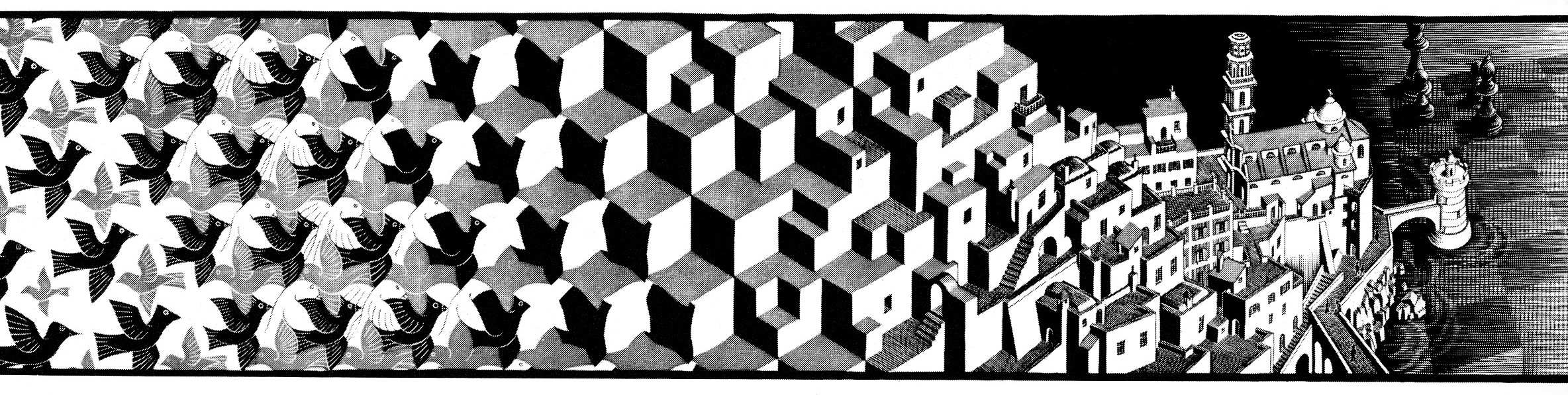
The hard part of 3 corners fillets is the tolerances. Each of those fillet operations has its own compounding float errors and when they meet, the intersection is so messy that they often do not intersect at all. This breaks almost every downstream algorithm because they depend on point classification to determine whether an arbitrary point is inside the manifold, outside, or sitting on an edge or vertex.
And that description of the problem is just scratching the surface. Three corner filets create a singularity in UV space at the common vertex so even when you find a solution to the tolerance problem you still have to deal with the math breaking down and a combinatorial explosion of special cases, almost each of which has to be experimentally derived.