Hacker News new | ask | show | jobs
by quonn 332 days ago
Wrong.

- mass unethical treatment (assuming you do not mean the fact that animals are killed) is related to the conditions which are related to price

- health risks can be minimal depending on the amount and type of meat you eat

- the CO2 impact again depends on the meat and conditions. Surely chicken in your backyard can be kept without CO2 impacts with some effort.

- your very existence has a CO2 impact. By your own logic you have two choices …

5 comments

> Surely chicken in your backyard can be kept without CO2 impacts with some effort.

I’m not sure this is possible, at least not in a typical yard or urban garden. According to one study[1] community gardens in and around cities emit six times the CO2 per serving compared to industrial agriculture. I assume this is roughly applicable to backyard gardens too. I wouldn’t be surprised if this isn’t applicable to livestock—which the study appears to have excluded—but also wouldn’t be surprised if the story is similar with chickens/livestock.

I imagine that even if it is less efficient to grow your chickens in the back yard, it might be possible to approach or exceed current industrial poultry farms in CO2 efficiency. My hunch is that if those farms get incentivized by penalties on CO2 production it would be impossible though.

[1] https://deepblue.lib.umich.edu/bitstream/handle/2027.42/1968...

I said backyard, not some urban garden.
Does that seem likely to make a difference? The study covered individual gardens as well. The low-tech gardening practices they mention sound exactly like backyard gardens.
Of course. The whole study is about cities, even the first sentences already make this very clear. It has nothing to do with normal gardens, nothing _at all_.
I may have missed the part in the paper which explains why a backyard garden is dramatically different in efficiency if said backyard is in a city versus the suburbs. Could you clarify or point me to the thing you’re referring to?
> - health risks can be minimal depending on the amount and type of meat you eat

Health risks from meat is an US-only issue. Here in Europe we have much stricter regulations on meat, so much so that American meat cannot be imported and cannot be sold here. IIRC (might be wrong on this) Canada doesn't allow importing US meat as well?

Meat is safe for consumption in Europe.

A while back, the EU relaxed restrictions on feeding animals to other animals in order to boost trade. Restrictions that were in place for good reason after the BSE crisis.

https://www.theguardian.com/world/2021/jun/22/eu-to-lift-its...

No. It generally doesn't matter where in the world cows are raised, the important point is the conditions. The health risks cannot be minimized because of antibiotic abuse (antibiotic "superbug" evolution) and pandemic virus evolution of cramming too many animals near people who care for them and wildlife.
> mass unethical treatment (assuming you do not mean the fact that animals are killed) is related to the conditions which are related to price

Source? I really don't buy that more expensive meat producers kill their animals that much more "humanely". And even if the killing was painless, you're still killing tens of animals per year for the sole sake of a tastier meal.

> health risks can be minimal depending on the amount and type of meat you eat

True.

> the CO2 impact again depends on the meat and conditions. Surely chicken in your backyard can be kept without CO2 impacts with some effort.

I trust you raise all the animals you eat, and don't feed them with imported grains? Don't be ridiculous.

> your very existence has a CO2 impact. By your own logic you have two choices …

You're basically telling anyone who's self-conscious about their environmental impact to kill themselves. Great.

> And even if the killing was painless, you're still killing tens of animals per year for the sole sake of a tastier meal.

Do you believe that's inherently immoral?

I believe there's a good argument to be made, yes. This video [0] by a philosophy teacher convinced me of it. Unfortunately, it's in french so most here probably won't be able to enjoy it.

[0] https://www.youtube.com/watch?v=HaVWbdlAiCQ

EDIT: he gives these sources that, fortunetaly, are in english:

https://philpapers.org/archive/HUEDOE.pdf

https://philpapers.org/archive/HUEDOE-2.pdf

https://philpapers.org/archive/HUEDOE-3.pdf

https://philpapers.org/archive/HUEDOE-4.pdf

Takes the form of a conversation between two people, like the texts of olde.

These come up every now and then, but are explicitly arguing against factory farming, not meat consumption in general. Factory farming is indeed immoral, but is a separate, but related issue to meat consumption.
Anthropocentrism.

philosophical viewpoint arguing that human beings are the central or most significant entities in the world. This is a basic belief embedded in many Western religions and philosophies. Anthropocentrism regards humans as separate from and superior to nature and holds that human life has intrinsic value while other entities (including animals, plants, mineral resources, and so on) are resources that may justifiably be exploited for the benefit of humankind.

Source: https://www.britannica.com/topic/anthropocentrism

It's hard to argue that we're not in some way unique when we're the only animals having this debate, and every other carnivore or omnivore (and many 'herbivores,' opportunistically) have no such qualms and happily eat all the other animals they possibly can.
Grossly incomplete.

The larger risks to us include:

- Pandemic virus evolution of viruses from complex people<->livestock<->wildlife interactions.

- Evolving antibiotic resistant bacteria since livestock are given most of the same compounds given to humans simply for economic advantage, and in some cases, to force-feed animals with unsuitable feed like too much corn in too short of a timeframe. Some CAFO farms, their cows would die if not given antibiotics. [0]

- Water, air, and soil pollution on a large scale. Liquid shit lakes that spread manure into the air with sprayers. Runoff from pesticides and fertilizer used to grow the corn, soybeans, etc. The list goes on.

And, yes, climate change, animal cruelty, and other concerns.. but like condoning genocides, nothing will be done about it because people want their fucking Costco-sized 40 pack of cheap hamburgers, BMW SUVs, and overwatered perfectly green grass and air conditioning set to 68 F / 20 C in Phoenix AZ.

0. https://www.cidrap.umn.edu/antimicrobial-stewardship/report-...

Nuances destroy agendas.
Nuances destroy absolutisms, yes, and it's a good thing because real life has a lot of nuances.
This comment is the opposite of nuance. They literally argued that everything you do has a CO2 impact, therefore you either shouldn't try at all or should just kill yourself.

That's, like, the least nuanced and most caveman-brained take on climate change you could possibly develop.

Also: appealing to edge-cases as a distraction isn't nuance, it's derailing. I can find fucking exceptions to anything. ANYTHING. How many people in the West are growing their own chickens? Give me a fucking break man.

I‘m trying to find something resembling a reasoned argument in your comment, but there‘s nothing except profanity.

I did not point out exceptions and the chicken example is merely an illustration of one of my points.

And who says we are talking about the west? Plenty of comments in this thread are talking about pandemics, something that is not known to originate from western agriculture.

You know what‘s a caveman take? Thinking that there is any chance to convince a meaningful number of people to reduce meat consumption globally in the required time window (20-50 years) in a way that has any bearing on climate change (as opposed to the many steps being taken that actually work). That‘s a caveman take.

But now some facts:

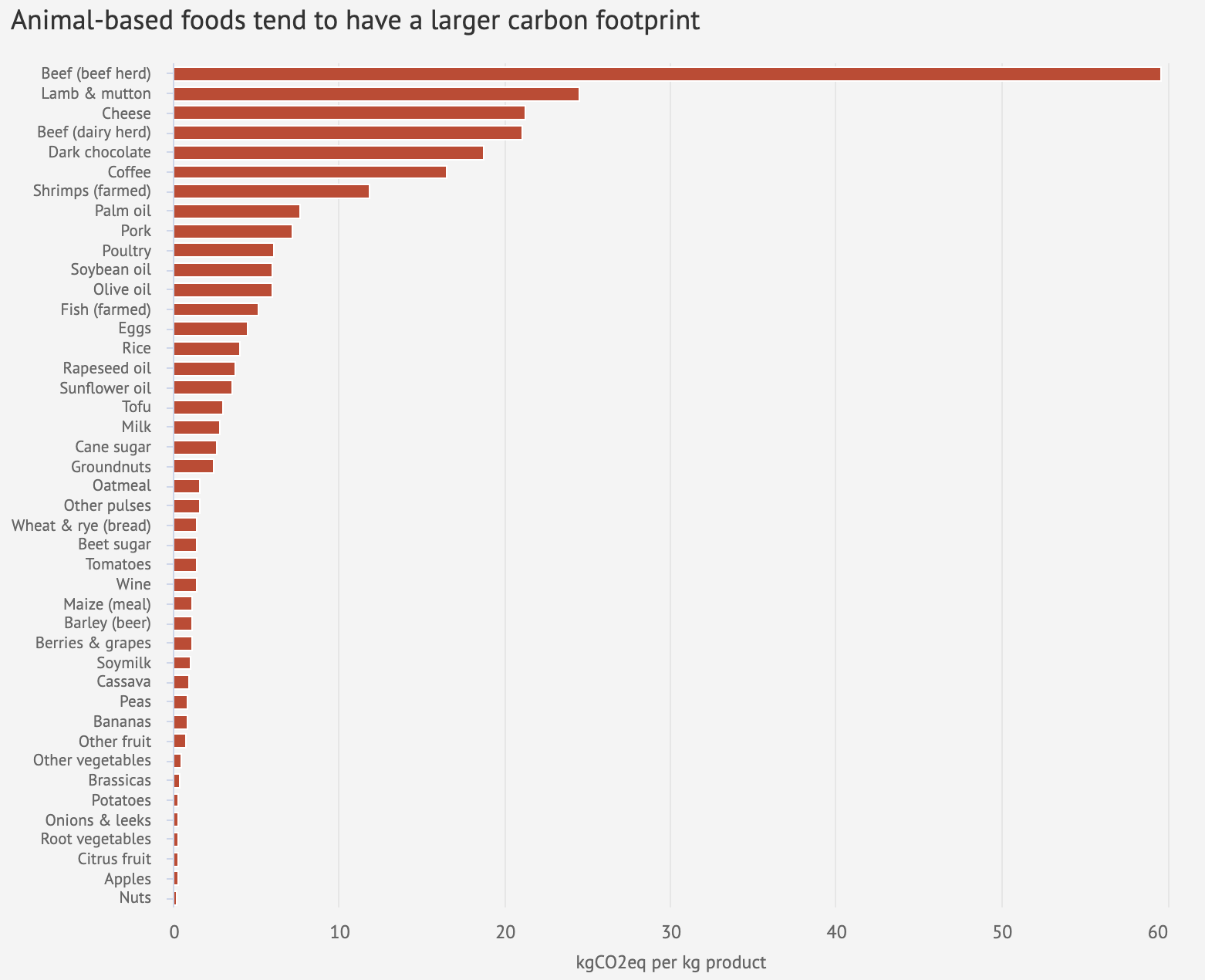
https://interactive.carbonbrief.org/what-is-the-climate-impa...

As you can see, the type of meat matters a lot. Cheese is doing worse than pork in this example (not sure I even believe this without more evidence yet). Non-meat sources of protein don‘t do very well: Tofu is just 2x better than poultry. Compare this to the giant bar for beef.

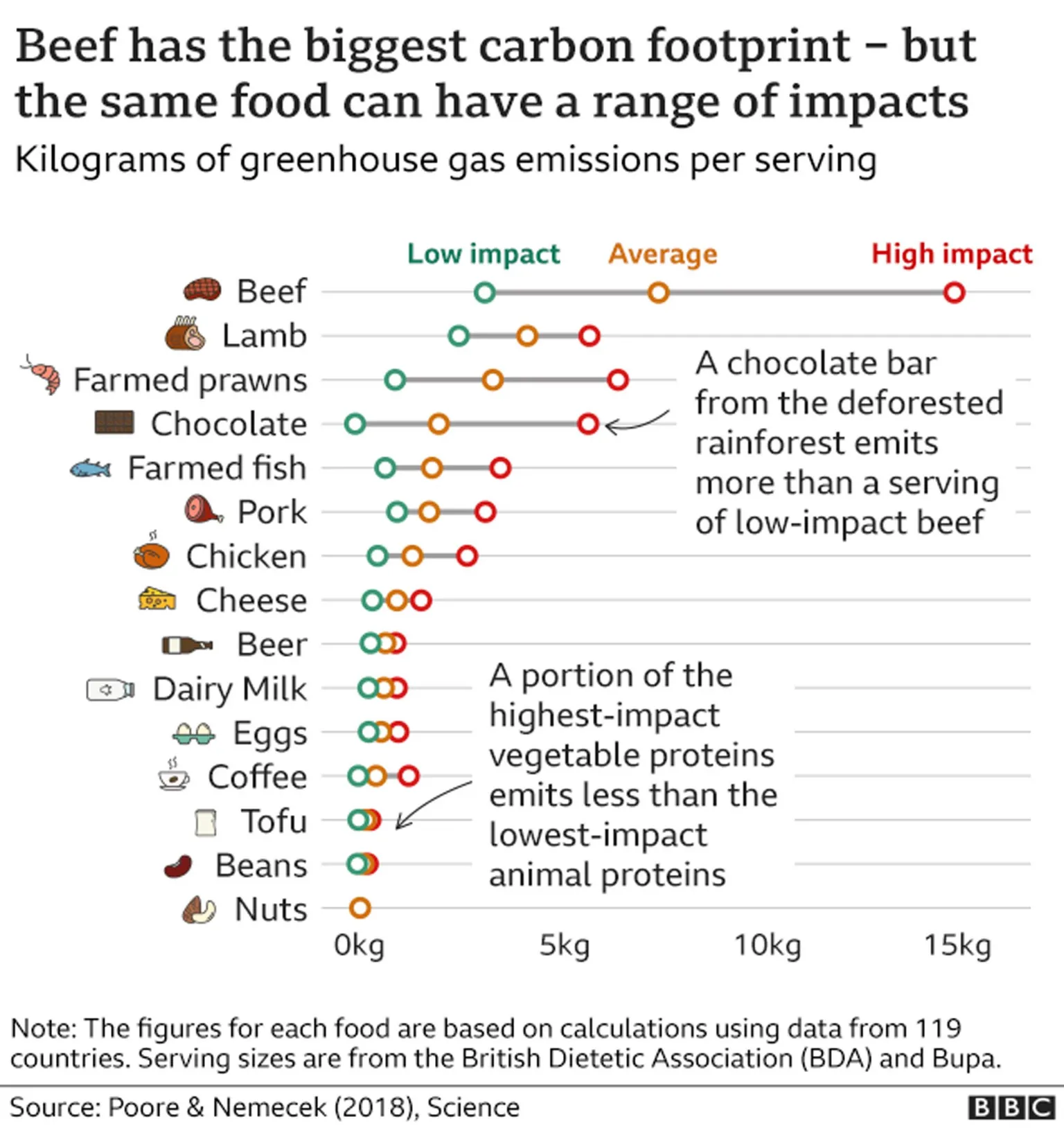
Better chart, apparently same source:

https://ichef.bbci.co.uk/news/1536/cpsprodpb/0477/production...

In short, yes, it would be theoretically possible to eliminate about 10% of global emissions if everyone everywhere stopped eating meat and replaced it with a balanced non-meat diet.

But such an outcome is not realistic.

This is my last comment on HN. It is sad what this corner of the internet has become.

In defense of myself not being a big meanie:

> You know what‘s a caveman take? Thinking that there is any chance to convince a meaningful number of people to reduce meat consumption globally in the required time window

The "caveman take" I'm referring to is when you implied the correct solution to climate change is suicide.

It's a caveman take because I've heard it numerous times, and it lacks all nuance or thought. Yes, we emit CO2 by existing the way we do. We can improve our situation without going to extremes. This is a "perfect is the enemy of good" type thought process.

It's what I call an anti-solution. It doesn't solve anything, but it does completely halt the conversation and makes sure that other real solutions can't pop up.

> As you can see, the type of meat matters a lot. Cheese is doing worse than pork in this example (not sure I even believe this without more evidence yet). Non-meat sources of protein don‘t do very well: Tofu is just 2x better than poultry. Compare this to the giant bar for beef.

Okay, but none of this was in your original comment. You talked about raising chickens, which I appropriately clocked as a not real solution that isn't going to work.

Eating more chicken and less beef is good, I agree, and a reasonable solution. You should probably lead with that.

And bikeshedding (or nitpicking while ignoring the main thrust of the argument) destroys interesting discussions.