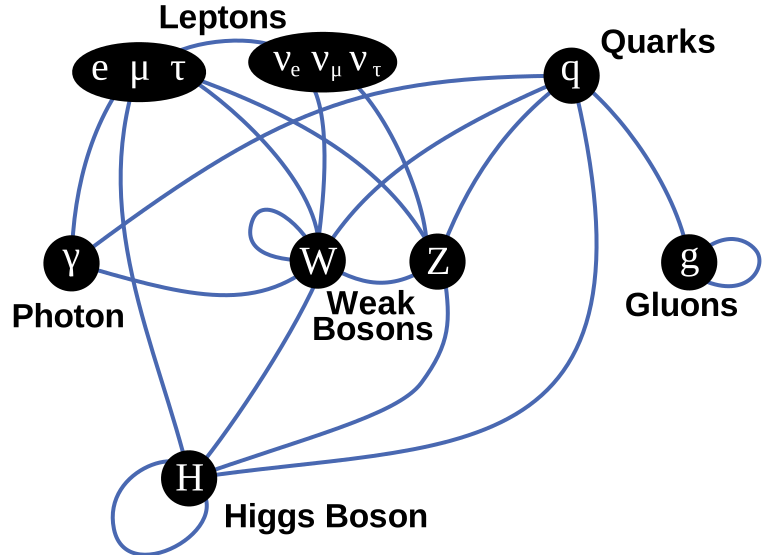
| This is really cool. If you look at this graph of the Standard Model interactions http://upload.wikimedia.org/wikipedia/commons/4/4c/Elementar... you will see the ways in which all of the particles we currently know about interact. If you'll notice though, there's one interaction between ALL of the particles that is missing: gravity. Gravity affects anything with energy. Photons, leptons, quarks -- they are all attracted to each other because they possess energy (negligible, unmeasurable attractions, but still extant). Wouldn't it be interesting if the only way that dark matter interacted with the other particles was through the gravitational force? Maybe from some alien's perspective it would constitute the matter of everyday life, but because it didn't interact with any of our particles except through gravity we would be missing out on a large aspect of our universe! Furthermore, is it that far-fetched to think there might exist particles that do not interact at all with the ones we have discovered? Gluons, for example, only interact with themselves and with quarks. Some other particle may interact with nothing we are familiar with -- and thus we could never study it. Is it even "real" then? (Any particle physicists on here, please feel free to educate me further!) |
At the moment, the most popular dark matter theory comes from supersymmetry. In this case, there's only one dark matter particle, and all of the rest of the particles interact with normal matter, in pretty much the normal way, since all of the underlying structure of the model is almost identical.