I honestly figured it’d be one of the first. That being said, France, UK, and USA are all moving towards more nuclear power. It might be at the point where it’s no longer possible to pretend we care about solar/wind, and can no longer realistically ignore climate change.
I’ve been saying for years that we’d know when governments were finally getting scared of climate change because we’d see real, very fast moves to install nuclear and, if possible, enhanced geothermal.
Because it's the one green solution that actually works as base load (other than hydroelectricity, but that's terrain-dependent), works 24/7 without any other affordances, and doesn't open you up to dependence on other nations to anywhere near the same degree.
Solar and wind are only cheap because a foreign nation makes the parts (if they were made domestically they wouldn't be cost-competitive, obviously). So in 20 years, when your PV panels are degrading and your turbines are wearing out, that foreign country's going to be able to charge you a lot more to replace it.
And if you want to see the results of cheap industrial inputs becoming expensive one only need look at the post-Nordstream German/European economic forecast. Even the poor should be able to afford to keep the lights on and the A/C running once the sun has set.
Solar panels won't start degrading in 20 years. Their degrading is linear and starts when you install them. As a very rough guide you can think of it as 1% per year.
The 20-year horizon therefore is not fixed. It's just a round number. There's a point at which it makes sense to add panels (or replace them if you are space constrained.)
Once large numbers of panels start getting replaced you may see them reused in space-available places, or potentially 'reconditioned' to extend their life. Think of it as similar to second-hand cars.
Of course if the price keeps dropping these avenues are less attractive. And if you are space constrained there are already space improvements that may make changing desirable well before 20 years.
Finally, lots of things we use are made elsewhere. And we make things others use. By trading our excess for their excess we create a trading relationship where both sides operate in good faith because it is in their advantage to do so.
The current climate, where the US operates in bad faith, and seems intent on damaging trade relationships, does not encourage other countries to behave well in the future (regardless of the motivations you (project? expect?) from them in the future.
Because solar and wind are extremely inefficient and dangerous when compared with nuclear. Nuclear and enhanced geothermal are both closing in on their dream forms (fusion and supercritical fluids), and are already sufficient as they are.
It’s not necessarily “over” them, it’s that it will get tons of attention because that level of power generation would take wayyyyy too long to build out and take wayyyy too much space before even getting into the fact that neither solution can work anywhere at any time.
Nuclear got a bad rap, but it is way too essential to ignore in this problem we’re facing. When the focus shifts, you can tell people are getting serious. Simple as that.
Edit: I did not realize this had somehow become a conservative viewpoint? I am a leftist.
Can you elaborate why you think nuclear is more efficient and safer than solar and wind? As far as I'm aware, the opposite is true: Nuclear energy is far more expensive than e.g. solar, for which costs continue to go down. While I understand that nuclear reactors are safe (if handled correctly), history has proven that freak accidents can and do happen. Also, waste storage mustn't be ignored either. How are solar and wind more dangerous?
Gave you an upvote not because I necessarily agree, but to counter the downvotes.
I agree that it’s clear we need more nuclear, but could you explain why solar and wind are dangerous compared to nuclear? Did you mean that all the attention on solar and wind, which can’t be scaled fast enough and must be paired with grid storage, has screwed us when it comes to addressing climate change?
Also, calling solar and wind inefficient isn’t precise enough. By what metric are you judging them to be inefficient?
When I say more dangerous, it’s just a pretty simple calculation - per watt of energy, how many people have been injured/killed when producing energy via a given source. Coal is incredibly dangerous, as is gas by this metric. Nuclear is far and above the safest when calculating in this specific way.
Solar and wind are inefficient, by my definition, because they require large portions of land and cannot run with highly predictable outputs at all times. As a result, you need other solutions to complete the story - larger farms, more farms, large batteries, grids that easily transfer energy long distances, etc.
Nuclear is able to sidestep all of those problems, especially with the relatively recent advent of small modular reactors (SMRs).
There are no "unsolved problems" for nuclear (because the safe storage of fissile waste for 10k years isn't a problem we need to solve, apparently). By contrast, getting solar+wind fully up and running requires totally solving the storage problem. Plus the libs love it. Hence ... nuclear.
> because the safe storage of fissile waste for 10k years isn't a problem we need to solve, apparently
We never solved it for the other material that we dug up and burned (coal). So coal ends up emitting a ton of radioactive waste because uh when you dig up the ground you also dig up radioactive uranium (there's no 100% pure carbon deposits).
It's also only a self-inflicted problem. You can technically re-use the waste until it only needs to be stored for ~300 years before it decays to "normal" levels. The US doesn't allow you to do that though while say France does.
> We never solved it for the other material that we dug up and burned (coal).
Oh yes. Having fucked up this badly with long chain hydrocarbon combustion, lets do it all over again with fission, because ... well, we did it once already, right?
The orders of magnitude are different here. Replacing something that becomes a huge problem within two hundred years with something that (potentially) becomes a problem in a few thousand years -- really is better than spending valuable time on developing an "ideal" solution
> because the safe storage of fissile waste for 10k years isn't a problem we need to solve, apparently
It literally isn't. There are two known solutions already. The stupid way, which is to put it in a dry hole in a geologically stable desert, and the smart way, which is to use it as fuel because it isn't actually waste anyway.
Neither of these things are currently happening for only one very specific reason: The global fossil fuel industry (including Russia) lobbies against them because they want to retain a piece of political rhetoric to argue against replacing fossil fuels with nuclear.
But that's a self-solving problem, because if you actually do replace fossil fuels with nuclear then the fossil fuel industry goes away, stops lobbying against anything, and then you can use either of the known solutions. Which means we'd only have to store the material for a few decades until that happens. The solution to that is what we're already doing at existing reactors, which is largely to keep the spent fuel rods at the power plant.
It may also give you some indication of the scale of the problem to realize that you can hold all of the spent fuel ever generated by a reactor that has been in operation for decades on the site of the reactor itself.
Climate change is a decades-order problem. Worst case is end of human civilization.
Waste storage is a problem for once climate change is solved. Worst case is local degradation of environment.
A grid powered almost-fully by nuclear and water is proven feasible by France. A grid almost-fully powered by renewables for a full year in an industrialized country is yet to be seen. Renewables do work well when combined to fossil fuels, but we need to get off them.
The Republicans programs for electricity is completely insane and renewables is a much better alternative than drilling more fossil fuels. Nuclear is more realistic but the political will is not there unfortunately.
> Plus the libs love it. Hence ... nuclear.
One can be supportive of Democrats and liberals while not agreeing with one policy point.
* Renewable energy sources collectively produced 81% of Denmark's electricity generation in 2022, and are expected to provide 100% of national electric power production from 2030.
* Renewable energy sources collectively produced 75% of South Australia's electricity generation in 2023, and are expected to provide 100% of state electric power production from 2027.
> Renewable energy sources collectively produced 81% of Denmark's electricity generation in 2022, and are expected to provide 100% of national electric power production from 2030.
This doesn't say anything about how much of Denmark's consumption this covers, only their production
It turns out they import a bunch of their electricity from neighbors
This is a sneaky way to pretend you don't consume fossil fuels
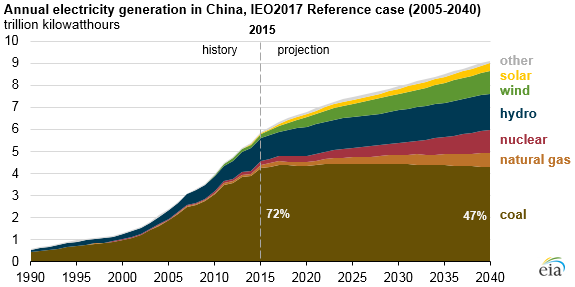
There seems to be a delusional part of the Internet that is convinced that nuclear is the only future, and solar and wind aren’t. To settle this, you basically need to look at what China is doing —- which is to build a lot of nuclear and then exponentially more solar and wind. We’re a huge percentage of the way down the slide to a mostly renewable world with storage, and some nuclear at the edges.
I don't get all that either, though I don't mind if nuclear is the future we'd just need to let go of the brakes on it. The other thing to look at is overall growth of each type - China is going ham on wind, solar, hydro, and nuclear yet they've still had to increase the total amount of power generated by coal, oil, and gas anyways. Graphs always predict something like https://www.eia.gov/todayinenergy/images/2017.09.27/main.png but we really always end up with https://upload.wikimedia.org/wikipedia/commons/thumb/1/18/Ch...
Whatever the cheapest (clean) option deployable is people should be wanting to throw it in as fast as we can until we actually hit a technology limit with its usability instead of worrying it won't be able to get us to 100% or not. Instead, the conversation tends to read like we've already succeeded in deploying clean energy fast enough and we should stop looking or that we are still looking for a technology which can cut our current emissions and waiting for an answer. Neither are true, we're still burning more fossil fuels during the day. The US at least managed to hit break even growth in electricity generation https://upload.wikimedia.org/wikipedia/commons/a/aa/US_Elect... even after stalling nuclear outputs but there's still a lot to go there all the same. I'm not as familiar with Europe.
About the only stances I've been able to make sense of (even though I don't personally agree with them) are the concern nuclear is a step back rather than a step forward and that's why we shouldn't deploy it and the people that just want the cheapest power regardless of source. Everyone else doesn't seem to have a reason to worry about "what" as much as "how to deploy more" for the moment. The dirtier power tends to be the one that's easier to spin up/down very rapidly anyways - "keep the capacity for now and just run it less when you can" is still a great thing.
I'm not sure what you're arguing that's different than what I'm arguing. What I'm arguing is that renewables are being deployed on an exponential (S-)curve and nuclear is not. Given the relatively short time frame we have to solve this issue, any viable solution must exhibit this exponential deployment increase.
(This does not mean we'll succeed. Maybe we're all doomed anyway. But any approach that doesn't have this shape is a disaster.)
If you actually care about this problem, the actual question is: how do we get nuclear onto that same exponential pathway that renewables are on? Fiddling around with our existing legacy nuclear plants is so inadequate to our emissions pathways right now that it's equivalent to surrender.
> There seems to be a delusional part of the Internet that is convinced that nuclear is the only future, and solar and wind aren’t.
"Exponentially more" means literally nothing. 1 is also an exponent.
China is building literally everything. It's also a geographically diverse country, with wide ranges of different climates. Solar is appropriate for Hainan, but makes little sense for Harbin.
One of the best things to come out of destroying environmentalism is that we can finally get working on renewable energy instead of being blocked by suicidal environmentalists who find wind farms too ugly.
Scratch an environmentalist and a NIMBY bleeds. I think we’ve seen the effect in America in general and California in particular. The Sierra Club is against infill housing to protect views.
Environmentalists have been pushing wind, solar, etc. for the last half century. There are a few shortsighted people who oppose wind farms but they represent a large, complex multinational movement in the same way that any one of us represents the tech industry, which is to say not at all.
In many cases, if you look at the complainants it’s also reasonable to question whether they’re fully honest about their motivations. For example, the big Martha’s Vineyard project was backed by the biggest environmental group in the area but by the opposition were people like commercial fishermen and various rich cranks like RFK Jr. and the Kochs who thought the change in view would affect their property values but do not otherwise live lives full of obvious strong environmentalist views.
Environmentalists push renewables the way homelessness activists push housing: It’s a great idea if it is near no one, hurts no one’s views, impacts zero birds, affects zero animals, and is not built for profit by the rich.
I suppose I could use their terminology, though: responsibly sited, balancing conservation priorities, and protecting local communities.
I recall, in my college years, being told how Real Communism hadn’t been tried yet. It seems that Real Communism never did get tried and no matter who tries Communism they never try the good Real variety. After years of watching top environmental organizations repeatedly oppose nuclear power as a whole and renewables often, I think I have to say: Real Environmentalism Hasn’t Been Tried Yet. No True Environmentalist Would Do What These Guys Do.
I am an „environmentalist“ and I’m in full and public Sport of the hundreds of windmills in clear view of my town and the solar on every new residential development, including my own house. As are all other „environmentalists“ I know.
If you’re going to make that kind of sweeping claim representing many different people and groups, I’m going to need to see some data. What you’re describing sounds more like the mechanism I described, where rich people use the language of environmentalism to make their NIMBY activities sound less venal but that’s saying that those specific people are hypocrites rather than a general commentary on the entire field.
They take quite a toll on both wild life and people living in the area.
And are often abandoned as soon as they don't generate enough profits/are too expensive to maintain, with no one wanting to pay for cleaning up the area.
A buddy of mine has two on his property, one within a stones’ throw of his house and barns. Not only does the sound not drive him insane, I couldn’t hear it (at all), nor any of the other ~600 in the area.
No, it won’t. This myth was started in the 2000s by Nina Pierpont who was looking for reasons to oppose wind farms near her property but it’s been studied repeatedly and there’s no credible evidence of any significant impact. Roads are at least as noisy, and have other forms of pollution, but I’ve never seen the same people call for banning cars.
I moved to a house that has the main road on my side. I do not wish it to anyone. I cannot stand noise, and I hear cars 24/7, ambulance at least 10 times a day if not more, and they turn on the siren even at 3 am when there is no traffic because of some specific laws.
I also got a cat (against my will, but gotta take care of her) who wakes me up around 4:30-06:00. :|
I cannot stand the noise pollution. It makes me want to live by the countryside even more.
Seems like the DOGE cuts were overhyped after all. Honestly, anything connected to Trump is overhyped. He has a protective aura of noise. You're not going to figure out what's going on by just reading headlines.
You offer no evidence, but you have convinced yourself so obviously abstracted from the ground that time will prove you were right. It’s a foolish path and I urge you to listen to what is happening. Within the last week government data is no longer accessible to researchers. Long standing government groups and private that study these areas are locked out. Overhyped? No. Like the manager that cuts the budget, gets the raise and sees the fallout much later. Your foolish comment falls flat Carly in line —- there are consequences and they are deadly. Overhyped? No. To suggest a thing is foolish beyond comprehension, it should ruin careers for such a bodacious and absurd point.
I’m here to say that the cuts to the NSF, NIH, DoE (both energy and education) and IRS are not overhyped at all; if anything they are badly underhyped.
What is overhyped is the actual “savings” that they are producing with all of this.
What would you cut? I don’t know what I would, but I do know that the United States is heading for a financial apocalypse unless drastic measures are taken now.
I know there’s a lot of hysteria around this, but I’m still at the place where I can be optimistic that the US will come out ahead. At least they’re doing something besides spending more money and acting like everything‘s OK. From a long-term financial stability standpoint it’s really not.
Were I concerned about fiscal balance, I wouldn't view cutting as the best way to solve the problem, I would raise high-end taxes.
> I do know that the United States is heading for a financial apocalypse unless drastic measures are taken now.
Insofar as that’s true, it is a direct result of the actions taking thus far this administration, not something they are correcting—and not through fiscal imbalance causing wider problems but by a broad economic collapse directly (which, because the broad economy drives revenue, has fiscal balance problems as a second order impact.)
It's worth noting that this "financial crisis" (which I disagree with) has been brought on by Republican governments. Bill Clinton left a budget surplus which is the easiest way to pay down the debt.
Secondly, if I had to cut something, the obvious target is the military. (Oh boy, ring on the downvotes there...) But hear me out.
Firstly, the adventures in Afghanistan and Iraq cost more than the current debt. With pretty much zero achieved. Focusing less on projecting power, and more on self-defense might deliver better returns.
Of course the military budget can't (and wont) be cut because it's not about the military. It's a carefully controlled jobs program that moves money from the federal piggy bank to pretty much every district in the nation. So it becomes a game of "cut x, but not y, because y is made in my district. It's easier to cut less-specific programs (like Medicare) because that isn't district specific.
Then again maybe the tide has turned, and they could cut military spending. The CHIPS act funneled tons of money to Florida and yet Floridians hated it.
Thanks to you and GP for a reasoned response. Appropriately taxing the wealthy is 100% something we also need to do and yes, I am skeptical that the current administration will move in that direction. Ditto cuts to the monstrous military industrial complex.
I think I’ll refrain from responding to the more inflammatory replies but what really sounded the financial alarm for me personally was this talk [1] given to the house on February 5th by Arizona rep David Schweikert. He makes a really compelling case about the dire state and future of the government’s financial position. If indeed I have been hoodwinked as other comments seem to think, I am open to being convinced otherwise. But this talk is well documented, and seems like a plea from a man who is desperate to sound the alarm so we can prevent disastrous consequences for millions of people in this country.
> but I do know that the United States is heading for a financial apocalypse unless drastic measures are taken now.
Do you have proof of this? Otherwise you are spreading propaganda and lies. “We need to cut stuff because the party I support says so” isn’t proof of a financial apocalypse and is only fear, uncertainty, and doubt. It’s the very hysteria lying in which you refer.
Do they have proof that 33+ trillion dollars in debt will begin snowballing larger than any country can actually service?
Do we need specific evidence about how debt interest works?
Sorry for how snarky this sounds but your response sounds like you don’t believe that the interest on over 33 trillion dollars is a big deal (and it’s growing…)
Please educate me if that’s not how interest or debt works (again I am dead serious here) but it seems disingenuous to claim that some sort of proof is required to point at the debt and say “Ah that’s not a problem unless you PROVE it’s a problem”
Big scary number does not mean system is broken. That is hysteria. I am not the one making generalized statements about financial apocalypse without some sort of notion of proof. Studies, links, evidence if you’re going to cry apocalypse and be taken seriously.
First of all, I don’t accept the a priori premise that cutting is needed. But if I did want to cut, I would want to have an actual plan for how to figure out what could be cut and what tradeoffs were involved, and then to execute that plan in way that balanced as many equities as possible and was done in a way that followed some sane and transparent process (as well as relevant laws).
Part of that might involve being able to show some kind of financial analysis about what was being cut, to justify it and to get buy-in from congress and other relevant stakeholders, and to do the cuts in a way that minimized their impacts, gave everybody who was going to be affected adequate time to be part of the process, and to plan for how to manage their side of the situation.
Needless to say, what we are seeing now is… none of those things.
A good example of what a saner process might look like would be the federal workforce reductions that followed a big analysis on government efficiency that Al Gore and his team led during the first Clinton presidency; look up the Federal Workforce Restructuring Act of 1994 to see how it all went down. They spent six months making a plan, then got it through congress to fund buyouts (it passed with major bipartisan support).
> I do know that the United States is heading for a financial apocalypse unless drastic measures are taken now.
The people you get your news from are lying to you, trying to get you to sell out your future to their profit.
The economic issues we’re facing right now were created by the current administration installing heavy taxes on imports while simultaneously creating a nationwide shock with federal spending. This is like declaring that you should save money and doing so by not paying your rent, skipping the doctor, and pushing your car into the sea.
If we rolled back to January 19th, when the economy had been growing steadily and all signs projected that trend to continue, the long-term problems still weren’t catastrophic. The primary problem was that Republicans broke our balanced turn of the century budget when they cut tax rates and started a couple of recreational wars, setting a pattern which has continued where we’re told that we have to give up things the public benefit from because the alternative of rich people paying taxes a few points higher is too miserable to even consider. That debt is a concern, but not as a fraction of the massive American economy – it’s like the difference in medical concern between noticing that you’re gaining 10 pounds a year versus 10 pounds in the last week.
The reason the lying about the crisis has ramped lately is that some of the tax cuts which racked up trillions of additional debt in Trump’s first term expire this year and others in 2028, but the Republicans want to cut taxes even further. It’s mathematically impossible to do that without unpopular cuts to things people like, such as Medicaid or children’s health insurance (CHIP), which is why they’re trying to distract with gross exaggerations of the currently-negative DOGE savings and trying to manufacture this air of impending disaster so people don’t think there’s a choice. While the choice is no longer as easy going back to Biden’s economic growth, it could simply be letting tax rise to the levels we had 20-30 years ago when the economy was thriving.
If your plan doesn't include passing bills through Congress that increase tax revenue and cut popular social entitlement programs, it is not targeting this problem.
A few dudes firing a bunch of people entirely through executive action has absolutely nothing to do with the financial problem you're worried about. The federal payroll is not a significant cost, and the executive branch doesn't control the budget.
It is no different than a magician doing misdirection. It's up to you whether you want to buy the act.
I don't think you understand how money works. Federal debt doesn't matter beyond its relationship to taxes and inflation. The US needs to raise taxes and address inequality through greater investment in public services and infrastructure, as well as stronger regulations on consumer goods pricing, not less.
Macroeconomics is very different from microeconomics. Your spending is my income and my spending is your income. If the government spends a dollar, where does it go?
Presumably it goes to some sort of goods and services. The employees pay income taxes. The businesses pay corporate taxes. And so on.
Similarly, when a business lays off 10,000 people, it's not their problem anymore. Whereas from a macroeconomic policy perspective, "everybody" is the government's responsibility.
It wouldn't raise enough money. Probably better to say: "Tax the multi-millionaires", or even people who earn more than 1M USD per year.
What if we change the tax code such that passive income (capital gains, dividends, coupon payments, etc.) is taxed at a higher rate than active (employment) income?
> What if we change the tax code such that passive income (capital gains, dividends, coupon payments, etc.) is taxed at a higher rate than active (employment) income?
Doing so by lowering the active income rate wouldn't raise more money, and doing so by raising the passive income rate would kill investment and job creation and send us into a depression.
>but I do know that the United States is heading for a financial apocalypse unless drastic measures are taken now.
No you don't know that, because it is outright wrong.
We could hold this level of debt for decades and safely reduce it over a long time frame. Plenty of other countries have done that plenty of other times. Christ, most of Europe only just got done paying us off for WW2!
Indeed, we had almost no debt at the turn of the millennium, after Congress during Clinton's admin cut a bunch of stuff after significant PUBLIC DEBATE, but Bush got us into multiple outright false wars to drop bombs in the desert for two decades and now all of a sudden the republicans are concerned about fiscal responsibility?
Fuck right off.
> At least they’re doing something besides spending more money and acting like everything‘s OK
That's literally what they are doing. The proposed budget is just more tax cuts for billionaires. Stop being so goddamned gullible.


I’ve been saying for years that we’d know when governments were finally getting scared of climate change because we’d see real, very fast moves to install nuclear and, if possible, enhanced geothermal.