Hacker News new | ask | show | jobs
by xp84 493 days ago
I applaud the author for putting thought into how to design digital controls, in contrast to the "just put whatever garbage on a touch screen" strategy most carmakers do today.

However, I still question the benefit of this complex, modal control (you have to press a single knob to "cycle between" multiple modes). My ancient, 2016 car features three knobs. This luxury allows me to, without looking, adjust any of three settings (temp, fan, air location), as well as a button which does each seat heater, without any "check what mode it's in, tap, look at the tiny screen, tap again if necessary" step.

True, in this trim, my car does not have a thermostat mode, which in theory is useful, but it is so trivial to modulate the temperature based on "do I feel cold, hot or comfortable right now" and reaching over to twist one of the controls anyway, and even in the other car I have which has this mode, I frequently need to adjust things anyway, except in that car some of the functions require multiple mode changes on the touch screen and looking away from the road.

11 comments

My 1997 Lexus has a knob that controls the digital climate control. Except that instead of a spinny position encoder, they used a knob with stops so you have tactile feedback for when the temperature is all the way up or down.

This is the kind of detail that I love about a well engineered car.

That's how the knobs normally work. And the original poster describes how "automatic a/c" or "climate controls" have always worked in cars, you set a target temp and they handle fan speed and air temperature.

Why does the article want to make a multifunction dial with no tactile feedback? Have they only ever driven a Tesla?

There's a whole section in the article about experimenting with different positions and weights of the haptic feedback as the dial is moved and how to tie them in to the display on the control itself.
Yes. But how about a dial that stops turning at the minimum and maximum and doesn't need you to take your eyes away from the road at all?

So last century eh? Maybe also less life threatening.

> But how about a dial that stops turning at the minimum and maximum

That, too, is mentioned in the article ("This means you can simulate different types of haptic feedback, like different detent strengths and hard stops.").

> and doesn't need you to take your eyes away from the road at all?

Also addressed in the article ("Showing three different data types in one dial is possible but definitely the maximum. When adding a fourth function, keeping track of your position in the interface without looking down becomes too difficult.").

> you set a target temp

You should be able to set 2 temps.

Early morning in summer: temperature is under 15°C, no need to heat over 20°C. Evening: outside is 30°C, I don't need 20°C in the car anymore but 25ish would be perfect. A 2 temperatures setting or 1 temperature + delta would prevent having to change it every time I enter the car.

You don't need any of that. You just need a knob that ranges from make as cold as you can to make as hot as you can and a reasonable fine grain in between. I can find the right set point because I'm literally sat next to the knob and I'm a better control system than anything they can come up with.
My (old, obsolete) car's knobs not only stop completely at the extremes, but they aren't truly continuous but have "stops" every half degree that you can feel in your hand while turning them without looking at them at all.

That's too ... physical ... for modern designs, I guess?

And I'm a lazy fucker: I want to set a temperature range and then not bother until I sell the car. Under the range? Heat it. Over? Freeze it. But a range, not a single point. So if the temperature is between min and max, the AC stays off.
I posit you're unusual in your opinion. I mostly observe people use the climate control knob like a heater knob. If it's cold, the set temperature gets cranked up; if hot it gets cranked down.
This is, by far, my main AC complaint. Since it's almost always not the exact requested temperature, the AC noise is always on.
Do you wear the same amount of clothing all year around? Never excerted yourself or been in a blizzard before entering your car where you might want to get back to your ideal body temperature quickly?
You're designing the controls for the area you live in and for your driving patterns now.

There's some famous electric car manufacturer that did the same. His products were unusable in some locales even before he went all political.

BMW's first iteration of iDrive was very ill-received, and so they improved it. I think launching a global car brand is pretty difficult, even if you don't like the guy.
But I test drove a Tesla and besides the stupid tablet controls the smart turn stalks couldn't hold a turn signal when turning left at a crossroads that wasn't at 90 degrees. That's life threatening if you ask me.

No, I don't need to know Musk's politics to avoid his cars.

Of course, it's well known that BMWs come without a turn stalk so maybe it seems normal if you compare those two brands :)

The issue I see with AUTO most often is noise. Almost every time I've disabled AUTO was in the beginning of a drive while talking to someone having to yell over the fans or just going to move my car 10 meters and it just being annoyingly loud.

The temp I don't believe you can really fix. Sometimes I throw my jacket in the back, sometimes I keep it on, sometimes I'm tired or my stomach is upset and I want it to be a sauna, sometimes I'm sweaty and want it to be a fridge..

From my experience: BMW, Subaru, and Mazda the auto settings are worthless / not functional.

Audi is okay.

The best I’ve found is Infiniti, which 2013 ish on, the auto settings are perfect 99% of the time.

(This of course means, you do have to adjust the temperature setting, but once set the fans spinning up and down are perfect along with the heat moderation. )

BMW could be user error on my part. The longest I’ve used a BMW is 3 weeks, with probably 9 weeks of total usage, and while I tried to get the auto settings to work, on multiple models it was nothing but agony for me.

When people get hyperbolic and state that AC controls are pure agony it shows a disconnect with reality and it’s hard to take that person serious.
Some cars have an option for how "intense" you want the system to be.
I just wrote the same thing. It seems obvious. Set range and forget.
The two thumb wheels on the steering wheel of my 2015 Tesla Model S 70D most definitely have tactile feedback. They can be 'programmed' to control various things such as media selection, cabin temperature, open/close the roof, etc. Unfortunately Tesla lost the plot with the Model 3 by removing most of the physical controls and then turned the Model S into a large version of the Model 3 by getting rid of the portrait orientation 17 inch screen and replacing it with the landscape 15 inch one from the Model 3.

I've rented a BMWs a few times in the past and they have a clever multifunction knob cum joystick on the centre console but it's a bloody nuisance to use compared to a touchscreen in my opinion

My 2004 5 series BMW had this (it was called iDrive). A command style knob that could move on an axis of sorts (up and down, left, right). You could also press it in. I absolutely hated it.
They have removed it in their newest models. They have truly lost their minds at BMW. Everything on the touch screen and the panel that housed all tactile buttons how now one big led strip. Truly dumb design and a ton of wasted space.
That was among the first generations of iDrive. I was (and to some extent still am) skeptical, particularly given how overwhelmingly negative the reception was at the time. But, FWIW, the motoring press was later – as BMW apparently improved the system significantly – swayed to accept, and sometimes even praise, the iDrive. At least from about 2015-20, or possibly as early as 2010-15.

Can't give any personal evaluation, as I've never (AFAICR) driven a BMW.

Small review, 2013 BMW 335xi (drove for a test drive). Loved iDrive. Remained my benchmark for car infotainment UI for 10+ years. The main thing, you could DRVIE the car, aggressively, and give commands to infotainment without missing a beat.

Truly a lost art today. Fond memories.

Aggressive BMW driver. You don't say.
The first iDrive version was CCC, and it was reviled back then and is still currently. I think the opinion shift happened with the CIC version, which started rolling out at around 2009 and had a massively different user interface. And you can tell that CIC was a much better system since the next version introduced around 2013, NBT, only tweaked the CIC UI instead of completely replacing it.
Curious if I am missing a detail: It sounds like a knob with endstops, incremental notches for a finite number of positions between the endstops, and probably a spinny position encoder underneath it?

(this also describes my 2009 saturn; I think; unsure, but that's a good sign: I don't look at/think about this knob conciously!)

That's all, you got it.

Its just a nice touch that was pretty clearly done by someone who had a very good grasp of intuitive human interfaces.

That's how all knobs used to work. Those were good times.
I agree. I don't want a "smart" knob. I'm dreading going car shopping sometime this next year. I anticipate having to rule out a large pool of cars to keep my controls navigable without looking.
My wife bought a new car with fully digital display a year ago. For me, I got a 2013 low mileage dumb car. Couldn't find anything new that I liked with my preferred level of UX technology (or lack of). I drive both equally and even a year later, I hate operating anything in her car. Once you get it dialed in, not too bad, but there's constantly edge cases of things you do infrequently and really have to search around for how to change a setting. The dealership always changes something when we take it for regular maintenance and it's always a PITA to figure it out how to get it back to normal. Also, it seems impossible to set a default setting for many things. There's a feature that activates anti-glare on the rear mirrors, for me it makes driving at night impossible, and I can't set and forget my preference. Every time the car starts my preference is overridden. It's maddening. The only saving grace is this feature only requires 2 clicks on the rear mirror (1 click of 2 physical buttons). I've memorized those clicks and can do them without having to go through screen clicks and hamburger menu hell.
Oh how I wish I could turn off the anti-glare function of my side mirrors (Audi). For the rear mirror I don't mind it, but it completely fucks my side vision in the dark. Brightness of lights is totally a valid way to guesstimate distance, and if everything is just a dark reflection I totally have no sense of depth anymore.
Don't forget that almost every car made in the last 5 years reports telemetry (including vehicle speed, accelerometer data, and location) back to the manufacturer who shares that data with third parties, sometimes including insurance companies.
And guess who gets use of that data in lawsuits between the manufacturer and you?!
Source?
I've found one good solution to this problem (for AC, at least): go for a car with a good "auto" mode!

I hardly ever touch my AC, I just leave it on auto and the car does the rest to get it to the right temperature as quickly as possible.

I suspect this is what most automakers think the real solution should be, just make it easy enough to set a temp and leave the rest to the computer.

Maybe in California :) In other places you need defrost, windshield defog etc.

I regularly cross our (small) mountains on holidays and that means temperature and humidity outside can change every 20 min on a trip as you go from a depression to a mountain pass and back to a different depression with a different weather.

The target temperature control stays unmoved, but i randomly have to turn on and off the defog, for example. Can't keep the defog on all the time because it pushes a ton of hot air to the windshield and then in my face, rather keep it off when i don't need it.

Hey speaking of fog, do Teslas even have fog lights? How many layers of menu do you have to go through to turn them on and off?

Newer cars read the outside temperature, and adjust the auto. I don’t know if they sense condensation on the inside. I know that they sense water on the outside to automatically engage wipers.

I have found even the best ones though, to get the rear defrost right, but fail to get front defrost correct in high humidity conditions that aren’t just normal rain. (Very dense fog, snow, sleet ).

Subaru front facing cameras just shut off the eye sight system when the window fogs. The defrost selection is a button, which means it's computer controlled.

In theory the computer knows when it needs defrost.

So yesterday was a windchill of -5F or something equally miserable. I spent about 20 minutes out in it and then drove home. When I got into the car, the heat felt perfect on full blast as I shivered and thawed. About 15 minutes into my 30 minute drive, my body temperature caught up and I had to turn the heat down to low as I was getting too warm.

A couple months from now, I'll have the same situation, except it will be 95 F outside after a long, hot work day and I'll jack the AC up to get down to a comfortable body temperature. Once I cool off, the AC on full blast will be way too cold to tolerate.

Thankfully, I've got an 8-year-old base model car that allows me to do all that with physical dials that don't take my attention off the road. I can't imagine what it would take to program an "auto" mode that knows how long it takes for my body to reach a comfortable temperature after being out in the elements. I think I'd lose my mind if my car just blithely set itself to 70 degrees and assumed that would work for me. That may be an option for office workers in milder climates, but they're not the only ones buying cars.

A lot of these solutions that people are mentioning, or the types of cars with climate controls they like, seem to be posting from places like San Diego or the California Bay area as opposed to places like, you know, the Midwest or the South or the Pacific Northwest or, you know, New England.
That's a reasonable point. Too bad an auto mode for my music and podcasts (of varying volume; also varying with whether I have a passenger) is probably not a thing...

On the other hand, my sense with how I use temperature control in my car is that most of my interactions are (a) set mode at start of driving (b) incrementally turn the temperature dial a notch or two without looking at it.

My current daily vehicle does a pretty fine job of figuring out what mode I want for HVAC.

Sometimes, I do mash the defroster button when weather commands warm/dry air on the windshield and it's easy enough to find that with muscle memory.

Otherwise, in normal seasonal weather, it works well and I don't change modes or temperature. Windows up, down, hot, cold, sunny, cloudy, dark, whatever -- it all works about the same.

Previously, I drove an older version of the same vehicle. It also worked well until it forgot how to figure out what day it was due to a software issue. After that, it kind of had a mind of its own.

(Now, a sane person would ask why that would have to do anything to do with HVAC performance.

It gathered the current date, time, and position from GPS, the bearing from the nav's compass, and the solar intensity from a sensor on th dashboard.

A bit of math and/or an almanac lookup later, and it also knows the position and angle of the sun relative to the car.

So it knows when sunlight is streaming on through the driver's window, and adjusts automatically to compensate by providing relatively cool air from the dash vents only on that side. It also knows not to do this on a cloudy day as well as other things that seem obvious once a person starts thinking about them.

Which is a magical kind of automation -- until the calendar is off by both years and months because Honda broke the clock and its understanding of the sun broke with it: https://didhondafixtheclocks.com/ )

Ok, that's pretty neat sounding. I'm behind the times with a 15 year old Saturn that's fully manual controls (except headlights turning on).

My temperature adjustments are the old fashioned "what temperature air to blow" and not "I want this end result temperature", so my previous comment is a whole different paradigm. Thinking about it, with more recent rentals, I haven't messed with temperature controls much either.

The older one was a 2007 Honda van -- the newer one is from 2012. I think that system was introduced in MY 2005.

Either way, it's almost certainly old enough that the patents are expired.

And I was surprised by it myself. It would have seemed like absolute wizardry to me if I knew of it back in '05.

You raise an interesting point about more-recent rentals: People don't talk much about how stuff like this works, because if it is working well then they don't need to think about it at all. They don't even need to notice it.

And it's not perfect, but it's still Really, Really Good at accomplishing that task of being out of mind.

I was complaining about lack of physical buttons in my VW compared to my BMW before it, but then I thought about it - what do I actually use? Climate control is set to 20C and stays there. Carplay starts when I board the car and resumes what it was doing the last ride. Seat and wheel heating start dependent on temperature. There is actually nothing to set besides window heating (dedicated buttons) and volume (slider and wheel buttons). I was a bit angry at capacitive wheel buttons, but since I've discovered that I can set speed by 10 steps with a swipe I have to say that I don't care that much.

I still think that Skoda has much better controls, though. They also look and work quite similar to the control in OP.

There's also the fact that most thermostats do manage to keep the sensor input constant, but that's surprisingly uncorrelated with how you actually feel.

(Often due to the slightly bonkers idea that single sensor, often not in any location the user is, will correctly reflect the actual environment)

"Make it warmer/colder" is sufficient input and doesn't pretend a precision it doesn't have.

Rolls Royce do this I think
> "check what mode it's in, tap, look at the tiny screen, tap again if necessary"

This is my concern as well. It's a perceived improvement in UI but still a loss over analog UX. I'll end up cranking the knob and wondering why my radio channels are rapidly changing when I wanted to adjust the volume. You're almost forced into retaining state of your knobs in your head if you want to do anything eyes-free. Eyes-free operations should be the ultimate goal, that's what we had with analog.

My Lexus has climate control up down and track selection up down in the same column within inches of eachother and I have to look every time. Even the fact there's a knob next to the track ones...
I gave up on having decent and reliable design of controls in cars. Even if someone would come up with something having minimal (preferably zero) cognitive disruption that is easy to learn and used to, the constant self-forced and determined nervous pressure of providing new, and new, and very new, and revolutionary, and new revolutionary, and disruptive, will make me re-learn whatever new idea is forced on me with a new car. I dread replacing our 20 yo car. But we have to. Maybe - considering all other troubles with modern cars, like very poor computerization and inherent safety issues, optimization to the level of corruption or unreliability, sales hostility (subscription), nauseating design nightmares - better move to a city and country with decent mass transit system. Could be a win-win for us and the environment. For the missed cases there is taxi and rental. Car dominated societies are not nice to live in anyway.
I gave up on cars in the US for few years now... I just bought a hyper electric escooter and use it to travel 60+/- miles per charge... no gas, no insurance, no maintenance (only the rare flats and brake pad changes), and no plate and safety/emission... etc etc.

Buy once, use till the battery dies... rinse and repeat... gear is inconvenient though but can put up with it.

Where I'm at there's a cross on the side of the highway every quarter mile or so to mark where people who decided to not use a car to commute that day are commemorated.
I find the thermostat mode only works on overcast days or at night as the sun contributes so much feeling of warmth when driving (in California) that the heating and cooling thermostat doesn't work well.
A sun load sensor mostly solves this, they used to be a high end feature but it's becoming more common.
High end? It's on my 15 year old Suzuki. I only know that because the diagnostics told my mechanic it's broken and he replaced it once :)

It may just not be advertised.

Thus more common, it’s still not an every model of every manufacturer thing. Tracking incoming angle is also less common etc.
I don't think my 15 year old Suzuki has it :(
Oh, neat, never knew about that!
As someone mentioned a Lexus in the thread, my memory popped up the fact that most expensive models have thermostat corrected for the sun position and probably current weather.
The author is pretty clear that having more than two modes diminishes the usefulness of the interface. Three modes was complex enough that he redesigned it down.

I've changed the channel tuner when I've reached for the volume knob. If the haptic feedback between the two is clearly different, that will help, no?

Controls that require a feedback loop have more cognitive overhead than controls you can just use “blindly” (this includes not having to check for haptic feedback to test what mode it’s in) and from pure muscle memory. For example, you learn that your preferred volume when driving on a highway is at (say) the two o’clock position, and with time you’ll blindly turn the knob to that position without even consciously thinking about it. If, on the other hand, you “know” that the knob could be in a wrong mode, you’ll tend to hesitate when operating it because of that anticipation, having to check back whether the knob is indeed in the correct mode.
Right. This "smart" knob is symmetrical, with no pointer that you can feel before turning the knob. So it's hard to use without looking. This is inferior to a simple mechanical knob.
It's not infinitely rotatable, though, like some knobs are; TFA mentioned a 270° rotation range. So a pointer “beak” (or some other haptically recognisable asymmetry) should be easy to add.
It's infinitely rotatable unless the software tells the motor to push back. The encoder appears to be relative, rather than absolute, so the physical positioning at power-up is unknown. Thus, the physical knob can't have a physical pointer with consistent behavior.

I have an LG washing machine with a knob like that. After power up, you have to turn it one notch before it lights up to indicate the current position, which is the default Normal cycle. So the knob has to be symmetrical, with no tactile pointer.

> It's infinitely rotatable unless the software tells the motor to push back.

Aha? OK, I read that wrong then.

The key is the blindly … driving is really a dangerous thing. Eye on as things happen.

I still have a nightmare about the dog of my relative run to the road and get out between 2 parking cars. It is a miracle it was not killed. I would not be able to detect it if I doing all these knob and feedback thing.

The old lady driving and stop in time in her old car … knobs and eye on help

Interesting comment regarding the lack of a thermostat. Sometimes, qualitative setting is better than quantitative. Precise temperature settings lead to overthinking and fiddling, in my experience. With qualitative settings, at most two interventions are necessary to reach a comfortable setting.
Digital controls? Hell no. Just say no.
Not even once
FTA

> I discovered thermal comfort depends on four environmental factors: air temperature, heat radiation, airflow, and humidity.

He's managing more variables than those handled by your three knobs, and also deals with seat temperature in his setting.

You might not want any of the finer control, some don't even want climate control and will run with open windows in dead winter. But I see a lot of benefit of his approach for anyone who cares as much as him about climate control.

A good interface would provide a helpful abstraction that allows the user to make clearer and faster decisions about those four variables rather than just exposing them directly to the user.
Toyota 3 knobs undefeated.
The real luxury for me was four knobs (or often sliders).

https://i.ytimg.com/vi/W9AjhGko2mA/maxresdefault.jpg

The fourth one controls recirculate, and it allowed you to set in-between positions between 100% recirculate and 100% fresh air.

To simultaneously optimize pollution/humidity/CO2 I find I prefer about 80% recirculate and 20% fresh air, but achieving this configuration is impossible in most (all?) modern cars.

It is achievable in every car by cracking the window
That's the workaround I'm forced to use, but obviously the disadvantages are noise exposure and forgetting it's cracked resulting in rain entering the car. :-(

Yay for "progress" eh? I know the recirculate door servo can stop halfway, just let me control it...

Putting the recirculation door on a servo was another dumb MoDeRn car idea. Bring back the mechanical control that never failed.
I used to do it in my former Skoda Fabia and the window just collapsed. Thank Indian roads. I noticed there is a subtle final movement from "cracked" to closed and I guess there is a big difference in vibrations related wear.

Toyota ran ads encouraging owners to crack windows in the rain and I noticed no final movement. But I'm not risking it.

"It ain't got no gas in it."
Simplicity: are they exactly the same knob, thus lowering ordering costs, shipping and receiving costs, inventory costs, supply chain costs, design costs, and error potential? Quite likely. This also allows upstream suppliers to double down on volume and work to lower costs at their end.

Versus... the designer of a custom complex multi-part powered assembly (manufacturing cost not discussed, cleaning not discussed, visibility in varying light conditions not discussed) who has the fantasy that users want to squint at a tiny screen on a knob while driving, and that pushing all this and associated documentation down a global service network is going to come at an acceptable cost to users.

This begs the question: who's the real knob?

Why is it that when the entire auto industry does something right Toyota gets credit? Fanboyism is a pox upon online automotive discourse.

Every OEM has used the 3-knob design on and off but it was particualrly hot in the 90s and 00s. It isn't a Toyota thing, or even a specifically Japanese thing.

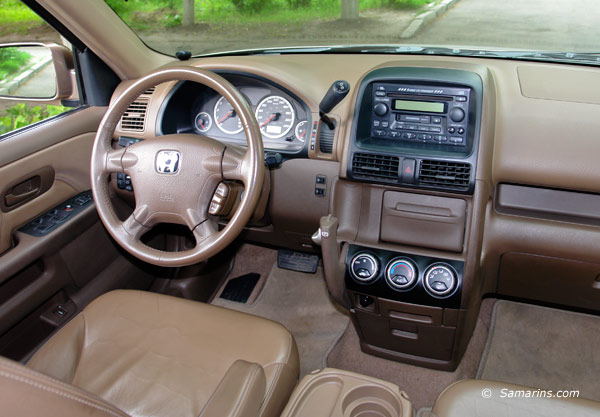
Here's a random 00s Honda:

https://www.samarins.com/reviews/img/cr-v_04_int_large.jpg

Here's the OJ era bronco:

https://media.carsandbids.com/cdn-cgi/image/width=2080,quali...

Here's a GMT800

https://jandjautowrecking.com/cdn/shop/files/57_8fc2bd4a-2cb...

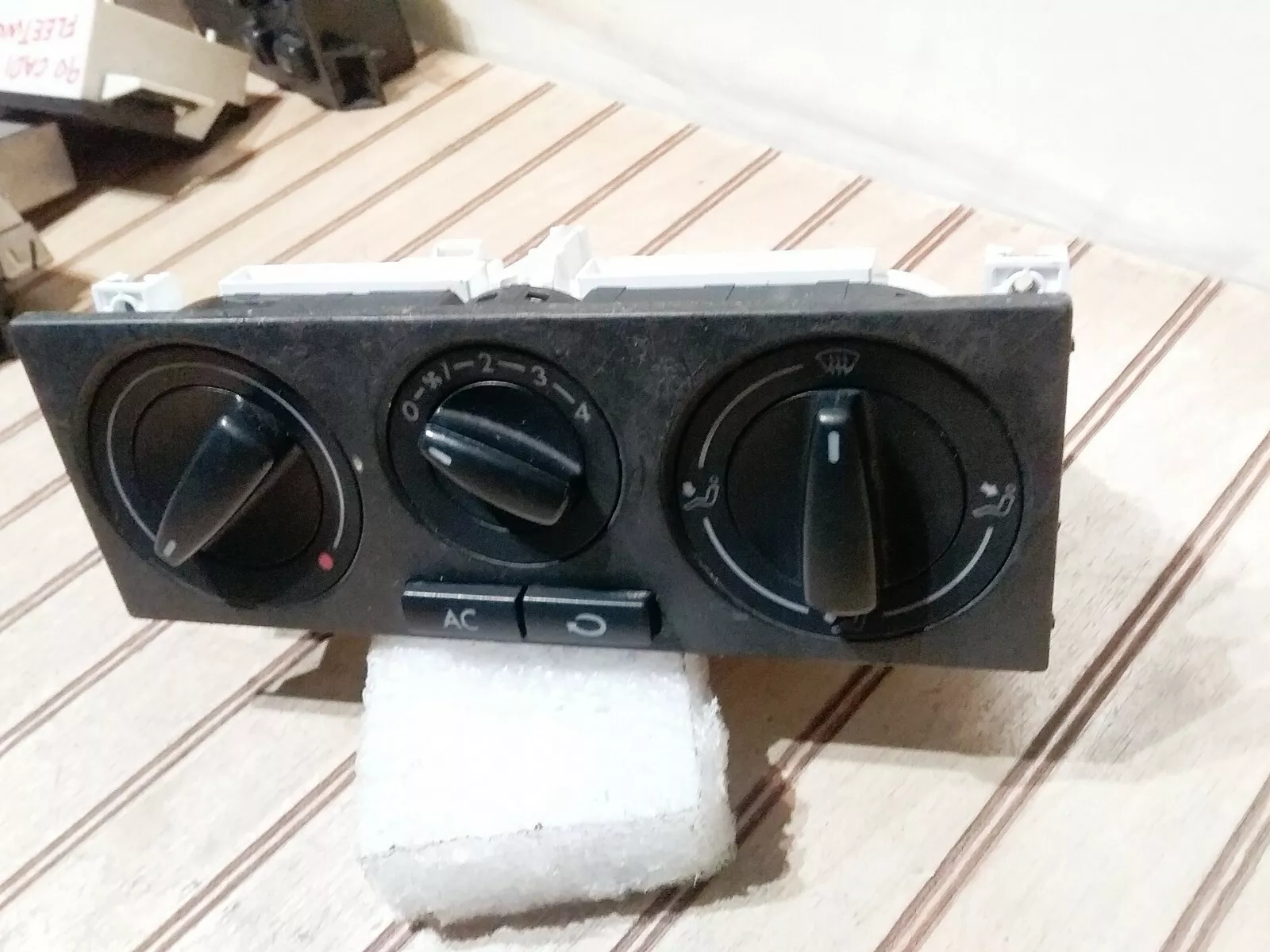
Here's a radom VW

https://i.ebayimg.com/images/g/7w0AAOSwApleAMyP/s-l1600.webp