Hacker News new | ask | show | jobs
by brap 507 days ago
While I’m not a fan of crypto, I don’t really understand how bitcoin is different from other commodities.

Would you say gold’s value is determined mostly by its practical use? Because it seems demand is largely driven by speculation as an alternative currency.

18 comments

Gold has a commodity value above zero. It’s used industrially. Even if everybody decides it’s not worth its precious metal value, it’s not worthless. Bitcoin has zero intrinsic value. None.
Which makes it better. Using gold as a store of value is inefficient. Only 11% of gold is used industrially, 89% of gold is literally wasted in financial games where bitcoin or any other fiat store of value with low supply inflation could be used instead.
My wife can't wear a bitcoin. She can wear a gold necklace and will be pleased to do it even if the price goes to 10%
What’s better: someone’s wife wearing a gold necklace, or a gold ignot sitting idle in Fort Knox?

What’s better: someone living in a house, or a house sitting idle as a store of value?

What’s better: someone storing his wealth in houses and gold ignots, or in special financial assets that don’t take away products from other people?

Hoarded wealth is a stinking manure; used wealth is a fertilizer.
> hoarded

It’s bad to be able to transport wealth through time? Spend it or lose it? Never work hard now for later?

Would she be happy to wear a necklace that appeared identical to gold to the naked eye, but anyone with a $10 instrument could demonstrate was not gold but something relatively worthless? If so, I have something I would like to sell you that your wife would really love.
I doubt she would be too pleased with the green stain left behind when taken off
Doesn’t the appeal of gold as jewelry rely on it being expensive? I think if the price cratered its use in jewelry would probably plummet.
It's the look. You also get resin / rock / clay / steel / ... (anything really) jewellery. It's not just about the price. And even then, a jewelry-sized gold piece is quite cheap.
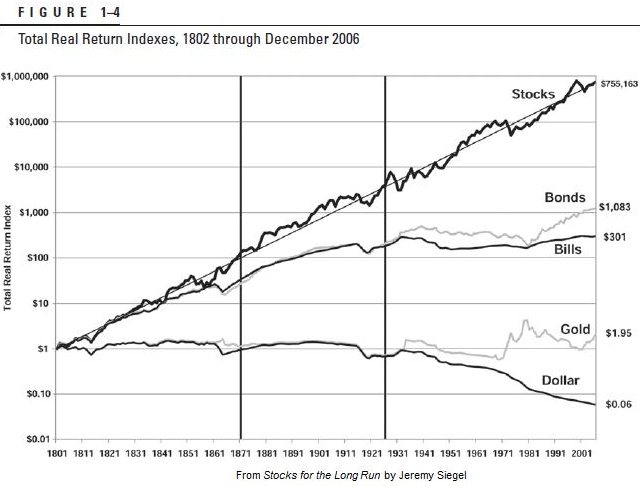
Yes, using gold as a store of value is inefficient. You would generally expect returns worse than global equity markets over any significant period of time. You are at significant risk of _losing_ most of your money (adjusted for inflation, gold has never returned to its 80s peak, and was _much_ lower for most of the last 40 years). ~No-one should be investing in gold.

And bitcoin is even _worse_ than gold, on the fundamentals; gold does have at least have that bit of intrinsic value (plus a few millennia of cultural cachet). Bitcoin has _nothing_.

Industrial uses of gold aren't the only uses of gold. Like it or not, jewelry (among other decorative objects) containing actual gold is an enduring status symbol that is hard to 100% fake, and there is quite a large amount of the world's gold that is used for decorative purposes.
It makes it hard to value Bitcoin.

It's not only almost 100% speculation, it doesn't have much history track record.

Crypto bros need to understand that they aren't the first people to discover a speculation market, and just because they can dream of utility doesn't mean they test if the world wants to treat it as a reality. What they're doing is, from a financial perspective, boring and in many cases outdated.

That's a stupid argument. When someone finds some niche applications of crypto currencies in payment services, or something like that, it's economic value is above zero. But what matters is how close the economic value is to the market value, not whether the economic value is literally zero or not.
The difference is that I can create an infinite number of different block chains and or crypto coins.

I can restart forks of both bitcoin and Ethereum on my laptop at this moment. I can restart 10 forks each. Or 100.

I cannot do that with gold.

Bitcoin holds 57% of total crypto value, Ethereum another 11%, some 15% is in centralized instruments like USDC or XRP, which are not really cryptocurrencies.

In addition to that, there are also 10.5 million altcoins (10000 new are created every day). But all of them together hold just 17% of crypto value. So you can, of course, create another millions of forks, but it won't make a dent in Bitcoin value.

Sure you can create 10 different blockchains but will those have "stable" value 10 years from now?

In China, it's nearly impossible to invest your assets without friends in the government. The government strictly controls conversion of their currency to non-Chinese currencies. As strange as this sounds, but with cryptocurrencies, you can export value from your country to something more stable.

Same goes for many south american countries.

I still wouldn't invest into Bitcoin or Ethereum but I live in the west where there is the rule of law and one can invest into a large variety of asset classes.

That's irrelevant. You can choose to speculate with literally anything, not just newly invented crypto currencies or gold. Historically people have speculated with tulips and countless other things. The problem is the missing economic value, not whether you can create similar things. It's irrelevant for the economic value of gold whether new elements can be created or not.
> The difference is that I can create an infinite number of different block chains and or crypto coins.

Yes, but Russian Federation uses only one to evade sanctions.

>When someone finds some niche applications of crypto currencies in payment services, or something like that, it's economic value is above zero.

No it isn't. My credit card has an intrinsic value of zero. It might even be negative due to the massive amounts of infrastructure necessary to run it, similarly to bitcoin. The value is in the networks surrounding it, not whatever method Visa uses to move the bits around, be it blockchain, databases, or whatever. And even then, Visa's value add is only a few points on the transaction. It's in no way a speculative asset and if Visa went away tomorrow forever, it would suck for maybe a month while we adjusted to using cash again. In the same vein, if bitcoin went away tomorrow, I wouldn't notice until reading a panicked article about it.

If the US dollar went away tomorrow, however, I'd be happy to have stocked up on ammunition and cured meats.

How much of gold value is honest commodity value and how much of it is speculative value? I think you will determine speculative value is something above 80%. If that is the case, then arguing that there should be a huge disrecepency between price of BTC and price of gold is intellectually dishonest, since 100% speculative value and 80% speculative value isn't THAT different.
>How much of gold value is honest commodity value and how much of it is speculative value?

It really doesn't matter. The honest commodity value is the same price as the market value. 60+ percent of new gold mined every year goes towards jewelry and electronics. The base price of gold is high due to demand, not due to speculation. Gold is pretty and pretty hard to find - thus the price goes up.

I agree about Bitcoin, but other cryptocurrencies like Ethereum or Solana have use as gas to power transactions on their respective networks. So it's interesting to see Vanguard nix those two as well and then say "We do have a lot of interest in blockchain, the technology behind cryptocurrencies. We believe its application to a number of other uses besides crypto will make capital markets more efficient, and we’ve been actively involved in research to use blockchain technology."
Bitcoin has transaction fees too, that's all gas really is, doesn't really change the fundamentals of the system.
It does, but Bitcoin's transaction fees are just paid to the miners. On Ethereum they are mostly destroyed. Combined with the lower issuance of proof-of-stake, this means that the supply of ETH sometimes actually shrinks.

That makes ETH is comparable to shares of a company, where fees are revenue, new issuance to stakers is cost, and any net profit is paid out to ETH holders in the form of stock buybacks. You can calculate a PE ratio.

Yes, but BTC can only be used as gas to power the transfer of gas. Meanwhile, ETH can be used as gas to power the storage and indexing of information on world computer. If we're talking about creating underlying value, I feel like the former is tautological and latter has an application outside of itself.
True, but you can do a much richer set of transactions with Ethereum/Solana, like moving stablecoins and making collateralized borrows, including against real world (tokenized) assets.
Bitcoin has no intrinsic value. It is not backed by anything real.

Gold has its uses. It’s a pretty metal and has practical uses in engineering and medicine.

It has been a choice for jewelry for thousands of years.

Paper bills, or “fiat” money, also have no intrinsic value.

Using paper money has already defined you as a participant in accepting the societal construct of money.

As such, Bitcoin having no intrinsic is not novel or consequential and has no bearing on its utility.

Well, I mean (a) it is unwise to accumulate a big pile of paper money (or the equivalent in a bank), like a common Disney duck plutocrat; if you do this, you will in the long run lose money in real terms. By design. Money (or at least modern money; things were somewhat different in persistently-deflationary pre-industrial economies) is not designed for investment. Money should not be the comparison; it’s a tool, not an investment vehicle.

But (b) money is given some real grounding by states; you can pay tax with it, in particular. It’s not much, and it’s not bulletproof, but by comparison to cryptocurrency, well, it’s _something_.

But really, it makes no sense as an argument that hoarding cryptocurrency is a good idea, because hoarding _money_ is, notoriously, a _bad_ idea.

Modern money has operated as you describe for less than one human lifetime. It might not work long-term, and indeed there are significant reasons for worry that it won't. Not that it _can't_ in principle, but that it _won't_ due to mismanagement and misaligned political incentives. A future alternate system might well have deflationary characteristics.
If you mean Bretton Woods, that is in many ways an implementation detail. Ignoring the Great Depression (which probably _should_ be treated as a special case), and brief (~1 year) shocks after WW1 and 2, the last time the US, to take an example, saw _persistent_ deflation was the late 19th century.
Fiat currencies have value because you have to pay your taxes with it. There’s no choosing not to participate.
> Gold has its uses. It’s a pretty metal and has practical uses in engineering and medicine.

Would you say gold’s value is determined mostly by its practical use? Because it seems demand is largely driven by speculation as an alternative currency.

It’s practical use both increases demand and removes the commodity from the market.

BTC is more volatile than gold.

>> Commodities are real assets that meet consumption needs

Granted a commodity's value may be driven by speculation, but at the end of the day it's a material that is consumed by various industries.

This will not be an argument but my perspective as an amateur investor.

Main difference between gold and bitcoin is in its history. Gold as a type of investment instrument has already earned its reputation and status. It’s not just a commodity, it’s a financial instrument that had its use in building and making of history and it’s well integrated, recognized and supported by most government and societies.

We still don’t know what Bitcoin really is and how it behaves. It could be valued 10k times up or down next year and there could be no clear reason why that happened. Bitcoin is not in hands of most powerful companies, people and governments and change of its value would not affect anything but net worth of certain individuals or organizations.

By no means, I think bitcoin is here to stay and it has a very clear future as an investment and payment instrument. But I think it’s really silly to say Bitcoin is speculative as much as other investment instruments.

>We still don’t know what Bitcoin really is and how it behaves We know both of those things 100%, it's in the source code and ledger of every transaction that has ever occurred from it's inception. We certainly do NOT know that in regards to gold, nobody has a good picture of the world's total gold reserves and where they are, the extraction rate, or it's exchange. A lot of what people say is true of bitcoin but not of gold seems to be precisely the opposite.

As far as what should bitcoin's utility be valued at to the world at large, sure this is in a volatile state, but I don't see how that bears on it's classification as an asset.

Gold is also not like other commodities. No one treats gold the way you treat iron or lithium or even platinum/palladium.

And for what it's worth, Vanguard doesn't have a pure gold ETF.

Besides practical use, gold also has aesthetic use: jewelry, as an external status symbol of wealth. That is not possible for crypto currencies in the same way. Of course as online presence and social structures mature, this might change. Maybe not in my generation’s lifetime, but who knows.
Im hate crypto as much as the next person, but is jewelry as a status symbol that different from an NFT as a status symbol or having a bitcoin wallet worth $1mil as a status symbol?

People in CS:GO pay (tens) of thousands of dollars for skins which are just digital status symbols.

Maybe the property of gold is that it is a status symbol which has a long history and cannot be duped.

In general, yes. Jewelry can be melted down and repurposed. It’s also visible in the physical world, which means more to many people today (maybe not to future generations). In that way, I think NFTs are more comparable to, say collectible mechanical watches, baseball cards, stamps, art. It might be worth dollar for dollar to some people, but the market for gold is much larger.
I'm not into gold or crypto but gold jewelry has a tiny bit more of a track record than nfts
Is a picture of gold jewelry (NFT) worth the same as jewelry?
Gold's fundamentals are it is mined and used for jewellery. Speculation and hoarding can cause it to fluctuate a fair bit but long term the price is driven by the mining cost. See the 200 year inflation adjusted price https://www.marottaonmoney.com/wp-content/uploads/2013/05/st... It's remarkably constant in the long run.

Bitcoin is different. Although it's mined, the mining difficulty constantly adjusts to keep the block time at 10 minutes. The price is set by the people in the market buying and selling it and so fluctuates all over the place.

I think the unsatisfying answer is that Bogle was a bit of gold bug -- he had a 5% gold allocation.
Gold was historically uncorrelated to other asset classes, so there was a portfolio theory reason to allocate in gold. In times of uncertainty and fear, people would flee to gold. Afaik, this effect has been muted in recent years. I don’t know if it has been fully explained, but it’s likely due to the highly available and interconnected investment products of today. Bitcoin has been shown to have a high beta with credit and other investment assets. So from a portfolio theory perspective, it is functionally more like a leveraged ETF than a hedge. This doesn’t mean that neither deserves a place in a modern portfolio. As they say, past returns are no guarantee of future results.
It’s arguably a _bit_ of a myth that people flee to gold in times of uncertainty. It’s something that many people believe happens, and it does seem to happen to _some_ extent, but not to the extent that people believe. Adjusted for inflation, gold has never reached its 1980s peak again, and may never do so, despite a number of greater economic and social shocks since that peak.
So it bubbled and crashed forty years ago. In the past 25 years it's had decent returns, and in particular:

2007: 31.59%, 2008: 3.41%, 2009: 27.63%, 2010: 27.74% [1]

Owning too much gold is terrible, but a modest allocation to gold in a portfolio of mostly stocks, which you rebalance every year or two, works out pretty well. [2]

[1] https://www.macrotrends.net/1333/historical-gold-prices-100-...

[2] https://portfoliocharts.com/2021/12/16/three-secret-ingredie...

I mean, each to their own. I don’t understand how anyone can look at that chart, and look at, say, an S&P500 returns chart (or an MSCI World chart if you want some more diversity) and say “yes, gold is a good long-term investment”, but you do you.

(NB. Gold enthusiasts will sometimes try to cloud the waters by comparing gold to, say, S&P500 price only (ie pretending dividends aren’t a thing). This honestly still doesn’t leave gold looking very attractive, but it’s also dishonest. To compare like with like you want to look at S&P500 with dividends reinvested, and at that point gold just isn’t even in the running.)

As I wrote above, by itself gold is a terrible investment. But as a small portion of a portfolio that you rebalance periodically, it has its benefits for improving risk-adjusted returns. See my second link for details.

But you can get the gist by observing that in 2008, the S&P500 dropped 38.49%,[1] while gold went up 3%. If you had, say, 10% of your portfolio in gold, then when you did your end-of-year rebalance you got to buy a lot of cheap stock. Gold also substantially outperformed stocks in 2007, 2009, and 2010. So I'm not convinced it's a "myth that people flee to gold in times of uncertainty." Maybe you're right that it's not as big an effect as some people believe, but it's enough to benefit your portfolio.

[1] https://www.macrotrends.net/2526/sp-500-historical-annual-re...

Portfolio theory suggests holding uncorrelated assets and rebalancing. If/when the stock market has a down year, it hopefully softens the drawdown.
> gold has never reached its 1980s peak again, and may never do so

Very true. OTOH, if you bought gold one week, one month, six months, one year, five years, ten years or twenty years ago you would have made money.

I am not really a gold bug. It has a place, but it’s not the best asset ever. As others correctly point out, it is unproductive in itself. OTOH, if you have two uncorrelated assets, you can make money simply by rebalancing periodically between them. Not a lot of money, but not nothing.

Note too that cash itself is unproductive. Dollars ultimately derive their value from the fact that Americans have to pay their taxes in them, not because pieces of linen paper are useful for a lot.

> OTOH, if you bought gold one week, one month, six months, one year, five years, ten years or twenty years ago you would have made money.

Well, yes, but that's a rather unusual condition (the last time that would have been true would have been for a period in 2011, and before that for like a day or two in early 1980).

By contrast if you'd bought a broad index fund you'd have made a lot _more_ money (except for the one week example, due to Nvidia shitting the bed today). Like, a _lot_ more money.

> Note too that cash itself is unproductive.

Sure; approximately no-one will argue with you on that one. But cash isn't really the alternative to gold.

If all you give me is leveraged beta I can replicate that more cheaply.
I honestly don't know how much of gold's value is driven by practical uses rather than speculation, but I think there's an important difference between "some practical use" and "no practical use" when it comes to commodities. The practical uses mean gold is unlikely to ever be worthless, but the same can't be said for a cryptocurrency.

Even from a speculative standpoint, gold or similar commodities have the advantage of being actually support limited. Now obviously the supply of an individual cryptocurrency can be limited, such as with Bitcoin, but the supply of cryptocurrency in general is essentially unlimited with very little barrier to entry. That's not great for even speculative investment, since you're essentially betting on the continued popularity of whatever currency you invested in with relatively little history to support that trend.

Does it really matter if the value of something is 95% speculative or 100%? Loosing 95% of the value of your investment is not a lot different than 100%.
Bitcoin is certainly extremely high on the speculative spectrum, but claiming gold is anywhere near the same level of speculation is specious.

Gold has the Lindy effect going for it. Humans have been trading it for thousands of years. Bitcoin has been around for 16 years.

Gold has industrial uses and if its value dropped, its uses would expand. Bitcoin has no such inherent supply-demand curve.

I like gold and bitcoin. But productive assets seem more useful to hold in general. Fiat, gold, and bitcoin are debt tokens on future humans. I'd rather own things than future human labor. Feels a bit like owning people.
Taking an investment position in a commodity vs a speculative position indeed could raise some non-trivial questions (if you believe in/subscribe to some sort dichotomy there).

I seem to remember in the past, commodity investments where viewed with an eye towards diversification benefits, for example.

an alternative currency because humans have a long history of treating it as a valuable item, mostly for jewelry / decorative purposes. crypto only copied the speculative currency part, but it's not useful even for showing off...
You can't eat or burn bitcoin, therefore doesn't need to be balanced or made sustainable through economical instruments.

You know all those economical instruments? They actually serve a purpose(like making the price stable or making the supply and demand predictable. This is important because it usually takes months to years to produce these things and you don't want to destroy your producers or production capacity for a glitch) and they're not just a gambling machine with strength rules.

>[economical instruments are] not just a gambling machine

Oh really? With stock buybacks, splits, and options, financial trickery, and market cap not matching production?

There are lots of forces in the market that make it very much a gambling machine. For example SMCI produces very real things, I've owned hundreds of their products, but some questionable decisions resulted in a huge drop despite them being well positioned for all the AI growth. Or TSLA, which has recently doubled from a point where many felt the stock price didn't match the available market.

The point is that their reason for existence isn't gambling. It wouldn't be surprising if more rules and restrictions are introduced if they end up not being able to serve their core purpose.
Don't take this the wrong way, but the way you say "their core purpose" makes me think that you agree that their reason for existence isn't gambling. I'd agree that they haven't lived up to their core purpose as much as they could have, and it's a lot gambling
Not functioning as intended is different than the original intentions and it is important when arguing for one more function.
Full disclosure: I've probably "lost" more by following advice like this article than everybody on this thread has lost on bitcoin.
Gold looks nice, golden jewelry can be beautiful. This is not going to ever change. Even if it does, gold's ductility and chemical resistance will still be important for industrial applications.

And the scarcity of gold is not likely to decrease in the near future, unlike with diamonds that can now be cheaply manufactured and bought on AliExpress.

Other commodities have a physical existence. That's quite a big difference.
Certainly true. Gold is difficult to transport and expensive to protect, whereas Bitcoin is neither.
Indeed. Other commodities have other strengths; oil can be turned into a huge range of products that make people's lives better, wheat can be literally used to make food to radically enhance people's lived experience, aluminium is a key component in an enormous range of goods covering almost every aspect of life. If what Bitcoin can offer isn't having any actual application that improves anyone's life but is easy to move around, well, gotta go with your only strength, I guess.
In India gold demand is driven by its use as jewelry. It is also used as a safe asset that can either be pledged or sold in time of need. This has been the case for hundreds of years if not more.
Gold is also no longer a good thing but still better than crypto.

In an apocalypse gold s still usable and gold has other uses. Like industrial and as jewelry

Gold is also a generally terrible asset to hold as a long-term store of value.
Gold is the single best thing that exists in the world and that has ever existed. That's where the value is.
You seem to have Gold confused with Tacos.