3 Generated frames sounds like a lot of lag, probably a sickening amount for many games. The magic of "blackwell flip metering" isn't quite described yet.
It’s 3 extrapolated frames not interpolated. So would be reduced lag at the expense of greater pop-in.
There’s also the new reflex 2 which uses reprojection based on mouse motion to generate frames that should also help, but likely has the same drawback.
"Frame generation (FG)" was not a feature in DLSS 2 - the subthread starter was speculating about MFG (of DLSS 4) having worse latency than FG (of DLSS 3), on the basis of more interpolated frames meaning being more frames behind.
To me this sounds not quite right, because while yes, you'll technically be more frames behind, those frames are also presented for a that much shorter period. There's no further detail available on this it seems however, so people have pivoted to the human equivalent of LLM hallucinations (non-sequiturs and making shit up then not being able to support it, but also being 100% convinced they are able to and are doing so).
Nobody is talking about DLSS 2 here so I don't know where that came from. The 2x, 3x, and 4x in my post are the number of generated frames. So 2x == DLSS 3, and 3x and 4x are then part of the new MFG in DLSS 4.
Digital Foundry has actual measurements, so whether or not that matches your intuition is irrelevant. But I think the part you forgot is that generating the frames still takes time in and of itself, and you then need to still present those at a consistent rate for motion smoothness.
Watched their coverage, not much in the way of details that would explain why the (slightly) increased latency. Your speculation about why MFG takes longer makes sense to me, although I have troubles picturing how exactly the puzzle all fits together. Will have to wait for more in-depth coverage.
Yeah, in hindsight I should have figured it was more generated frames presented at a lower frame times (shorter period).
The Digital Foundry initial impressions are promising, but for me with a 144hz monitor that prefers V-Sync with an an FPS cap slightly below, I'm not sure using 3x or 4x mode will be desirable with such a setup, since that would seemingly make your input lag comparable to 30fps. It seems like these modes are best used when you have extremely high refresh rate monitors (pushing 240hz+).
This is true, but it's worth noting that 3x was 5ms additional latency beyond original FG and 7ms for 4x, so the difference in latency between DLSS 3 FG and DLSS 4 MFG is probably imperceptible for most people.
yeah but it means MFG still has the same fundamental problem of FG that the latency hit is the largest in the only scenario where it's meaningfully useful. That is, at low 15-45fps native FPS, then the additional impact of an additional frame of buffering combined with the low initial FPS means the latency hit is relatively huge.
So Nvidia's example of taking cyberpunk from 28fps to 200+ or whatever doesn't actually work. It'll still feel like 20fps sluggish watery responses even though it'll look smooth
Do you have a source for this? Doesn't sound like a very good idea. Nor do I think there's additional latency mind you, but not because it's not interpolation.
Interpolation means you have frame 1 and frame 2, now compute the interstitial steps between these two.
Extrapolation means you have frame 1, and sometime in the future you'll get a frame 2. But until then, take the training data and the current frame and "guess" what the next few frames will be.
Interpolation requires you to have the final state between the added frames, extrapolation means you don't yet know what the final state will be but you'll keep drawing until you get there.
You shouldn't get additional latency from generating, assuming it's not slowing down the traditional render generation pipeline.
Could you please point out where on that page does it say anything about "extrapolation"? Searched for the (beginning of the) word directly and even gave all the text a skim, didn't catch anything of the sort.
The literal word doesn't have to be there in order to imply that it were extrapolation instead of interpolation. By your logic, there is no implication of interpolation versus extrapolation either. Nvidia simply won't use such terms, I believe.
They did specify [0] that it was intermediate frames they were generating back when the 1st version frame generation was announced with DLSS 3, which does translate to interpolation. It's only natural to assume MFG is the same, just with more than a single intermediate frame being generated.
It is also just plain unsound to think that it'd not be interpolation - extrapolating frames into the future means inevitably that future not coming to be, and there being serious artifacts every couple frames. This is just nonsense.
I checked through (the autogenerated subtitles of) the entire keynote as well, zero mentions there either. I did catch Linus from Linus Tech Tips saying "extrapolation" in his coverage [1], but that was clearly meant colloquially. Maybe that's where OP was coming from?
I will give you that they seem to intentionally avoid the word interpolation, and it is reasonable to think then that they'd avoid the word extrapolation too. But then, that's why I asked the person above. If they can point out where on that page I should look for a paragraph that supports what they were saying, not with a literal mention of the word but otherwise, it would be good to know.
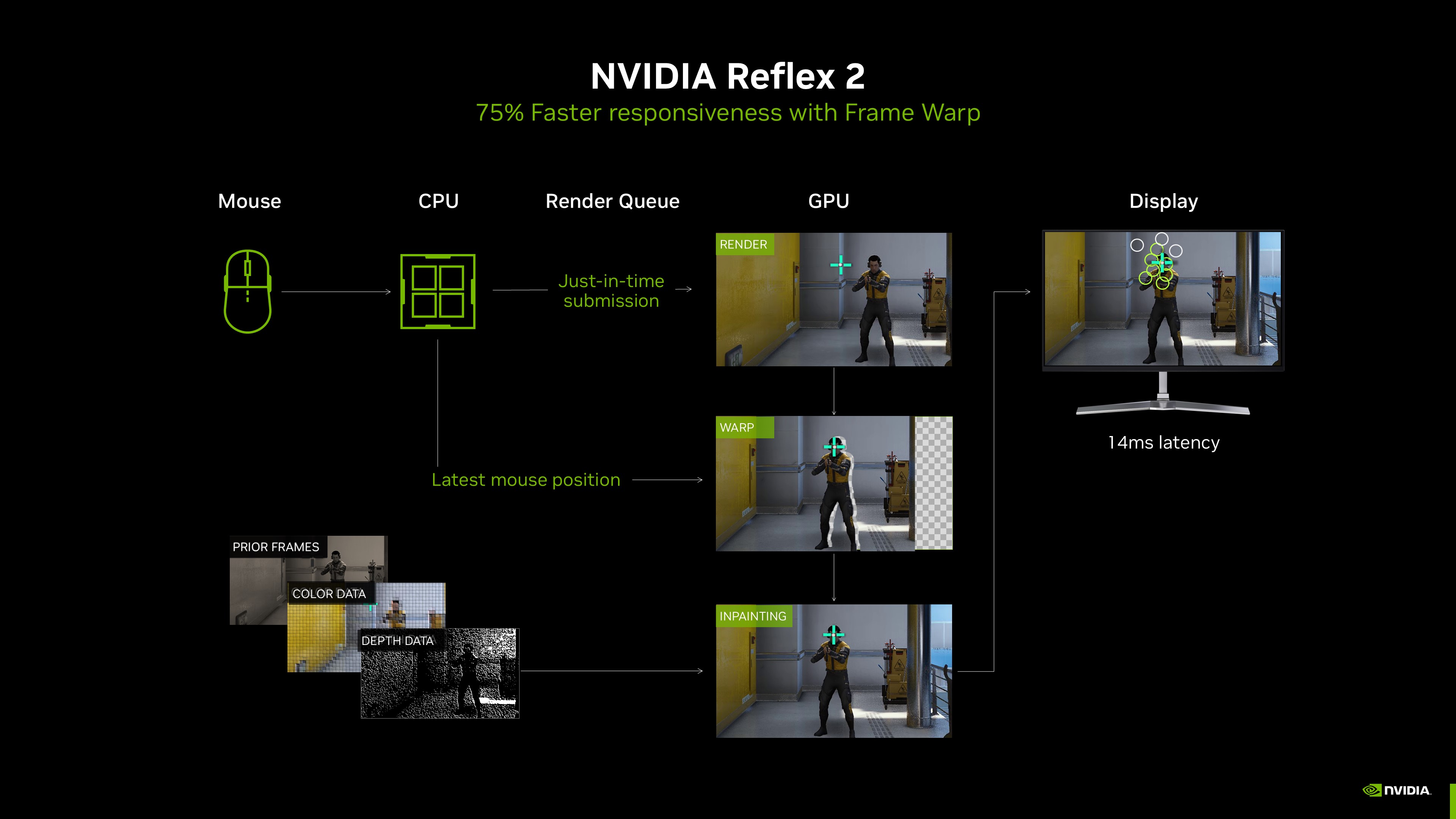
There’s also the new reflex 2 which uses reprojection based on mouse motion to generate frames that should also help, but likely has the same drawback.