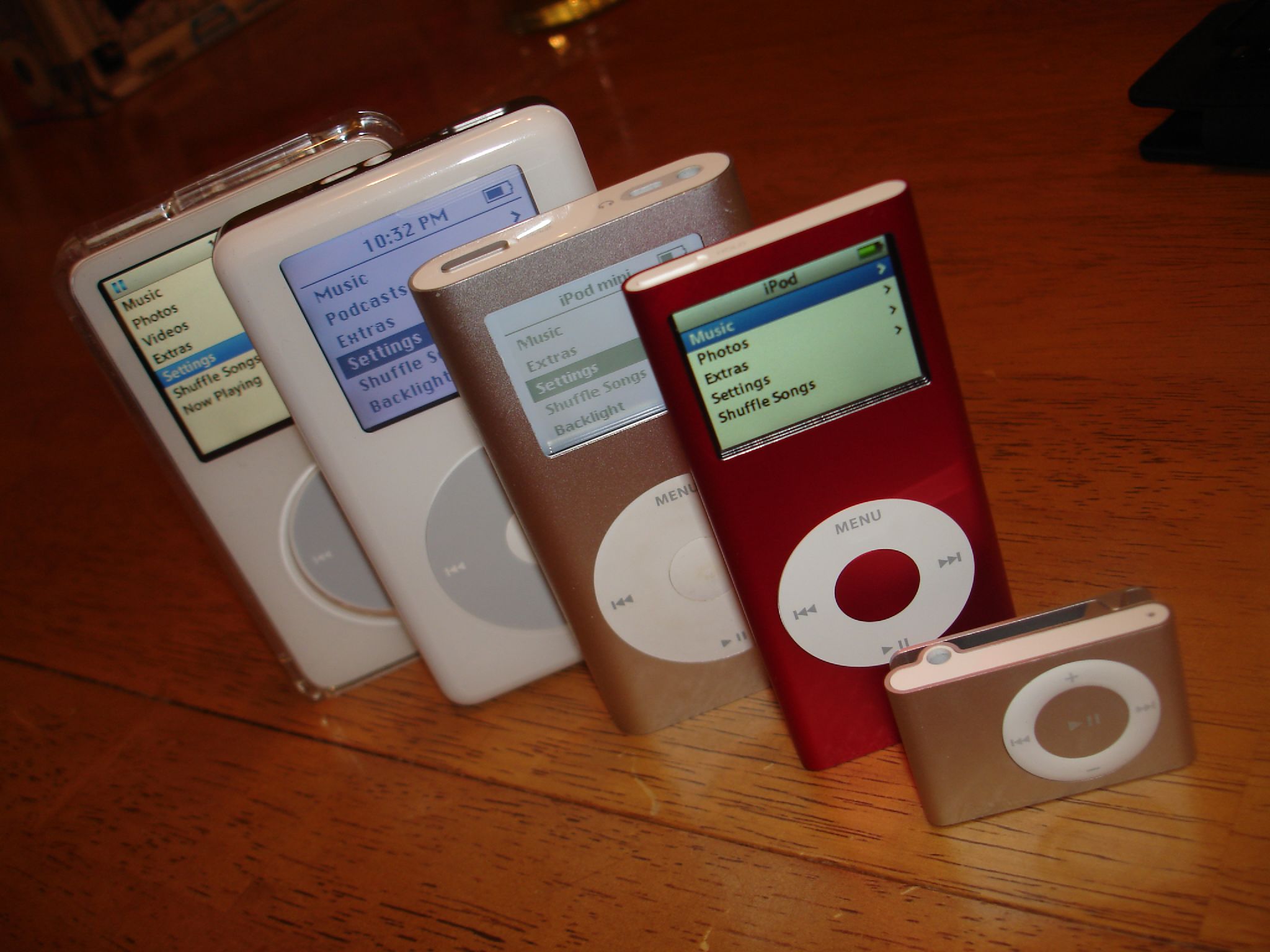
...Steve Jobs got on stage, gave the usual state of the business update, and then he did something I’d never seen before. He killed a wildly successful product...
... and replaced it with a wildly similar product.
Well, the move away from spinning rust to flash seems like a pretty big deal. Also B&W to color was the kind of upgrade television milked for a generation.
Everything that you mentioned, and also: the relentless miniaturization. That took a lot of engineering.
It's emphasized in the video linked to in the OP, but it disappears in the images linked in the response above, which are not proportional. Here's a side-by-side comparison:
All these years later, and with the new MBP, they're still pushing system miniaturization, flash memory, and high-res color displays. It's a straight line in some respects.
I think the general counterargument is: killing off a product line simply to replace it with a relatively iterative model (that could have easily been iPod Mini 2) is less a visionary move and more an attempt to double down by getting iPod Mini owners to quickly replace their mp3 players.
(Not saying I agree with that particular argument, but it exists.)
Their engineering team produced a much smaller version and their competitors had products very similar to the mini. So there was a very good reason to release the superior product -- why hold back?
What was great about the mini -> nano transition is that they did actually kill the mini. Too many companies would have hedged their bets and kept it around, which I think would have been a mistake.
Here's what's risky about it, the iPod Mini was genuinely very much adored throughout the lands. Apple figured they could change up the market and land a new product, but they had no guarantees that the people who loved the Mini would love the Nano. They effectively gambled a big chunk of revenue on proving to the industry that the Mini was were the puck was, and the Nano was where the puck would be.
Now, it's less risky for Apple as at the time anything iPod was likely to draw in sales, but for the majority of companies would they take a risk of killing an entire product line to make room for something they didn't know would be as well received? I'd wager no, the majority would sell side-by-side and cause consumers to weigh up the relative benefits of both. You'll get sales, but your line won't be as strong. Apple saw that the market responded to the Mini with a dozen 'Mini-alikes' and decided to go all in with the Nano, banking on the competitive advantage it'd give them.
It definitely seemed like an arbitrary example; a better one would have been the move to the "fat" Nanos (which was a bold design shift, and not particularly well received), or the shift of the Nano brand into primarily the exercise+watch niches (including the removal of video, the signature feature of the previous iteration), or the redefinition of the iPod from music player to generalized pocket computer.
But the overall point stands; many other companies would have kept selling the successful iteration with only minor changes for as long as they could, and only made a bold shift when sales dropped or competition started nipping their heels.