Hacker News new | ask | show | jobs
by jhawk28 667 days ago
Chevron has been zombie precedent for years. Do you really want the interpretation of administrative law changing every four years? This is just another example of the Supreme Court telling Congress to do their job which is where the political focus should be. If you want PFAS to be cleaned up, then get your congressperson to pass a law to have the executive branch do it. It is going to be much more effective in the long run.
4 comments

Do you really want review of novel harmful chemicals to require an act of Congress to stop? PFAS are kind of iffy, the science is very mixed and it makes sense that there's going to be some flip-flopping depending on the administration. But like if there were some novel substance like DDT with similar toxcicity, that shouldn't require Congress to step in and say "no you can't put this in the water supply." Seems totally reasonable that the law should simply specify what effects require regulation and leave it to the administrators to determine which substances have which effects.
Congress doesn't need to pass a law per chemical, they need to firmly and clearly pass a law to follow up with what they want that bar for review to be in a way the Supreme Court is left without a doubt of what the existing laws meant to say.

The consequences of reversing Chevron definitely seem dire to me but the court's majority opinion of why they did is also pretty reasonable.

I'd suggest you consider reading the laws that Congress has passed to create agencies. Congress already does this.

Congress does not simply write "This bill establishes the Department of Slinky Tossing" and lets the Executive define, without any restriction, what this agency should do.

Congress would at least define this agency as responsible for launching Slinkies in a manner that is at least partially airborne for some of it's trajectory.

Now here's where things get tricky, Congress must write in immutable words that must withstand decades of scrutiny on their definition. Let's say "airborne" was used because they did not want this agency merely cradling Slinkies into the ocean, nor did Congress want the Slinkies to remain in boxes.

So in a few years of tossing Slinkies around on earth, this "Department of Slinky Tossing" partners with NASA to throw Slinkies around on Mars.

A new opportunity arises for the true linguo-contrarian looking for a gladitorial match entrenched in establishing meaning: Congress used the term "airborne". Airborne requires an object being in air. But how does one define "air"?

Did Congress intend for air to refer to the atmosphere on Earth? The gaseous atmosphere around any planet? And really, what is a planet? Could this definition of "air" be restricted to gaseous mixtures consumable by humans? Who knows!

Now we must defer to a court to decide if the breathability of air impacts the definition of the term "airborne", and if the "Department of Slinky Tossing" is allowed to toss Slinkies on Mars simply because "airborne" has been ambiguously defined in both common usage and law.

Unfortunately, the Department of Slinky Tossing is unable to defend itself by claiming that Congress continued to fund their wiggly experiments, which to the agency, suggests the agency was still within permissible bounds.

Congress' appropriations process ensures there is an opportunity every year to refuse the "Department of Slinky Tossing"'s space aspirations if inter-planetary slinky tossing is a leap too far. The Court seems to disapprove of the notion that the appropriations process is Congress allowing an agency to continue to operate as it's been running.

Ultimately, I think this ruling simply cements that language-pedants ought to spend their energy finding a fufilling hobby.

Why ask if I've read the law and then come up with a story about airborne slinkies? The Chevron case itself was an already easy to explain example: lack of clear definition of source combined with lack of clear deference to the agency to decide. If the law was just written clearly then the EPA wouldn't have changed it's interpretation of what a source is over the years. If the EPA was supposed to be able to make more blanket decisions on the matter then the law needn't halfway spell out the details in that portion and just say that instead.

A base assumption that every law comes with an implied "lets the Executive define, without any restriction, what this agency should do" is certainly not something I'd want the country to just assume (and not even something I'm sure I want any law to specify outright either...)

A base assumption that every law comes with an implied "lets the Executive define, without any restriction, what this agency should do" is certainly not something I'd want…

You badly misunderstand what Chevron deference was about and how it worked. This is not at all how it worked.

The text you've quoted contains GP's interpretation of how these laws in general are written and my response to that. It is not related to my understanding of the Chevron deference. Putting it in separate paragraph was supposed to make that clear so sorry if it was left ambiguous. My understanding of the Chevron defence largely stems from and concurs with the notes in the "Opinion of the Court" section of https://www.supremecourt.gov/opinions/23pdf/22-451_7m58.pdf

If you meant something else then all the same you've left no other clues to interpret what your assertion is disagreeing with or why so.

Asking you as a fellow human: do you have any hope of congress actually making pressing regulation like this while companies opt to just poison people (which they historically have done over and over again?)
The only thing that makes it pressing is congress waited ~40 years without clarifying the law and instead relying on a particular interpretation of a particular court. I don't have hope that change will now happen overnight but I do have hope it means we will not let this kind false urgency and consequences mistake repeat so much in the coming years. I'd rather we clearly set policy via our democratic branch than behold the interpretation of it to the latest courts of unelected members, even if it means one of our mistakes in that regard rears its head for a bit. Sometimes the options in life are "shit flavor 1 or shit flavor 2?" not "1 is shit so are you human in wanting option 2?"
This can be done without Chevron - Congress just needs to be more explicit than they were pre-Chevron, or else risk lengthy litigation.
This only serves to further hamstring any hope of slowing the climate crisis. Instead of climate scientists and experts making sensible small policies in service of general goals laid out by congress (i.e. Clean air act etc), we will have to rely on a purely reactive mess of lobyists and general congressional bullshittery tasked with implementing technical details at a layer of abstraction far from where those institutions are supposed to be spending their attention. This ruling was celebrated by the biggest polluters and environmental criminals in human history for a reason.
> Chevron has been zombie precedent for years.

Where do you get this bullshit? "Chevron" was not a zombie precedent, it was very much the defining factor of the US administrative state.

A quick google search can quickly find how the legal community has viewed chevron as zombie precedent... Zombie Chevron: A Celebration [https://moritzlaw.osu.edu/sites/default/files/2022-01/10.Sun...] Gorsuch Says "Chevron Doctrine" is Dead Even Though the US Supreme Court Refuses to Say So [https://www.afslaw.com/perspectives/environmental-law-adviso...]
Chevron deference has been cited in more than 18,000 Federal lawsuits.

It was NOT a zombie doctrine. It had actively been used, all the way to the recent decision.

That “proof” is merely people that hated Chevron calling it a zombie.
Totally disagree. Administrative law has not changed every four years, and it is literally impossible for Congress to legislate every detail of every policy.

The intent of overturning Chevron was to do away with regulations, and it's likely to work. Congress could spend a month working out the exact right policies and chemicals and requirements for PFAS, and there would still be some loophole / discovery that a chemical is slightly different than exactly what was legislated. And in the meantime, the

This is literally like saying the Alphabet board of directors should have to write every product requirement for every product in every company in Alphabet's portfolio. Delegation is the only way large organizations can work effectively, and outlawing it in government is expressly intended to make government impossible.

That is not what the decision overturning Chevron says. The requirement is not that Congress now has to write regulation about specific chemicals or specific details of every area. It's that ambiguities in the authority granted by Congress to regulatory agencies are resolved by the courts - not by the agencies themselves.

Nothing stops Congress from writing a law which unambiguously grants an agency broad authority to regulate (for instance) chemicals and pollutants.

> that ambiguities in the authority granted by Congress to regulatory agencies are resolved by the courts - not by the agencies themselves.

that is exactly the problem; those decisions should be made by regulatory agencies, who are experts in science, not on courts, who are experts in the law.

It's a horrible ruling that makes these types of decisions even more political than they already were.

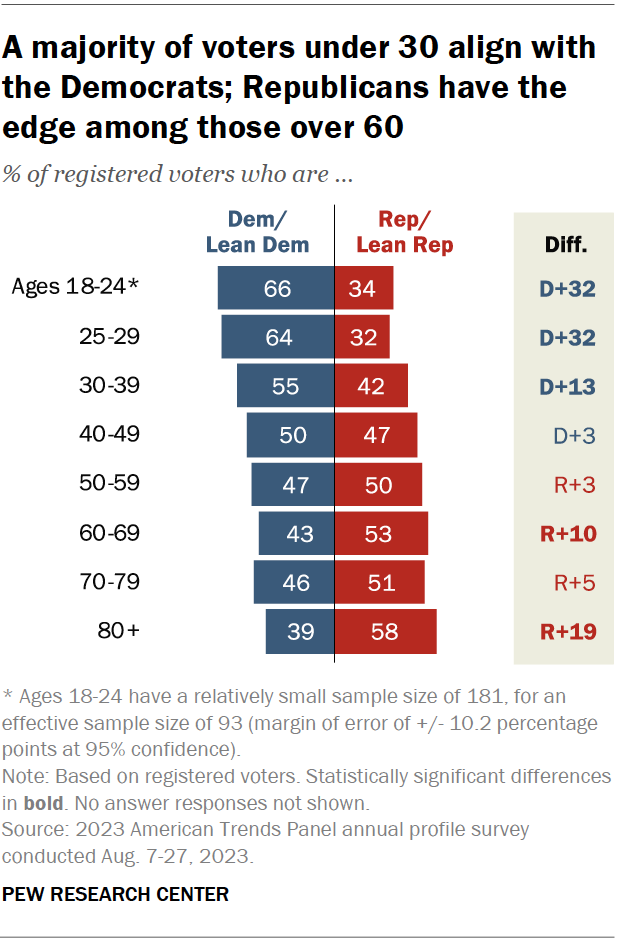
You’re being disingenuous. Congress is deadlocked and ineffective, so to say “Nothing stops Congress” ignores reality. “Congress stops Congress” for years, if not decades, until enough of the older cohorts age out and functional reps get elected [1] [2]. 25% of Congress doesn't even believe in climate change [3]. Ergo, pack the court and override the dysfunction. This works itself out through demographics eventually [4] [5] (~1.8M voters 55+ age out every year, ~5k/day, ~4M young voters age into voting each year). We do what we do best as a species: we kick the can into the future.

[1] https://www.axios.com/2023/12/19/118-congress-bills-least-un...

[2] https://www.pewresearch.org/short-reads/2022/03/10/the-polar...

[3] https://www.theguardian.com/us-news/article/2024/aug/05/clim...

[4] https://www.pewresearch.org/politics/wp-content/uploads/site...

[5] https://www.ft.com/content/c361e372-769e-45cd-a063-f5c0a7767... | https://archive.today/lQoLa

So, you think we should have the president make the laws, and the president should also control the courts so that they’re unable to stop him from making the laws?

Do you not see a potential problem with this approach?

Congress is not deadlocked. What you mean is, you support a policy which is not popular enough to pass Congress, and you feel strongly enough about the need for this policy that you think it should bypass the American democratic system and be enacted through extra-legal means if necessary.

Tell me, which party is threatening democracy again?

Congress is the one that creates these agencies, and Congress chooses to fund or not fund them on a routine basis, and new executives must be approved by Congress and firing is severely restricted. In a healthy democracy, should a legislative body have the prerogative to be general and create new agencies empowered to act on general & vague mandates? Not obvious.

Congress never loses the reigns here. This is the legislative will, as they are created and financially sustained by acts of legislature, and their leadership approval and dismissal process is determined by legislature. These agencies are "executive" in a very limited way. They are moreso extensions of Congressional power with very limited execute oversight.

Yes, Congress is deadlocked. There are many bills which have the support of a majority of the House but cannot pass because of the Hastert rule.
You're not wrong that Congress is now incapable of doing its important job, but I don't know if I agree that the answer is to just trust the executive branch. Keep in mind even if you like the current guy that it's about to be run by a guy you definitely don't like.

What I'm saying is it's complicated, and it seems we are paying the price for letting our government be utterly destroyed in its effectiveness.

> You're not wrong that Congress is now incapable of doing its important job, but I don't know if I agree that the answer is to just trust the executive branch. Keep in mind even if you like the current guy that it's about to be run by a guy you definitely don't like.

If the options are hope or action, and action might need to be fixed down the road, I ain't pickin' hope. This is a reasonable risk to accept based on the situation and options available, we are at an impasse.

> What I'm saying is it's complicated, and it seems we are paying the price for letting our government be utterly destroyed in its effectiveness.

Agreed, but the only path forward is to try to fix it, not bikeshed about how sad it is we got here. Talk to Newt about that.

https://www.theatlantic.com/magazine/archive/2018/11/newt-gi...

https://history.princeton.edu/about/publications/burning-dow...

https://www.thedailybeast.com/the-inside-story-of-how-newt-g...

>What I'm saying is it's complicated, and it seems we are paying the price for letting our government be utterly destroyed in its effectiveness.

I guess the Constitution really is a suicide pact after all.