Hacker News new | ask | show | jobs
by brookst 667 days ago
Totally disagree. Administrative law has not changed every four years, and it is literally impossible for Congress to legislate every detail of every policy.

The intent of overturning Chevron was to do away with regulations, and it's likely to work. Congress could spend a month working out the exact right policies and chemicals and requirements for PFAS, and there would still be some loophole / discovery that a chemical is slightly different than exactly what was legislated. And in the meantime, the

This is literally like saying the Alphabet board of directors should have to write every product requirement for every product in every company in Alphabet's portfolio. Delegation is the only way large organizations can work effectively, and outlawing it in government is expressly intended to make government impossible.

1 comments

That is not what the decision overturning Chevron says. The requirement is not that Congress now has to write regulation about specific chemicals or specific details of every area. It's that ambiguities in the authority granted by Congress to regulatory agencies are resolved by the courts - not by the agencies themselves.

Nothing stops Congress from writing a law which unambiguously grants an agency broad authority to regulate (for instance) chemicals and pollutants.

> that ambiguities in the authority granted by Congress to regulatory agencies are resolved by the courts - not by the agencies themselves.

that is exactly the problem; those decisions should be made by regulatory agencies, who are experts in science, not on courts, who are experts in the law.

It's a horrible ruling that makes these types of decisions even more political than they already were.

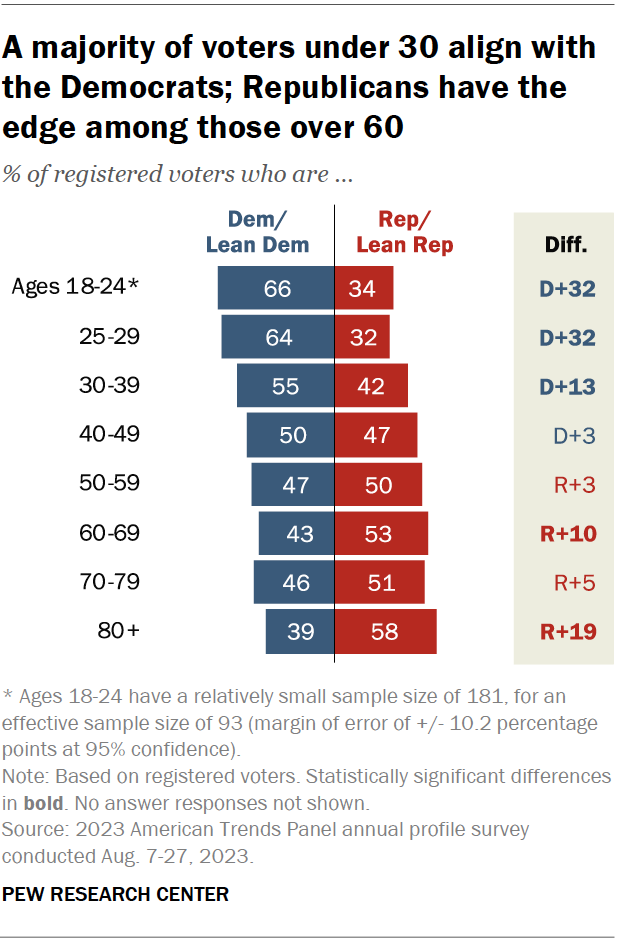
You’re being disingenuous. Congress is deadlocked and ineffective, so to say “Nothing stops Congress” ignores reality. “Congress stops Congress” for years, if not decades, until enough of the older cohorts age out and functional reps get elected [1] [2]. 25% of Congress doesn't even believe in climate change [3]. Ergo, pack the court and override the dysfunction. This works itself out through demographics eventually [4] [5] (~1.8M voters 55+ age out every year, ~5k/day, ~4M young voters age into voting each year). We do what we do best as a species: we kick the can into the future.

[1] https://www.axios.com/2023/12/19/118-congress-bills-least-un...

[2] https://www.pewresearch.org/short-reads/2022/03/10/the-polar...

[3] https://www.theguardian.com/us-news/article/2024/aug/05/clim...

[4] https://www.pewresearch.org/politics/wp-content/uploads/site...

[5] https://www.ft.com/content/c361e372-769e-45cd-a063-f5c0a7767... | https://archive.today/lQoLa

So, you think we should have the president make the laws, and the president should also control the courts so that they’re unable to stop him from making the laws?

Do you not see a potential problem with this approach?

Congress is not deadlocked. What you mean is, you support a policy which is not popular enough to pass Congress, and you feel strongly enough about the need for this policy that you think it should bypass the American democratic system and be enacted through extra-legal means if necessary.

Tell me, which party is threatening democracy again?

Congress is the one that creates these agencies, and Congress chooses to fund or not fund them on a routine basis, and new executives must be approved by Congress and firing is severely restricted. In a healthy democracy, should a legislative body have the prerogative to be general and create new agencies empowered to act on general & vague mandates? Not obvious.

Congress never loses the reigns here. This is the legislative will, as they are created and financially sustained by acts of legislature, and their leadership approval and dismissal process is determined by legislature. These agencies are "executive" in a very limited way. They are moreso extensions of Congressional power with very limited execute oversight.

Yes, Congress is deadlocked. There are many bills which have the support of a majority of the House but cannot pass because of the Hastert rule.
You're not wrong that Congress is now incapable of doing its important job, but I don't know if I agree that the answer is to just trust the executive branch. Keep in mind even if you like the current guy that it's about to be run by a guy you definitely don't like.

What I'm saying is it's complicated, and it seems we are paying the price for letting our government be utterly destroyed in its effectiveness.

> You're not wrong that Congress is now incapable of doing its important job, but I don't know if I agree that the answer is to just trust the executive branch. Keep in mind even if you like the current guy that it's about to be run by a guy you definitely don't like.

If the options are hope or action, and action might need to be fixed down the road, I ain't pickin' hope. This is a reasonable risk to accept based on the situation and options available, we are at an impasse.

> What I'm saying is it's complicated, and it seems we are paying the price for letting our government be utterly destroyed in its effectiveness.

Agreed, but the only path forward is to try to fix it, not bikeshed about how sad it is we got here. Talk to Newt about that.

https://www.theatlantic.com/magazine/archive/2018/11/newt-gi...

https://history.princeton.edu/about/publications/burning-dow...

https://www.thedailybeast.com/the-inside-story-of-how-newt-g...

>What I'm saying is it's complicated, and it seems we are paying the price for letting our government be utterly destroyed in its effectiveness.

I guess the Constitution really is a suicide pact after all.