Upper stage engines are notoriously difficult, because the operate in a very different environment than we're used to, under annoying mass constraints, and after exposure to the rigors of a rocket launch (high vibrations and acceleration).
Also, they must ignite without any help from the ground, without any felt gravity (which really helps with pumping fuel and oxidizer).
All that makes the previous run of successful missions all the more impressive.
I agree with the reasons you list. Would like to add one more which is somewhat specific to spacex. They are reusing the first stage, but can't reuse the second stage. Which provides complications in two ways:
Every second stage they fire is a brand new one. There are no "flight-proven" second stages. (of course the design is flight proven, but the actual piece of hardware itself is not.)
The other one is since the second stages are not recovered it is much harder to do an after-flight engineering analysis on them. With the first stage SpaceX have most of them back after the flight. That means they can check that all is looking as they expect it. If something with the design is "marginal" in a way they haven't designed them to be marginal they can adjust the design to improve it. With a second stage you can not do that.
Of course this is the default state of every other rocket ever flown. But in spacex's case I would expect the first stage just a tiny bit more reliable than the second stage because of this. (Just a tiny bit, since there is a lot of commonality between the stages)
Oh. Interesting! I haven't thought of that. It sounds super cool, although my gut reaction is that it would be a lot of work for not much bang.
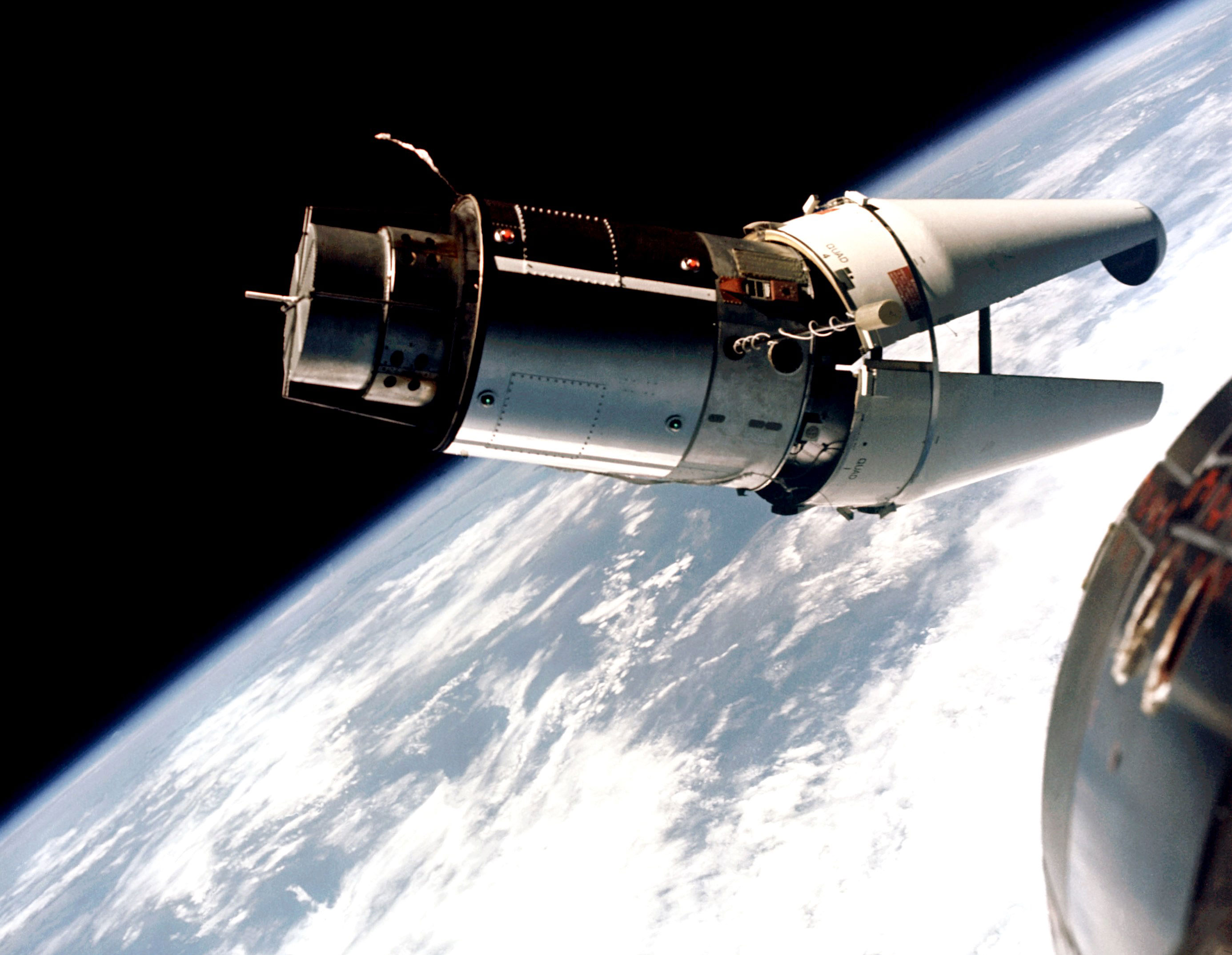
My childish imagination pictures the proposal as the Agena target vehicle from the Gemini IX test flight. There the fairing did not separate correctly leaving the docking target looking like a hungry space alligator:
https://www.nasa.gov/wp-content/uploads/2016/05/5-s66-37966-...
One could imagine the aligator gobling up a drifting second stage. :D It would absolutely not look like that in reality, but if life were a cartoon that is how it would happen. :)
I don't know. Surely it will be a sellable feature of Starship eventually to service and/or return aging sats from orbit. Grabbing an F9 second stage feels like the perfect way to demonstrate that capability. It's not like they're going to have a shortage of Starships returning from orbit in the future.
Low orbits clean themselves up relatively quickly though, and that’s where most of the newest satellites are going.
One of the Shuttle’s selling points was exactly this mission. Apparently it recovered a total of five satellites, three of which were research satellites launched specifically with the expectation of being recovered ahead of time. The other two were mis-launched into the wrong orbit because of a rocket failure. https://space.stackexchange.com/questions/15094/what-satelli...
> IIRC one of the initial animations had a landing second stage
Of Falcon 9?
Yes, they were aiming for that, and put significant engineering effort towards it before it was deemed too difficult, and instead to focus on Starship, which is a second stage design for re-use from the ground up.
(Same story for catching faring halves in a net on a ship.. they tried and tried, and ended up just making them a little tougher and letting them land in the ocean before fishing them out.
For Starlink and Starshield flights, upper stages are generally configured slightly differently than flights for external customers. These flights are used as an opportunity to explore "optimizations" that, if successful, could be used to lower costs and increase performance for future customer flights. If something doesn't work out, the impact to the Starlink and Starshield constellations is relatively modest and a lesson is learned.
Unfortunately second stage has been a business area where there has been considerable employee turnover and a cluster of mental health episodes and harassment and assault allegations. I hope the people there are and remain safe.
Worst part of it is that lower stage engines, in SpaceX's case, have been thoroughly studied after flight, because they return back in working condition, so any quirks in them have been found and fixed long ago. Upper stage engine is based on the lower stage one but all of the delta between them could only be validated through telemetry - there's never a returned article in a recognisable shape to study and fix bugs in - because upper stage is not reusable and mostly burns up upon reentry. It makes hidden, rare bugs very likely.
There's a lot of commonality. Especially as the first stage also needs to relight in a similar environment for the boostback burn. Engine commonality is a real strength of the Falcon 9 architecture, it keeps that delta as small as possible.
Also, they must ignite without any help from the ground, without any felt gravity (which really helps with pumping fuel and oxidizer).
All that makes the previous run of successful missions all the more impressive.