Hacker News new | ask | show | jobs
Ask HN: Is it just me, or does the job market for IT seem bad today?
83 points by alvperez82 737 days ago
I am a developer with nearly 20 years of experience trying to find a new job to try new things and naturally to get a higher salary, but even though I haven't been seriously involved in selection processes before, I used to feel that recruiters would respond right away, like you had to fend them off, and now they don't.

Do you get the same feeling?

31 comments

In the late 90s, early 00s I would submit 5 resumes, get interviews from 4, get offers from 3. The whole process would take a few hours - no studying, no projects, no indefinite rounds of interviews. I could actually talk to the hiring manager and get a sense for my odds of getting the job before putting the effort in.

Now it's like submit 1000 resumes, get interviews from 4, spend 20+ hours preparing and doing interviews, get ghosted at the end.

I have a friend who works for local government. They have an open GIS programmer position. I've done GIS programming for government (as a contractor), and it's not hard stuff. She says they received many 100s of resumes and are currently interviewing 30 people. They had so many people apply that they required each applicant to submit a very involved project beforehand just to weed people out. So, there are literally 30 people out there right now, putting in 20+ hours to complete a project just to get a job that pays probably $110k / year.

In contrast, a guy in my neighborhood is a head of some local police task force. He says they have open positions that pay 80-90k a year, and they can't fill them. There are people straight out of the police academy (a couple month process) that are demanding over 100k / year. But, that messes with their overall pay structure because there are officers with 10 years of experience that aren't getting paid that much.
The interview process in an average company started to change around mid 2010's, before that it was (mostly) just an hour interview with some FizzBuzz (even that was rare).
Might as well pick a name from a hat and hire someone out of those 30 people, and just tell no one that's how you picked them. At least then you wouldn't be wasting their precious time they could be looking at other jobs for.
Reminds me of the old joke about shuffling the stack of candidate resumes multiple times and then picking the top 3 (and throwing away the rest), because you wouldn’t want to hire unlucky people.
Hah that's great, I'm mostly joking, but like, at the same time, having spent months not finding anything, I'd rather hear that it's not happening sooner than be strung along. Don't make me do a project if I'm not getting any compensation for my efforts. Time is money, and some of us are not making any whatsoever when job hunting.
Oh, absolutely agreed.

I remember back in college thinking that take-home project assessments were great (as a candidate). Even after getting fleeced on those a few times (e.g., spent a week completing the assessment, everything seemed picture perfect, submitted it, waited a week, automatic rejection with zero feedback or explanation, wtf?).

These days, I would rather go through 5-6 rounds of leetcode+systems design interviews. Takes much less time, each one gets easier and faster, and zero extra overhead with each subsequent interview (while with take-home projects, each one will take around the same amount of time). And I am not even gonna dive into the whole cheating issue with take-home projects.

I simply got other things in life at this point that I would rather do, than to spend over 10 hours in a week on a single take-home project, while i can spend that exact same number of hours to complete ~2 full leetcode-centric interview loops at 2 different companies. And that’s not even mentioning that take-home project interviews also have leetcode and other rounds as follow-ups anyway. As well as the whole “the company doesn’t care about this being easily cheatable” attitude with take-home projects not really making me want to work there (acting as a weak proxy for the general quality of candidates they are hiring).

P.S. I think of leetcode as the best lowest common denominator. Yes, there are certain niche interview processes that are very one-of-a-kind that are great, but they are imo not easily transportable outside of the company conducting those. The one that came to my mind personally was Dropbox (the whole process from start to finish was fantastic, and they treated candidates like reasonable adults, no lowballing on offers or any other bs), with one specific round being “prepare to discuss any project you worked on before in depth, and a week ahead of it send a very short 1-2 paragraph description of what the project is to your interviewer.” It was one of the best interviews I ever had in my entire life (not talking about my performance on it, but rather in terms of how in-depth it went and how just great it felt to talk all that systems design and decision-making).

P.P.S. Another one I can think of is Netflix, but I didn’t interview there myself yet. A couple friends of mine did, and apparently there was almost no code involved at any point there (no leetcode, no take home projects, nothing). 3 years later, those firends are still at Netflix and seem to be loving it, so Netflix definitely did something right there.

Strangely I'm more comfortable with this kind of market.

I was fed up to see entitled wannabees be paid a lot of money to slow me down by forcing me to do some parody of scrum that they learn at one bootcamp, feeling they were in any way important as they drank they in-house latte during multiple remote meetings a day.

I much prefer a market where people I work with are actually paid according to their skill and ship code rather than power point or worse, an update to the code of conduct to include some inclusive edge case.

I would prefer a balance of all worlds, that would be fairer. But you can never quite reach it, because you pass it on the way up or down quickly as the pendulum swing.

So if I have to choose, I prefer a hard market.

I understand that people need to eat and that it's not everybody's preference, though.

Why do you think the current interview style leads to "paid according to their skill"?
IT/CS pays well which brings in a lot of competition to the market.
>In the late 90s, early 00s

Right, but in the late 90s and early 2000s, unless you were a manager climbing the ranks, you weren't making big bucks.

Even folks at Microsoft, which at the time was one of the most dominant software companies, were only millionaires if they joined pre-IPO. The company wasn't minting IC millionaires.

Now you have a whole host of FAANGMULA companies that do mint millionaires if you stay long enough and get your full vest, and don't get totally unlucky on the timing of RSU grants.

It is indeed, judging by the HN Who Is Hiring / Wants To Be Hired comment ratio [1].

[1]: https://github.com/bilbof/whoishiring-ratio

I commented on this when you initially posted it, but you really need a Y axis for this graph. Also if its a ratio, which way is it? A double bar or double line chart would probably be easier to interpret.
I don’t mean to be rude but honestly the graphic is entirely uninterpretable. No labels, no explanation. I can’t make sense of it.
This really needs more than just a time axis, it's impossible to know what it's trying to tell you. Does a higher bar mean more applications? More jobs? Less jobs? Can't understand it at all
It would help to explain what the axis is. Is higher more seekers or more jobs?
Higher is more jobs
So what units does it show? Are, say, those two little green blocks down on the lower right (May this year?) two jobs more than seekers? Two percent more jobs? Two times...?

Without that, it still says pretty much nothing.

That is an interesting graphic. Maybe one cannot use it to say things about the global economy, but definitely about the software economy (in the western hemisphere).
Thanks for doing this! I'm a bit confused by the readme:

"This script outputs how many job seekers there are vs how many jobs."

Isn't it actually showing the ratio of jobs / job seekers? It does seem so by the chart and the code but the text makes it sound the opposite. (Or is it my wrong reading?)

"vs" doesn't specify any numerator/denominator relationship, just that two things are being compared.
Just commenting to say that is awesome (both idea and execution).
Very cool!
It took me getting referred to by a former coworker. I was laid off in November (what an awful time to fire someone honestly) got hired last month. Anyway, always add coworkers on LinkedIn, and keep in touch with them now and then. I send former coworkers links to tools I think they'd love to learn about, and just talk to them in general. Then when I'm looking for new work, I reach out to them. You might be able to find a lot of them on LinkedIn still. Many are likely in new companies.
November of 2022 is when the Facebook and Amazon had their big layoffs, and Google, Microsoft, and Salesforce etc. followed in the two months after.

I haven't had a recruiter contact me on Linkedin for over a year, in 2022 and before I was being contacted by recruiters on Linkedin all the time.

Companies have different modes - mass layoffs, small layoffs, no hires, only hiring replacements, a few new slots open, many slots open. In early-mid 2022 we were in the last category and it's moved to one of the other modes for most companies, except for LLM hires.

There are different sources of information, I found this helpful ( https://interviewing.io/blog/when-is-hiring-coming-back-pred... ) from a company with some insights into tech hiring.

I have gotten requests on LinkedIn, but they're all automated about how awesome my experience is and how this job would match.

My profile is marked as remote only. The offers are all on-site.

So I have my doubts that it is a match.

This doesn’t seem shocking. We just had a year or two of rolling layoffs across major tech companies, interest rates are high, the market is fluctuating, and all of that is affecting hiring pipelines.
Most people are missing is that there was a tax code change as part of the Trump tax cuts that made engineers much more expensive in the short term. Companies, especially startups, were hit with a high tax bill. The layoffs are, I believe, a direct result of this tax change.
Yes! And so few people are talking about this one.
Would like to hear more about this. I thought there was an effort to adjust this...did that fail?
Wait... how can I learn more about how this affects engineers?
This is a good explanation.

https://blog.pragmaticengineer.com/section-174/

A recent bill has given relief for the domestic amortization but is still stuck in the senate.

https://gop-waysandmeans.house.gov/wp-content/uploads/2024/0...

look up "IRS Section 174 changes". here is a decent link, specific to startups[0].

but a simplified TL;dr is that companies used to be able to expense that year's R&D costs (including salaries for developers etc) in that same taxable year. now, that is no longer the case, and companies must amortize those R&D costs over 5 years.

this is not ideal.

[0] https://www.axios.com/2024/01/20/taxes-irs-startups-section1...

My suspicion is that the vast majority of companies out there (especially small companies) are just not complying with this change. It's such a stupid, company-ending change that it makes way more sense to just classify your engineer time such that you don't have to amortize their salaries, and risk the audit (which is pretty unlikely).
There's been a lot of redundancies. Games industry hit particularly badly. I'm not sure how much of it is "real" and how much is sentiment; personally, I think profitable companies having layoffs is always "sentiment".

The interest rate rises were intended to contract the economy and reduce wage inflation pressure by increasing unemployment, and they seem to have had that effect.

The AI bubble is also causing a lot of companies to believe in the idea of replacing their staff with AI.

"The AI bubble is also causing a lot of companies to believe in the idea of replacing their staff with AI."

Replacing generic slogan writers with AI might work, but replacing IT workers with AI at this point will be funny to watch (from a distance).

The expectation with AI is that fewer devs will create and maintain more. It's not that the tools aren't useful, but they're a lot more useful for employers to squeeze out more from employees.
The worst IT professionals, like bottom 10% (which seem to be in the top .01% for getting hired and holding a job, somehow), are about on par with AI in my experience. At least with Health care IT professionals, which might be a huge selection bias. I am just about as likely to see complete nonsense suggestions or a complete misunderstanding of the problem from either.
Oh, no doubt about that. But also like you said, people who hired them in the first place, apparently cannot judge them correctly, so won't judge correctly now, who to fire as incompetent.
Unemployment is very low (in N.A.).

What changed is remote work. My company got rid of US/UK based employees and only hires LATAM contractors by the hundreds.

What interests me is if this is a natural dip that will be followed by an upturn, or if something fundamentally has changed, and it will remain lower demand. Perhaps the AI boom will decrease the demand from now on. Waiting for better times may be futile?
> Perhaps the AI boom will decrease the demand from now on. Waiting for better times may be futile?

I'm not claiming to be very knowledgeable about AI/LLMs or the job market or "the economy" in general, but I'd be absolutely shocked to find that the AI stuff has any impact on the current IT job market.

I know that some people are using AI tools to help generate code and stuff, but it seems like those tools can't even generate correct code a lot of the time- and that's with a professional human programmer asking it to. I can't imagine that these tools are increasing productivity so much that it could actually reduce hiring.

I have been hanging out in a game dev forum where you've got people asking coding questions as if it's chatgpt, except to real live humans who are able to understand and explain exactly what the person needs to do to implement a feature. And they still can't handle it. No amount of handholding can substitute for knowing what you're doing.
How would it not have any impact? If it allows people to be 10% more productive, you need 10% less people to accomplish the same amount of work.
That's considering production stays constant, which shouldn't be the case since new companies are being created all the time.
That assumes people are being more productive on net. I suspect generative AI is still a net negative in terms of productivity overall. Lot’s of time spent playing with it and tracking down bugs more than offsetting what little benefit it’s providing people.

I’ve heard people on HN suggest it’s definitely helping them, but I’ve yet to see it in person. So ehh maybe they are just working on very different things.

Never works this way. Efficiency gains will result in the expectation of doing more.

Maybe that “more” will be in other areas of the business or economy and thus lead to less headcount, but given how profitable tech is.. I’d assume they’d be redeployed to build more product

Most companies "need" to grow, so if you did see 10% more productivity, you aren't going to lay off 10% of your workers--you're just going to enjoy hopefully 10% more profit (grossly simplified).

Not to mention that I'm so skeptical right now that I highly doubt these AI tools are helping IT workers be even 5% more productive.

Historically, every time a new web framework comes out that swears it'll make web devs so much more productive, it doesn't seem like that ever causes a noticeable change in the job market.

I suspect the answer is a bit of both. On the one hand, the era of zero interest rates is apparently over, so that'll effect things a bit. And the end of the pandemic means that the numbers we saw during that time period probably won't happen again, at least without a major world emergency breaking out.

But things will likely improve eventually. Probably due to a mix of laid off developers finally finding new jobs, a decent percentage of developers/engineers leaving the industry, and new companies being founded in future.

We're unlikely to see another 0% interest era, so that's effectively a fundamental change. The changes to Section 174 are fundamental, but likely to be repealed.

I think things will get better, the effects of the above will lessen with a rate cut and probably a repeal, but the golden era is past.

As Nassim Taleb said: "I've seen gluts not followed by shortages, but I've never seen a shortage not followed by a glut."
It's not a feeling, the IT job market is dead relative to how it was in the recent past and is unlikely to recover imo.

Were I to guess, 20 years ago you were in niche group of weirdos who enjoyed writing computer code in their free time which just so happened align with the 90s-00s internet revolution and 10s smart phone revolution.

For a couple of decades there just hasn't been enough nerds to build all apps and websites companies wanted built, and therefore competition for these jobs was extremely high. If you wanted to win the best IT talent you had to pay 6 figures and offer endless perks.

Today every government in the world is trying to push kids to code in an attempt to win a share of economic success that companies like Google and Apple have had. But with more people now going into software, more outsourcing and with cloud software like Shopify allowing those without a technical background to build and ship websites and products on their own, the demand for engineers relative to the number of engineers is now decreasing for the first time.

Going forward I'd bet on AI continuing to erode the relative demand for software engineers.

I'd also argue it's less that the IT market today is bad, but that it's adjusting to be more comparable to other skilled labour jobs which are more competitive and less favourably compensated than IT.

Clearly going forward the shortage is likely to be in jobs that have geographical restrictions and require hard skills. You can't outsource a roofer and use Gen AI to generate you a roof, and it's a profession that takes years to master therefore you can't just hire anyone to do it, and yet no one wants to do these manual labour jobs anymore. Were I in my teens today, this is where I'd be looking for career security. As it stands I'm not going to complain after lucking massively over the last ~15 years – there really was no better time to be a computer nerd.

https://fred.stlouisfed.org/series/IHLIDXUSTPSOFTDEVE

SE job listings have returned to the levels they were at before the huge ramp up in hype a few years ago. Unfortunately FRED data only goes out a few years here.

Question, are you looking for remote work or are you located in a tier 1 or 2 city? I am not having too many issues with interviews but I am in San Francisco. One of the first filter questions I get from recruiters is location.
As a native mobile developer I just noticed a new trend called fullstack mobile developer (web and mobile), it seems most companies prefers cross-platform frameworks nowadays. One company wants me to develop their mobile app on iOS and Android while also help manage their AWS backend.

I’m not looking for new mobile dev jobs soon but the market for native looks like shit.

Please send those my way!

I have worked on mobile app (iOS and Android) and done full-stack web and app development.

When I apply for places the recruiter literally cannot fathom this "Um. So...Are you frontend or backend?" Both. "...But which one" BOTH "Which do you prefer?" I prefer a company that can handle the concept of someone who can and HAS done it all.

What is this magical ios/android/web full stack called?
I think this makes no sense, as web development is not the same as mobile app development.

I always thought fullstack meant front end and backend, not front end across multiple platforms.

They mentioned cross-platform frameworks. Things like React Native mean the same codebase can compile to web, Android, and iOS.
It’s mostly called full stack [app] developer, app is optional. It is mostly prevalent in internet of things jobs.
Many projects coming out of contractors are using React Native on Google Firebase.
Looking for a job with 20 years of experience is not like looking for a job with 2 years experience.

You want to be paid like you have 20 years. The experience should make you worth that. That is, you should be more productive than someone with 2 years of experience.

But not every company understands that. And even, of the companies that do understand, not every one of them needs that. Some just need a junior that they can plug in.

And, of the ones that are looking for someone of your level, most of them understand that this is a hire that is somewhat more important to get right.

The net result is that this is a slower process than it was for you 20 years ago. You need to adjust your expectations. But jobs are still there - they just take longer to find.

I feel like it is pretty bad, although I do noticed that there is a lot off interest in people who can manage self-hosted software using kamal and hetzner for example.

guys from 37 signals are really pushing the post vercel era.

Where are you seeing these sort of roles? Are they labeled as "devops" or something else?
Platform engineers perhaps, that's what my company is hiring for at the moment to get off heroku
It's definitely rather bad at the moment. Probably a tiny bit better than last year/the beginning of this one, since I've had a lot more interview calls than I did then, but still really bad compared to previous years.

Now it seems like 80% of open positions are for senior developers/engineers, the list of required technologies for these roles is higher than ever, and you're competing with hundreds if not thousands of other candidates too. If you ever want to feel depressed about the market, one look at LinkedIn's candidate numbers for any role is probably gonna do it.

As for why this seems to be the case... the best I've heard is that the end of the pandemic shook multiple industries to their cores.

Interest rates were good (for these companies) during that time period, so they had money to throw around on hiring developers en masse. And with everyone locked inside, internet based businesses were booming, whether it was online tools like Zoom, media companies like Netflix or gaming companies as a whole.

Unfortunately for them, when the pandemic ended, all this went away. People went back to normal life, and in many cases, actually spent far more time offline than ever before. So the stats went down, the beancounters and CEOs panicked, and we've seen the effects ever since.

All those companies either shut down, laid off a bunch of staff or outsourced the work to some cheaper locale, and said staff flooded the market. So now it's an employer's market where they can be ultra choosy about who they hire, and where the requirements to get hired are higher than ever.

Yes, it is bad. The first reason is because of the many layoffs that started after Twitter laid off more than 50%. Many companies over hired during covid and CEOs felt it's OK to lay off 10-20%. So now the market has a lot of developers looking for jobs.

The second reason is AI. The biggest use case for LLMs is writing. They are really good at writing, including writing code. Developer are more productive as a result and companies can do more with less people.

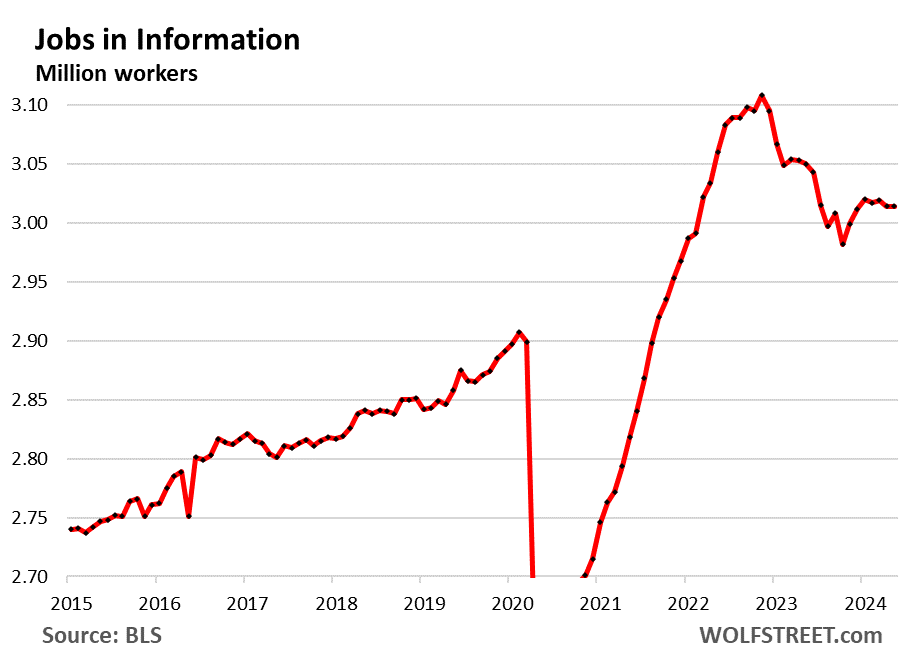
You can see from this graph that IT peaked at the end of 2022, and has stabilized at about 80k less positions since then. That means there are roughly 80k people around that could still be looking for IT jobs. Some of them probably have switched to other fields, but it still a lot of people sloshing around and jumping at job openings.

I don't think there's an end in sight for that issue, and it likely could get worse if the AI surge alleviates (or pops entirely!). It sucks, but I'd look in non-traditional IT places (government, universities, non-tech companies) as many of them are still growing quickly!

Graph: https://wolfstreet.com/wp-content/uploads/2024/06/US-employm...

That looks just like a regression to the trend line - connecting the two endpoints on the graph correlates on par with the growth from 2015-2020. The recent hiring boom was an overcompensation from the 2020 covid dip, and now we're back to business as usual.
I wonder how many of those positions were filled by people taking multiple jobs. While I don't think its common, I have heard enough stories. And 80k is roughly 2% of the total 3.1 million on that graph. I wouldn't be surprised if 1 out of 50 people were double dipping. Of the engineers I know, and the ones I know who were doing this, this seems about the correct magnitude.
I wouldn't say it is bad or getting bad.

But for a long time it had been really really good to a point that even people which fairly lacking qualifications could often easily get a job in a very short time frame (through also with some common biases/discrimination e.g. against age, and some positions, like very very well paying ones are still not easy to get).

And I would say that times are about to be over soon.

Honestly what has me worried the most is that nonsensical bias against age often found, as if having experience for 5,10 years is good but dear you have 20 years of experience in server development not its bad .... wtf. Especially given that I don't buy many of the argument people in favor of it often push. Sure the tech landscape is constantly changing but a lot of the base principle aren't really changing that much only the tooling and how you apply them, even with LLM supported programming that is still true. Similar arguments like older people being less willing to work overtime as IMHO misleading as every time I have seen companies (mostly with young people) do a lot of overtime the results where quite subpar in quality to a point that it created some huge issues often just one or two month down the line (or well days later, in some cases). And sure some people really get stuck up with certain approaches with age (but not all), but as far as I can tell that as less of a risk then blindly following the newest trends (e.g. framework) without a deep understanding of the things it implies mid to long term (which is what I have often seen with younger people).

I mean I'm not old yet, but if the industries doesn't fix its mess that will be a problem for me in 10-15 years. (Generally we also need to fix teaching and sustainability of a lot of software development. But that is a different topic, one which has gotten worse through LLMs as they allow keeping unsustainable approaches for a longer time).

Yeah don't let the HN bubble make you think that companies want the newest best tech. That's for startups only. The bigger the company, the slower they move. The company I work for retired tape backups a few years ago and Lotus Notes around the same time. The Lotus notes servers are still running. Our user names are based on an old IBM system etc. There will always be jobs in "old" tech and it usually pays pretty well.
100% this ^

For every cutting edge startup chasing young people to abuse, there are a dozen existing companies with tons of legacy technical debt. They don't pay FANG salaries, but they will pay.

In my experience lately, it seems like Engineering and Developer positions have taken a hit, but backend infrastructure and DevOps type positions are still very hot, especially if you have cloud automation experience and know your way around Linux.

Not in LCoL countries. I am a developer with 20+ years experience, I'm starting a new job in September and I only interviewed with this company, plus another one who emailed me halfway through the process. The trick is that I'm living in Warsaw, Poland.
What's a reasonable wage like for a developer with 20+ years in Warsaw? Somewhere in 5-10k USD monthly ballpark?
I'm currently slightly above that band pre-tax and counting the monthly stock vesting but I may be an outlier, so I'd say 5-10k USD sounds reasonable.
It's interesting that finally US techies begin to understand what the job market is like for the average person since the 2009 recession.

And I mean the desirable, well-paying jobs, not the $20/hr service/food jobs that anyone can get.

Actually I think the reverse is the case, now.

If you're a doctor, and you apply for a hospital job, do they at least reply to acknowledge your application? Do they then send a rejection letter if you're simply 'not what they're looking for'? If they then start to consider you as a candidate, do you have to 'trial cure' a couple of patients, take a cell-function exam, and endure 6 rounds of other interviews and screens before getting on the final shortlist?

Tech applications mostly just go into the void (sometimes there's an autoresponder to at least say your application has been received into their system, but often not even that), occasionally they'll give you a rejection letter if you're not suitable, but often they won't bother, and then at any time during the arduous rounds of tests and screenings you may be ghosted; just they can't even be bothered to tell you you're no longer in the funnel.

I really don't believe this hiring experience is something inherited or 'caught-up' from other industries.

> If you're a doctor, and you apply for a hospital job, do they at least reply to acknowledge your application? Do they then send a rejection letter if you're simply 'not what they're looking for'? If they then start to consider you as a candidate, do you have to 'trial cure' a couple of patients, take a cell-function exam, and endure 6 rounds of other interviews and screens before getting on the final shortlist?

I think this shows a better version of trade school is needed for software developers; computer science degrees don't seem to be enough to have confidence in someone's abilities. At least doctors have rigorous schooling and training, arguably even a bit too long and expensive.

Yes because non of us techies ever had other jobs before we got better jobs. This is such insulting post. Should I refer to you as a "non-techie".
Pointing out that a group of people generally lack perspective is insulting? Okay...

Yes, you can refer to me as a non-techie if you want. I don't find that offensive, but it would just be inaccurate. I am tech-adjacent.

I think conditions for older employees are getting worse. Teams are outsourced, either to younger people who work from home, or to other countries, making older remaining employees seem like an unnecessarily high cost.
I'm late 50's, 35+ years professionally programming, mostly business software and ecommerce. I entertain at least one serious offer a month and numerous inquiries a week, none of which I intend to take but instead use as leverage for raises at my current position which I now have been at over 15 years. I have leveraged a 50% salary increase in the last 5 years. I am not a hard bargainer, just matching my estimated value. I am not in a big city. I work in an office.

I have outsourced coworkers that I tutor. They are almost universally pathetic at software development and are a net negative overall. I get the most done during the times upper management can't overlook the lack of progress on current projects and leave the offshore people to their own devices for a spell, or have fired them as we go through cycles of hiring and firing. Management just can't stop touching themselves thinking about those sub-minimum wage salaries but somehow never grasp you get what you pay for.

Want a job in software development?

- Love it for the work not the money. If you're in it for the money you'll never be good.

- Don't chase fads. I know little of crypto, web 3.0 (what version are we on now anyway?), javascript frameworks, and use AI sparingly. But I know programming and software development well enough to ace the little pointless tests they give in job interviews.

- Don't play games with getting hired. Use people not technology to find a better job. That means being presentable and personable and networking. Indeed is not networking it's a marketplace and you're the product.

Everyone has reasons not to attempt these things, but believe me when I say I can do it so can you. I have pretty good social anxiety but we're all bozos on this bus and I just keep that in mind at all times.

You’re lucky that your employer negotiates. I worked at a place that came back with: “oh, you looked for another job, so you are not happy here. We pay you what we think you’re worth and if you don’t agree, it sounds like you aren’t happy here anyway. Here’s a severance package, now go fuck off.” (Paraphrased).

It was their legit policy to fire you if you tried negotiating your salary.

I have 6 weeks of vacation which I never take more than 2 at a time at my employer's request because when I'm gone it's less than optimal. They are acutely aware of this. For the last 6 or 7 years we've had good metrics on developer productivity and error rates which also helps make my case. If they fired me I'd just take the position I was offered anyway.
True words of wisdom, thanks
> either to younger people who work from home

What, older people aren't allowed to work from home?

I don't know about in general, but in my environment people in the 25-40 range are the most common to work from home, and the most common to majorly profit from it.

Like the benefits you can get with working from home if you e.g. have a partner and children are much much larger in practice then when you are a single student. Through also the challenges you have to overcome to make working from home viable. With the main challenge being proper working from home needing more space (in general) at home which with high apartment prices isn't always easy.

I'm in a remote first company and my entire team is over 40.
Im not in US but I work for a well known company based in SF. We had a position open for almost six months, with a simple take home test. The position was fully remote. The number of resumes was very low and no one passed the test even remotely close to be considered a potential hire.It wasn’t a dev role but rather something along the lines of devops/sysadmin, but anyway. Oh, and the test was a couple of leetcode style tasks, easy level (or maybe just a little above easy).

The position is now closed and we’re hiring internally instead.

Airbnb?
I keep seeing reporting claiming a big chunk of job postings are fake.
It seems to be very bad right now. Check out this data from Indeed:

https://data.indeed.com/#/postings

Select the "Sector" tab, and check the "IT Operations & Helpdesk" and "Software Development" options under the "Sector" dropdown.

I'd wage it's the post-mania return to median. This is how job markets tend to look outside of our comfy tech bubble.

Even assuming rates will start to drop H2 this year and cost of capital will be lower, some of the new-found productivity demand will be consumed by maturing AI tools.

tl;dr this looks like the new normal.

IT market is weird right now.

Skilled talent with a good network can find a job fast. I know multiple people who have gotten new jobs within weeks of getting laid off this year.

But I also know people who are absolutely struggling to get a job despite being quite good and putting out lots and lots of applications.

I've been looking for a few months and it's very difficult to get any bites.

I've only heard back from three companies but I've probably applied to over 100 (5+ yoe).

Oh boi let me tell you a fresh anecdata from right this Monday:

> I receive screening call in a bad moment.

> Me: "Right now it's a bit difficult for me. Can we do this at another time, like maybe in 30 minutes?"

> Them: "Sorry, I have another interview at that moment. We'll call you tomorrow."

Of course "tomorrow" is euphemism for "never", and I knew it, so I wasn't even disappointed when I didn't get the call next day.

So yeah my guess is that with so many applicants, interviewers are looking for the absolute tiniest reason to reject anyone.

Maybe it got even more worse in these last few months compared to the beginning of the year, or maybe it's specific to the company, or maybe both.

Because earlier this year I got a call early while I was still sleeping (went to sleep late the previous day) but they were chill and even laughed, saying "no worries, is it fine at [some hour]?".

I wonder why US voters don’t call for banning outsourcing. Their jobs are shipped overseas, for the benefit of investors and managers.

Also, some of the migration is to lower the business costs. That too could be addressed.

Yeah, same for me. H1B hires should not be approved under these conditions. That was allowed because there was a shortage of eligible citizens with these skills. There's now a glut and people with these skills are needing to take jobs they are overqualified for if they're lucky.
They will continue to approve H1B hires because the whole point of the program is to keep costs down for the businesses that fund campaigns.
Things have been generally bad except for a small group of AI/ML people. If you are in your mid forties and above and lose your job, tough luck.

SPY trajectory is misleading as it is dominated by a small set of companies.

https://www.zerohedge.com/markets/fed-chair-powell-admits-bi...

This 'article' is taking a lot leeway from the following 11 words, "there is an argument that they may be a bit overstated." This whole thing reads like it belongs on OAN.
ZH is like a less-respectable OAN
Doom porn for the economically unsophisticated.
Lol, stay in your echo chamber. They caught the discrepancy in job stats a year ago.
Funny getting advice like that from within the Putler-propaganda echo chamber.
Note the date: 15 Feb 2022 -- a week before Putler's invasion. Of course they'd been ramping it up in preparation, to the extent that even the AP reported on the agencies' findings.

It's a bit like RT: Before the invasion, lots of naïve Westerners used to buy that drivel too; now only the most deluded conspiracy kooks do. It's just that secondary site metastases like this ZH aren't as obviously descredited, so all the "keeping an open mind to the extent my brains have fallen out" conspiracy-flirters, semi-kooks, and other morons keep sucking the propaganda teat.

Fed chairmen don’t tell stories. They are terse. Thats a lot for a fed chairman to claim that government overstated stats.
Far more a general trend. We have a major transition right now.

https://tradingeconomics.com/country-list/interest-rate

Most businesses never operate from an operational budget but rather debt. When rates go high, the businesses have to cut the fat. Which generally means the job market tightens.

This is but 1 factor in why the governments should be obligated by constitution to balance the budget.

That feels like the wrong lesson. Surely during downturns you want to government to step up spending to stabilise the economy, and to get safe bonds out on the market to compensate for stock market downturn?
> Surely during downturns you want to government to step up spending to stabilise the economy

That model might work if they cut spending during good times.

As is, the modern government spending model is that they (almost) constantly increase whether things are going well or poorly. Then the next time there's a downtown, government spending as a portion of the (shrinking) economy is a higher % and therefore it takes more to "stabilize" it this time around.

Think of driving down the road. If it's a normal straight road in good weather, you minimally adjust the wheel back and forth and if something happens, you have many degrees of freedom and even momentum pointing you in the right direction.

Now think of a road at night in a storm with lots of curves. As you tighten your hands on the wheel and steer back and forth, things are quite a bit different. The direction you want to go now vs 10 seconds from now are a little different. And a disruption - however so small - may need a bigger reaction to avoid and a bigger after-reaction to recover. Momentum can easily work against you.

>hat feels like the wrong lesson. Surely during downturns you want to government to step up spending to stabilise the economy, and to get safe bonds out on the market to compensate for stock market downturn?

Nope. Keynes himself created this idea and then disproved it. There's 1 key factor of why this fails EVERYTIME.

Lets say the downturn was just the uranium mining industry. Government comes in, adds spending to stabilize. Then you ASSUME the government will stop once the issue is over. Nope. Never ever does. Politicians who created the subsidy move on to other issues and those temporary government measures become permanent.

This is a big gap for the difference between theory and practice.

On occasion you'll hear about the need to end corporate welfare. Nobody ever actually does it, but then when that industry bounces back, they are supercharged by free subsidies. Then the next politician is told, you can cut but it's going to cause people to lose jobs. Which is true.

Government should never be in this business to start with.