Hacker News new | ask | show | jobs
by frading 743 days ago
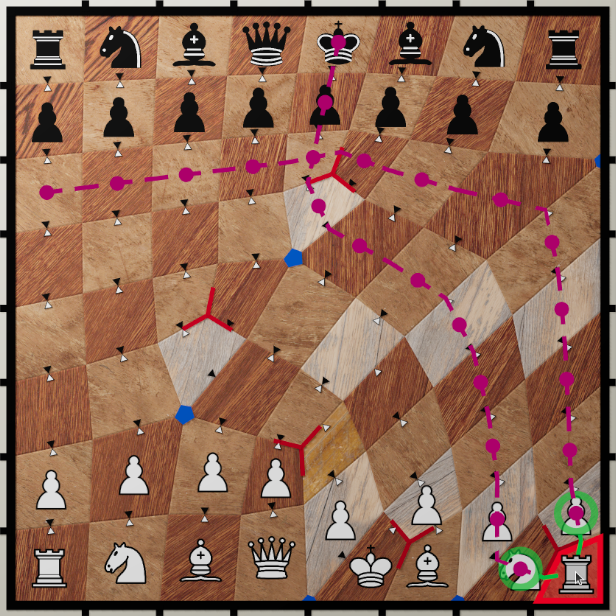
There are those little black and white arrows on each tile, which indicate which way is forward for a specific player. Does that help? Or maybe you saw them and you mean something else?

Interestingly, someone here mentioned that those arrows add a lot of clutter, and someone else on twitter said they only noticed them after I pointed them out. It's interesting how people perceive things like that so differently.

2 comments

It might be worth considering just changing the rules for the pawn to deal with this. It's hard to tell what it means to move "forward" on a board like this, even after understanding the indicators.

Maybe pawns could just move horizontally/vertically and attack diagonally, regardless of color?

That's an interesting suggestion.

The pro is that it will simplify things, remove visual and cognitive clutter.

The con is that we stray away from classic chess rules, which I'd still like to avoid as much as possible.

I will think about it. It may be possible to allow as an option.

Your constraint should be that if the board is the special case of regular chess, the game should play exactly the same. Allowing the pawn to move towards any side is too much because it would violate this principle.

Perhaps define forward as the direction(s) which, when extrapolated as a rook, would reach the opponent's backrank. If it doesn't exist, the direction(s) which, when extrapolated, terminate on the opponent's half. This would allow extra freedom to pawns in some funky topologies that can occur in your game, but generally follows the principle of least surprisal.

yes, GP reached the same conclusion as you. https://news.ycombinator.com/item?id=40550176

I'm still unsure, as I describe in my reply there, an issue I see is that you can't know the path a pawn would take, unless you know where it comes from.

But since both of you reached the same solution, I'll keep thinking about it.

I get the dillemma, but I don't think it's a problem that the string of squares used to define "foward" isn't always the same as path the pawn will actually take if it chugs along.

This only happens when there's no straight path to the opponent's backrank, so you are allowed to go "sideways-foward" until you hit a square from which there is a clean forward path again.

Agreed that the past should not matter, only the current position.

Thanks a lot for insisting of this, and that end up convincing me. I describe the change in the sibling comment: https://news.ycombinator.com/item?id=40634675

That was super useful. So don't hesitate if you have any other feedback.

The first image shows a rook traveling a path different from the one shown in the arrows though? Why would the definition of forward be different for a pawn vs rook?
I classic chess, the rooks can move in any direction. Forward, backward and sideways are allowed. The pawns are the only pieces that are limited to forward movements. So the arrows are only necessary for the those.

Or maybe I'm misunderstanding your question?

In this image we are seeing the two paths this took can take (“left” and “forward”). But forward is not the same as a pawn’s forward. The pawn would, about halfway down, “turn” away from the rook’s path

https://polyreplay.com/games/assets/chesstwist/description/s...

Personally I think the rook makes intuitive sense as shown. I would vote for the pawns following the same path even if it means they cannot reach the other side. Then remove the forward indicators and just make the pawns statefully indicate their direction.

I think I see. You mean those tiles, is that correct? https://imgur.com/a/YHSYjSe

The way I see it, is that for a rook, it is easy to know which path it can follow. You simply take it's current position and allow it to move to any neighbor tile sharing an edge, and then the opposite tile, and the opposite again, and so on.

For a pawn, it can also move to neighbor tile sharing an edge, but there are multiple ones, and only one is allowed. So how to you define which it is?

If we were to say, as I understand is what you suggest, that it will follow the same path as a rook, here is the problem that I see. If it was in one of those tiles you mention, we can't infer which path a rook would take from the pawn current position. We would instead need to know its starting position. And by just looking at the board in a given state, the pawn could come from 2 places ( see https://imgur.com/a/sExTqsP ). So that would require the player to always keep in mind which pawn comes from where. Which I think is really hard. Especially for games with no timer, as those could last days.

I'm much more in favor of a definition of forward which is comprehensible by just looking at the board, without having to think about the starting point. Which is why for now I've settled on using the direction of the tile edge. Even if there is a non-negligible cost of visual clutter.

Also, I'm quite keen on preserving the fact that all pawn can be promoted to a piece when reaching the opposite edge. As soon as you know that a pawn can't do that, they lose a lot of their threat potential.

But I don't want to close off this idea. It does make me think, and I'd be happy to be convinced otherwise. And it could very well end up as a variant inside this variant!

Well what I’m saying is you should make the pawns themselves have an appearance that denotes the direction they are facing (e.g. a bit pointy or just slap an arrow on them). That way you do not need to know their starting position in order to understand their current state. This way you can also remove the arrows indicating tile direction.

I think pawns changing from being relatively worthless because they’re not on a promotion track to very dangerous because capturing a piece has allowed them to shift into one is pretty fun actually. Diagonally capturing a piece would also occasionally cause the pawn to “turn” which would be a really Tricky change in its zone of attack

I kept thinking about it, did some tests, and you convinced me. So the pawns movements are now changed. It works like that now:

- pawns move forward in their "track", just like a rook would do, just one tile at a time.

- if the track reaches the end of the board, the pawn can promote as usual.

- if the track ends on the left or right side of the board, when the pawn reaches it, it changes track. If there are multiple tracks it can take from there, the one that reaches the end in the least amount of moves is selected

- when a pawn captures, it changes track following the same rule.

And I agree now that using capture to change the zone of attack of a pawn is a very nice addition.

On top of that, if multiple pawn are constraint to turn sideways at first, it's not simply a handicap. It also helps strengthen the defense in that area, as you can have more efficient pawn walls.

In all all, it's great, thanks a lot for arguing in favor of this change.

oh that is interesting, I haven't thought about changing the appearance of the piece to convey more info. That's definitely something worth exploring.

And I agree as well that pawns changing track when they capture can be a fun one. It could even make you reconsider a capture if the pawn is on a good track and would end up on one that turns to the side.

I'm not promising I'll change the current behavior, but that does make me think.