I see lots of progress and resources put towards monitor refresh rates but very little progress on making 5K displays cheaper. Any reason why ? Is this due to gaming ?
Mostly because 4K is the standard for video content and game consoles, and on desktops it is fine for Windows users, who make up the majority of the market. The only people really clamoring for >4K monitors are Mac users due to Apples decision to standardize on 220dpi in macOS. That is a potential market, but it's a price-insensitive one, so the current gouging for monitors in that category probably isn't going to stop any time soon.
I don't think so. I'd love to have 8k or more panel at 27-32 inch. The reason is that I can easily see pixels from a metre away and it is annoying. I'd love to have more detail etc. for instance being able to display nice texture underneath my text editor so it is more pleasing and easier to read.
The cables and ports for 5k120hz barely exist at this point (it needs displayport 2.1 uhbr13.5 or better, which only exist AMD's 7000 series GPUs at this point). Dual cable solutions always suck so everyone tends to avoid them.
32" is large enough that you can get away with 100% scaling and have much more actual workspace instead of increased clarity. It's not really until you get to the 15" or 17" laptops 4k starts being about high DPI and in that space the MacBook Pro screens actually overshoot the target a bit.
Because most people pick monitors by size, not resolution and PPI.
4K is also popular because it fit within the capabilities of common HDMI and DisplayPort ports on people’s computers and cables.
If you try to sell a monitor that doesn’t work well out of the box with the average laptop, it’s going to have an extremely high return rate. That’s why display resolution will always lag behind the common capabilities of your average HDMI port on a cheap laptop.
I had one, Dell's UP2414Q. It was a piece of shit, mostly due to requiring multi-stream transport to run in 60 hz mode. So you'd get a GPU driver or OS update and the screen would stop working. Sometimes the panel would split in half and one of them would black out or shift its content sideways so there was a seam in the middle and a piece of the edge wrapped around to the center. Would not recommend.
The ones afterward that got rid of the MST requirement might've been better. Pixel density was great.
The gaming market is huge. And gamers are typically willing to spend top money on hardware (thanks to nVidia raising the bar every time). That's why the market is flooded with expensive 1440p models featuring ridiculous refresh rates and RGB lightning.
This is the same reason why you can get a 65" 8K OLED TV from Samsung for "just" €2500, but you still pay €4000 for a Dell 32" 8k monitor. The market for 8k TVs is just so much bigger than 8k computer monitors.
> This is the same reason why you can get a 65" 8K OLED TV from Samsung for "just" €2500, but you still pay €4000 for a Dell 32" 8k monitor. The market for 8k TVs is just so much bigger than 8k computer monitors.
I was with you until this point. I’m fairly certain that this is due to shrinking pixels to cram 8K in 32” is much harder than doing it at 65”. That’s why it’s cheaper. Recently, many super high resolution TVs debuted at CES (or whatever has replaced CES) start at larger sizes and it’s an accomplishment when they start to come /down/ in size.
> This is the same reason why you can get a 65" 8K OLED TV from Samsung for "just" €2500, but you still pay €4000 for a Dell 32" 8k monitor. The market for 8k TVs is just so much bigger than 8k computer monitors.
Speaking of which... the market has this really obnoxious hole in it.
There are 32" 8k monitors and 65" 8k TVs (I think there are a few older 55" models), but there's nothing really in between.
I really hope someone either makes smaller 8k TVs or larger 8k monitors, because the situation is a little absurd. From what I can tell, 8k monitors are one of the few areas where people could be expected to notice the difference in resolution from 4k at normal viewing distances.
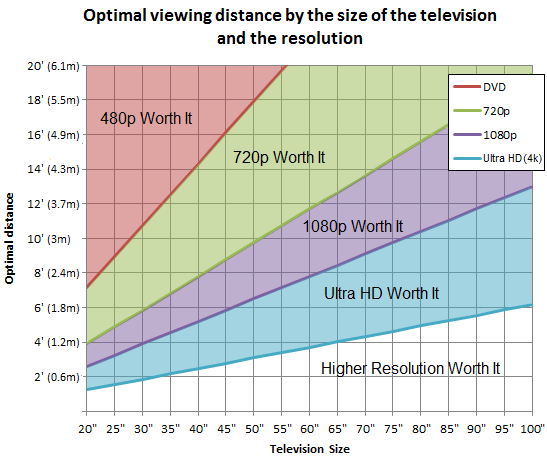
I was going off of this chart[1]. It's true that some people sit relatively close to their TV, but in most of the living rooms that I've been in, the TV has been more than 6 feet away.
This is purely subjective. I could definitely tell the difference from more than 6ft. The picture looks just more life like.
There are people for whom it makes no difference or they don't pay attention to details. Like I have a friend who wouldn't tell 720p from 4k, unless you tell them what to look for and still they wouldn't understand what's the fuss about.
I've also heard some handwavey explanation about how certain parts of the panel manufacturing process is essentially separated by DPI. That you can reuse certain aspects of a ≈ 100 DPI manufacturing line across varying refresh rates (and physical sizes).
Then those line can probably serve a large part of the gaming / normie market, while the ≈ 220 DPI (e.g 5K @ 27") have a very small market.
Yes. The two mass markets for good screens are business and gaming. Business pushes for color accuracy and good stands at reasonable prices, gaming for high refresh rates.
Of course gamers also like 4k, but given a limited budget for monitor and GPU a high refresh rate has the better payoff