Hacker News new | ask | show | jobs
by ramenmeal 812 days ago
disclaimer: I know nothing about this stuff.

> This area is separate from the subduction zone

150 miles off the coast doesn't sound that far from the subduction zone. Seems hard to believe there wouldn't be some tectonic relationship between the areas.

3 comments

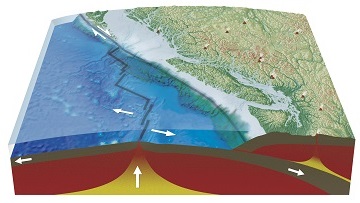
The phrasing is a little unfortunate, but this area sits on the Juan de Fuca Ridge, which is in one sense the "origin" of the Juan de Fuca plate. If you imagine the overall Pacific Plate and the North American plate, in the area off the coast of Vancouver/Oregon/Washington there's an other mini plate wedges between them called the Juan de Fuca Plate. In this area, it's the Juan de Fuca plate (not the Pacific plate) which is subducting under the North American plate.

The boundary between the Juan de Fuca plate and the Pacific plate is this Juan de Fuca Ridge. This ridge is a site of sea floor spreading - it's not subducting.

So there is a tectontic relationship between the two sites - sea floor spreading at the ridge is one of the factors that drives the subduction of the Juan de Fuca plate. But at the same time, any activity happening at the ridge is not "caused" by the subduction.

> But at the same time, any activity happening at the ridge is not "caused" by the subduction.

Is that true? One of the leading theories of the cause of plate motion is "slab pull", which comes from subduction zones.

Trying to get a sense of what's going on - and you seem knowledgeable. Is this thumbnail a reasonable approximation?

To my completely uninformed mind, it seems like you're saying, there's no huge plate to plate buildup of pressure, it's more like the ocean floor is spreading out, kinda like that picture?

https://www.earthquakescanada.nrcan.gc.ca/images/intro/wallA...

So that sounds like “the ocean floor is ripping apart” is a normal and expected phenomenon in that area.
The point is that subduction zones are convergent plate boundaries (two plates are coming together, and one dives under the other) while rifting zones like this are divergent plate boundaries (two plates are spreading apart). Distance doesn't matter, it's the direction of travel.
disclaimer: I'm not an expert, but I've been watching some geology lectures focused on the pacific northwest [1] for fun recently.

This is on the Jaun de Fuca Ridge, on the other edge of the Juan de Fuca plate [2] from the Cascadia subduction zone, so it's related in the sense that it's the same tectonic plate, and the plate is very small (as far as I understand, it's a remnant of a plate that has been subducting under North America for a very long time). It is not (in my very-non-expert opinion) necessarily related in a direct sense to what is happening in the subduction zone.

[1]: e.g: https://www.youtube.com/playlist?list=PLcKUIuDhdLl92gfymRabw... [2]: https://en.wikipedia.org/wiki/Juan_de_Fuca_Plate

Wow, that playlist is absolute gold. These kinds of instructional, high-quality, long-form lecture series are IMO maybe the best thing on the internet. The kind of thing when I encounter it makes me take a step back and really appreciate the fundamental beauty and utility of the internet.

A few other examples:

  - https://www.youtube.com/playlist?list=PL9GwT4_YRZdBf9nIUHs0zjrnUVl-KBNSM
  - https://www.youtube.com/watch?v=ncd6q9uIEdw&list=PLND1JCRq8Vuh3f0P5qjrSdb5eC1ZfZwWJ
  - https://www.youtube.com/watch?v=ycJEoqmQvwg&list=PLbN57C5Zdl6j_qJA-pARJnKsmROzPnO9V
  - https://www.youtube.com/watch?v=Ps8jOj7diA0&list=PL9D558D49CA734A02
 
Sometimes I wish there was a frontend for YouTube that only has these kind of long-form lecture series, but I've never found one. I think part of the reason why is that essential "quality" is somewhat ineffable.