|
|
|
|
|
|
by icegreentea2
820 days ago
|
|
|
The phrasing is a little unfortunate, but this area sits on the Juan de Fuca Ridge, which is in one sense the "origin" of the Juan de Fuca plate. If you imagine the overall Pacific Plate and the North American plate, in the area off the coast of Vancouver/Oregon/Washington there's an other mini plate wedges between them called the Juan de Fuca Plate. In this area, it's the Juan de Fuca plate (not the Pacific plate) which is subducting under the North American plate. The boundary between the Juan de Fuca plate and the Pacific plate is this Juan de Fuca Ridge. This ridge is a site of sea floor spreading - it's not subducting. So there is a tectontic relationship between the two sites - sea floor spreading at the ridge is one of the factors that drives the subduction of the Juan de Fuca plate. But at the same time, any activity happening at the ridge is not "caused" by the subduction. |
|
|
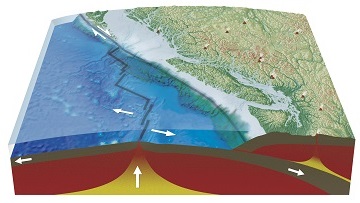
Is that true? One of the leading theories of the cause of plate motion is "slab pull", which comes from subduction zones.