Hacker News new | ask | show | jobs
by 1d22a 832 days ago
How is is that dark energy density does not change with time? Surely the total amount of dark energy has to be constant (energy can't be created or destroyed, and all that), and then as the universe expands, that's then the same amount of energy over a larger volume, right?
3 comments

Dark energy may be the energy of vacuum itself, that's why it's constant. And no, energy conservation does not apply in this case. There is a good blog article on precisely this question by Sean Carroll: https://www.preposterousuniverse.com/blog/2010/02/22/energy-...
> How is is that dark energy density does not change with time?

Because that's how a cosmological constant works.

There are alternate models where there is "dark energy" (as in, stress-energy that causes accelerated expansion) whose density does change with time (for example, a "Big Rip" model in which the dark energy density increases with time), but such models do not match our best current data.

/me not a cosmologist.

I think the story is that dark energy is indeed created, in the new emptiness resulting from the expansion of space.

<mumble> I believe it's supposed to be spacetime that expands, not 'space'. But it's beyond me to explain what that even means; as I understand it, spacetime refers to the whole Universe, across all of time. To 'expand' means 'to become larger over time'. But if the thing that's expanding includes time itself, then I'm bewildered.

It is in fact the metric expansion of space. The spatial part of the Robertson-Walker spacetime metric expands equally along the time axes of a family of freely-falling future-directed worldlines (we can call them "Eulerian observers", and individual clusters of galaxies are good approximations).

That is, in the past, galaxy clusters are relatively close together, and in the future they are relatively very far apart.

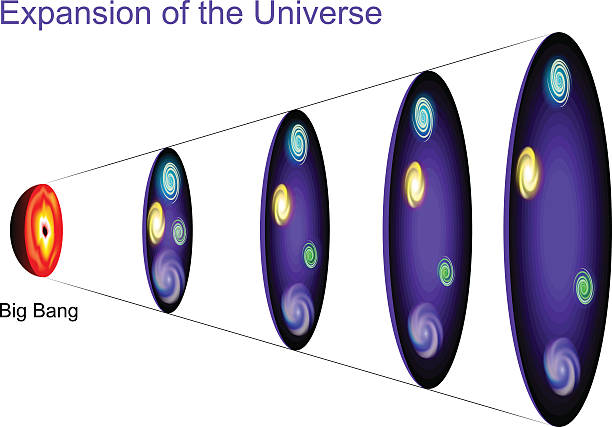
If you need an image, think of a vase of cut flowers, with the stems tightly bound together at the bottom of the vase, and the flowers loosely separated at the top. Time is in the direction away from the vase's bottom. A super thin slice through a stem represents a snapshot of a galaxy cluster at a particular time in its existence.

https://s3-eu-west-1.amazonaws.com/images.linnlive.com/de6e1...

<https://media.istockphoto.com/id/578833902/vector/expansion-...> : time increases from the left to the right.