Hacker News new | ask | show | jobs
by mbitsnbites 876 days ago
> Single-length instructions, for example. Even x86 instructions aren't much of a problem when you can afford to throw more pipeline stages at the problem

I think that the problem is bigger than that. Sure, the branch predictor usually keeps even the x86 pipeline busy, but x86 variable length instruction encoding becomes a problem for at least three problems:

1. Decoding width - There is a practical limit to how many instructions you can decode in parallell. You can add pipeline steps, but at some point it becomes absurd.

2. You get a very big range of minimum-to-maximum number of bytes that you need to fetch to extract a fixed number of instructions each clock. E.g. an eight-wide front-end would have to fetch 8-120 bytes per clock cycle. And it gets worse since your next eight instructions may not start on a nice power-of-two boundary, so you have to fetch much more, e.g. 256 bytes per cycle, in order to cover the worst case scenario (compared 32 bytes per cycle for a fixed width 32-bit RISC encoding). And you may gate cache line / page crossings in your "bundle".

3. Since you need to do fairly heavy translation work into an internal RISC-like encoding (which, by the way can not be as compact as compiler-generated RISC instructions - you typically need 64 bits per internal instruction or similar), you need to cache your translations into a uOP cache (or L0 cache). This cache uses much more silicon per effective instruction than a regular L1I cache, so it can not hold as many instructions (and I'm pretty sure that most of the instructions in the L0 cache are stored in the L1 cache too - so not really extra cache memory). All this silicon could be used for a larger L1I cache, for instance (or a better branch predictor).

So, yes, branch prediction really helps, but it does not solve all problems.

2 comments

> 1. Decoding width - There is a practical limit to how many instructions you can decode in parallell. You can add pipeline steps, but at some point it becomes absurd.

Branches. Branches also make really wide decodes useless. The cost/benefit is towards wider decoders for A64 than for AMD64. The average A64 instruction does slightly less work than the average AMD64 instruction so the net result is that it makes sense to have slightly wider decoders (in terms of "work") for A64 than for AMD64.

X86 CPUs don't quite use a "RISC-like encoding". The µops support RMW for memory, for example. The encoding is of course very much regularized, but I don't think the RISC people have a patent on that.

Translation to an internal format is common for high-performance RISC CPUs as well. The Power CPUs call it "cracking" when complicated instructions are split into simpler µops.

> The average A64 instruction does slightly less work than the average AMD64 instruction so the net result is that it makes sense to have slightly wider decoders

I'm not sure that the difference is that big. A64 actually has quite powerful instructions, and some of them do more work than similar x86 instructions (madd and ubfx come to mind). In my testing A64 code often has fewer instructions than x86: https://www.bitsnbites.eu/cisc-vs-risc-code-density/

> X86 CPUs don't quite use a "RISC-like encoding". The µops support RMW for memory, for example.

I would love to learn more about that. Do you have any references? I was under the impression that internal instructions followed the load/store principle since I assume that the internal pipeline is a load/store pipeline?

> The Power CPUs call it "cracking" when complicated instructions are split into simpler µops.

Yes, it's the IBM term AFAIK. They call it cracking in zArch too. I also suapect that at least some ARMv8/9 implementations do cracking too (many AArch64 instructions have multiple results, which might be better handled as multiple internal instructions - I think it's partly a code density thing).

> I was under the impression that internal instructions followed the load/store principle since I assume that the internal pipeline is a load/store pipeline?

Well... peterfirefly is making a very generalised statement that isn't really true.

As far as I'm aware, no out-of-order Intel processor can do a full read-modify-write in a single uOP. And if you go all the way back to the original P6 pipeline (Pentium Pro, Pentium II, Pentium III), it does appear to be a proper load-store arch. RMW instructions generate at least 4 uOPs

But the Pentium M and later can do a read + modify to register in a single fused uOP, and a RMW in just two fused uOPs. Fused uops kind of muddle the issue: they might issue to two or more execution units, but for the purposes of scheduling, they only take up a single slot.

So it's far from a proper load/store pipeline. And when you think about it, that makes sense, x86 isn't a load/store ISA so it would be wasteful to not have special accommodations for it.

-----

And then there is AMD. Zen and later are more or less identical to Intel's modern fused uOP scheme.

But their older cores had much more capable internal encoding which AMD called "macro-ops". And those macro-ops could do a full read-modify-write operation with a single op. Unlike Intel and the later Zen core, each integer execution unit needed to have both ALUs and AGUs, along with read/write ports to the data cache.

> I would love to learn more about that. Do you have any references?

Agner Fog is the best resource for this type of thing.

https://www.agner.org/optimize/

A combination of microarchitecture.pdf for details about the various pipelines and instruction_tables.pdf for what uops the various instructions breakdown into on the various pipelines.

Thanks, I have read the Agner documents before. I will dig around some more and get updated.

Anyway, I found this, regarding RMW (for Ice/Tiger Lake):

> Most instructions with a memory operand are split into multiple μops at the allocation stage. Read-modify instructions, such as add eax,[rbx], are split into two μops, one for address calculation and memory read, and one for the addition. Read-modify-write instructions, such as add [rbx],eax, are split into four μops.

I read it as a instructions that use memory operands (other than simple mov instructions) are usually split into at least two uOPs, which makes perfect sense for a load/store pipeline.

> So it's far from a proper load/store pipeline. And when you think about it, that makes sense, x86 isn't a load/store ISA so it would be wasteful to not have special accommodations for it.

The way I see it, modern x86 microarchitectures are load/store. My definition of load/store is that all instructions/operations that flow through the execution part of the pipeline can either load/store data OR perform operations on registers, not both (except possibly edge cases like calculating an address or writing back an updated address to a register).

That is by far the most efficient way to implement a CPU pipeline: You don't want to read data in one pipeline stage, use the data in an ALU in a later stage, and possibly write data in an even later stage. That would drastically increase instruction latency and/or require duplication of resources.

This is, AFAIK, one of the main advantages and probably the raison d'être for uOPs is the first place: translate x86 instructions into uOPs (multiple ones for instructions that access memory) so that the pipeline can be implemented as a traditional load/store pipeline.

In a way the x86 front end is similar to software binary translation (a'la Transmeta, NVIDIA Denver or Apple Rosetta 2). It's fairly complex, and the prime objective is to take code for a legacy ISA and transform it into something that can run in a pipeline that the ISA was originally not intended to run in. By doing the translation in hardware you avoid the latencies inherent to software translation (JIT or AOT), but the costs are unavoidable (particularly silicon area and power consumption).

It's only a load/store architecture if you consider the "unfused-uop" to be the native internal ISA of the underlying pipeline.

But that seems to be an incorrect perspective. The pipeline's native internal ISA appears to very much be the "fused-uop". It's the only metric which matters for most of the pipeline, decode limits are specified in fused-uops, the uop cache stores fused uops, the ROB only uses a single entry for fused-uop. The only part of the pipeline were that deals with unfused-uops is the scheduler and the execution units themselves. Even the retire stage works on fused-uops.

It's probably better to think of the pipeline's native ISA as an instruction that can sometimes be scheduled to two execution units. It's almost a very basic VLIW arch, if you ignore the dynamic scheduling.

Sure, the execution units are load/store. And the scheduling is load/store. But I don't think that's enough to label the entire pipeline as load/store since absolutely every other part of the pipeline uses fused-uops and is therefore not load/store.

> This is, AFAIK, one of the main advantages and probably the raison d'être for uOPs is the first place: translate x86 instructions into uOPs so that the pipeline can be implemented as a traditional load/store pipeline.

I'm really not a fan of the "translate" terminology being used to describe modern x86 pipelines. It's not quite wrong, but it does seem to mislead people (especially RISC fans) into overstating the nature of the transformation.

It's nothing like software binary translation (especially something like Rosetta 2), the transforms are far simpler. It's not like Intel took an off-the-shelf RISC architecture and limited their efforts to just designing a translation frontend for it (the few examples of direct hardware translation, like NVIDIA Denver and Itanium have pretty horrible performance in that mode).

No, they designed and evolved the pipeline and its internal ISA to directly match the x86 ISA they needed to run.

All the front end is really doing is regularising the encoding to something sane and splitting up some of the more complex legacy instructions. Instructions with memory operands are converted to a single fused-uop. The front-end only splits the read-modify-write instructions into two fused-uops. The transform into proper load/store form doesn't happen until much further down the pipeline as the fused-uop gets inserted into the scheduler.

I have quite a bit of experience writing software binary translation software, and I ensure you such translations are significantly more complex than the transforms you find inside an x86 pipeline.

> Thanks, I have read the Agner documents before. I will dig around some more and get updated.

I swear every single time I read them (or usually just parts of them) I learn more about x86 microarches (and CPU design in general). It's not something that can be absorbed in a single pass.

Good points. I guess it's a debate of nomenclature, which lacks real importance (although it helps to reduce confusion).

My point of view is mostly that, no, the x86 architecture certainly is not load-store, but internally modern x86 machines have execution pipelines that are built like regular load-store pipelines (i.e. the topology and flow is mostly the same as a RISC-style load-store pipeline).

Or to put it another way, x86 execution pipelines are much closer to being register-register than being register-memory.

> No, they designed and evolved the pipeline and its internal ISA to directly match the x86 ISA they needed to run.

Yes. That is very true. Although the front end is the part of the pipeline that is most x86-specific, there are many parts of the rest of the pipeline that is tailored to be optimal for x86 code. It was obviously not designed in a vacuum.

An interesting observation is that even other ISA:s and microarchitectures have been influenced by x86 (e.g. by including similar flags registers in the architectural state), in order to not suck at emulation of x86 code.

I think it's a bit strong to say that branch prediction "solves" the problem of x86's complex variable length encoding. But it certainly goes a long way to mitigating the handicap, and allowing x86 uarches to be very competitive with more RISC designs.

I suspect that original handicap is a large part of the reason why x86 managed to become a dominant ISA, beating out all of its RISC derived competitors in the high-performance space. The requirement to continue supporting the legacy complex instruction encoding forced x86 uarch designers to go down the path of longer (but not too long) pipelines, powerful branch predictors and extremely large out-of-order windows.

It wasn't the obvious approach back in the 90s/2000s, high-performance RISC designs of that era tended to stick with in-order superscalar pipelines. And when they did explore out-of-order designs, they were much more restrained with way smaller reorder-buffers.

But in hindsight, it seems to have been the correct approach for high-performance micro arches. I can't help but notice that modern high-performance aarch64 cores from Apple and Arm have pipelines that look almost identical to the designs from AMD and Intel. Main difference is that they can get away with 8-wide instruction decoders instead of a uOP caches.

> which, by the way can not be as compact as compiler-generated RISC instructions - you typically need 64 bits per internal instruction or similar

Nah. According to Agner Fog's testing, Intel only allocates 32bits per uop.

Immediates/Addresses larger than signed 16bits are handled with various complex mechanisms. If a 32bit/64bit value is still inside the -2¹⁵ to +2¹⁵ range, it can be squashed down. Space can be borrowed from other uOPs in the same cacheline that don't need to store an immediate. Otherwise, the uOP takes up multiple slots in the uOP cache.

I suspect AMD also use a similar mechanism, because as you point out, caching un-encoded uOPs would be a huge waste of space. And there is no reason why you need to use the exact same encoding in both the pipeline and the uOP cache, it just needs to be significantly easier to decode than a full x86 instruction.

I'll have to read up on Agner's findings.

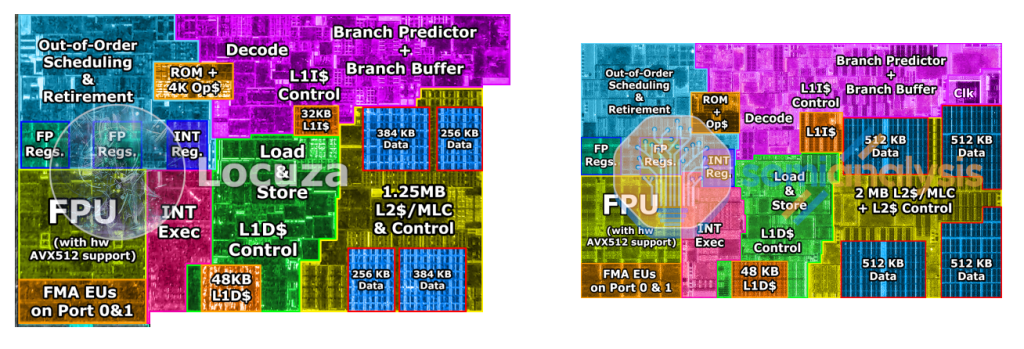
My assumptions are largely based on annotated die shots, like this one of Rocket Lake (IIRC): https://substackcdn.com/image/fetch/f_auto,q_auto:good,fl_pr...

If they are correct, the uOP cache consumes at least as much silicon as the L1I cache, while they generally can hold fewer instructions.

Some napkin math: x86 instructions are 4 bytes long on average, so a 32KiB L1I can hold 32/4=8K instructions, while the uOP cache can hold 4K uOP instructions (how many uOPs does an x86 instruction translate to on average?). That would indicate that uOP:s require twice the silicon area to store compared to "raw" x86 instructions - or that the uOP cache is more advanced/complex than the L1I cache (which may very well be the case).

Also visible from the die shots: decoding and branch prediction are far from free.

According to the label, that block contains both the uop cache AND the microcode ROM (which is actually at least partially RAM to allow for microcode updates). I guess it makes sense to group the two functions together, they are both alternative sources of uOPs that aren't from the instruction decoder.

So really depends on what the balance is. If it was two or three of those memory cell blocks, I agree it's quite big. But if it's just one, it's actually quite small.

Agner's findings are for the Sandybridge implementation. He says Haswell and Skylake share the same limitations, but doesn't look like he has done much research into the later implementations.

The findings actually point to the uOP cache being much simpler in structure. The instruction cache has to support arbitrary instruction alignment and fetches that cross boundaries. The uOP cache has strict alignment requirements, it delivers one cache line per cycle and always delivers the entire line. If there aren't enough uops, then the rest of the cacheline is unused.

> Also visible from the die shots: decoding and branch prediction are far from free.

Yeah, it appears to be massive. And I get the impression that block is more branch prediction than decoding.

Nothing is free in CPU design, it's just a massive balancing act.

> According to the label, that block contains both the uop cache AND the microcode ROM

Yes, so it's hard to tell the exact size. We can only conclude that the uOP cache and the microcode ROM combined are about twice the size of the L1I cache (in terms of memory cells).

Another core die shot of the Zen 2 micro architecture is this (it appears to be correct as it is based on official AMD slides): https://forums.anandtech.com/proxy.php?image=https%3A%2F%2Fa...

Here uCode is in a separate area, and if we assume that the SRAM blocks in the area marked "Decode" represent the uOP cache, then we have:

* The uOP cache has the same physical size as the L1I cache

* uOP cache size = 4K uOPs

* L1I cache size = 32 KiB ~= 8K x86 instructions

If all this holds true (it's a big "if"), the number of uOP instructions that the uOP cache can hold is only half of the number of x86 instructions that the L1I cache can hold, and the size of uOP entries are in fact close to 32KiB / 4K uOPs = 64 bits each (given how similar the SRAM cells for the two caches are on the die shot I assume that they have the same density).

Furthermore I assume that one x86 instruction translates to more than one uOP instruction on average (e.g. instructions involving memory operands are cracked, and instructions with large immediates occupy more than one uOP slot - even the ARMv8 Vulcan microarchitecture sees a ~15% increase in instructions when cracking ARM instructions into uOPs: https://en.wikichip.org/wiki/cavium/microarchitectures/vulca... ), which would mean that the silicon area efficiency of the uOP cache compared to a regular L1I cache is even less than 50%.

Edit:

> Nothing is free in CPU design, it's just a massive balancing act.

Yup, and a large part of the x86 balancing act is to keep the x86 ISA alive and profit from the massive x86 ecosystem. Therefore Intel and AMD are prepared to sacrifice certain aspects, like power efficiency (and presumably performance too), and blow lots of energy on the x86 translation front end. That is a balancing act that designers of CPU:s with more modern ISA:s don't even have to consider.

Yeah, that logic seems to all work out.

I found annotated die shots of Zen 3 and Zen 4 that pretty much confirm the op cache: https://locuza.substack.com/p/zen-evolution-a-small-overview

Pretty strong evidence that AMD are using a much simpler encoding scheme with roughly 64bits per uop. Also, That uop cache on Zen 4 is starting to look ridiculously large.

But that does give us a good idea how big the microcode rom is. If we go back to the previous intel die shot with its combined microcode rom + uop cache, it appears intel's uop cache is actually quite small thanks to their better encoding.

> Furthermore I assume that one x86 instruction translates to more than one uOP instruction on average (e.g. instructions involving memory operands are cracked

I suspect it's not massively higher one uop per instruction. Remember, the uop cache is in the fused-uop domain (so before memory cracking) and instruction fusion can actually squash some instructions pairs into a single uop.

The bigger hinderance will be any rules that prevent every uop slot from being filled. Intel appears to have many such rules (at least for Sandybridge/Haswell/Skylake)

> and blow lots of energy on the x86 translation front end

TBH, we have no idea how big the x86 tax is. We can't just assume the difference in performance per watt between the average x86 design and average high performance aarch64 design is entirely caused by the x86 tax.

Intel and AMD simply aren't incentivised to optimise their designs for low power consumption as their cores simply aren't used in mobile phones where ultra low power consumption is absolutely critical.

> I found annotated die shots of Zen 3 and Zen 4

Ooo thanks! Sure looks like strong evidence.

> TBH, we have no idea how big the x86 tax is.

No, and it gets even more uncertain when you consider different design targets. E.g. a 1000W Threadripper targets a completely different segment than a 10W ARM Cortex.Would an ARM chip designed to run at 1000W beat the Threadripper? Who knows?

> Intel and AMD simply aren't incentivised to optimise their designs for low power consumption as their cores simply aren't used in mobile phones where ultra low power consumption is absolutely critical.

They'll keep doing their thing until they can't compete. They lost mobile and embedded, and competitors are eating into laptops and servers where x86 continues to have a stronghold. But perf/watt matters in all segments these days, and binary compatibility is dropping in importance (e.g. compared to 20-40 years ago), much thanks to open source.

IMO the writing is on the wall, but it will take time (especially for the very slow server market).

BTW... Except for the indications from the die shots, one of the reasons that I don't think that uOPs can be as small as 32 bits is that studying fixed width ISAs and designing MRISC32 have made me appreciate the clever encoding tricks that go into fitting all instructions into 32 bits.

Many of the encoding tricks require compiler heuristics, and you don't want to do that in hardware. E.g. consider the AArch64 encoding of immediate values for bitwise operations.

Also, even if you manage to do efficient instruction encoding in hardware, you will probably end up in a situation where you need to add an advanced decoder after the uOP cache, which does not make much sense.

The main thing that x86 has going for it in this regard is that most instructions use destructive operands, which probably saves a bunch of bits in the uOP encoding space. But still, it would make much more sense to use more than 32 bits per uOP.