> Nunavut is the only province or territory in the country [Canada] without access to fibre internet. The project would bring fibre to both Iqaluit and nearby Kimmirut.
Right now, everything is over satellite. Too bad the big "internet cache" systems don't have sneakernet approaches to filling their caches. Unsure if their local ISP does any kind of caching. So every stream/download/update, etc. is its own "hit" over the downlink.
Thanks to Canada's terrible mobile telecom pricing and lacklustre competition, a cell phone with a dataplan in this territory is cost-competitive with the rest of the country...
The whole territory of Nunavut is under 40k habitants. It's totally fine to serve it with satellite. Also I don't see how any completion is possible, again, for a territory with under 40k habitants.
Some years ago I visited the Transatlantic Cable Station on Valencia Island off the west coast of Ireland, from where the first submarine telegraph cable was laid to Newfoundland in 1857. After several attempts the cable reached Newfoundland in 1866.
Before that moment the fastest way to get a message from Europe to America was aboard a ship; two weeks or so. After that it could be sent over a cable with Morse code.
If this sort of thing interests you, I highly recommend "Mother Earth Mother Board" by Neal Stephenson. Probably my favourite piece of writing in Wired.
Came here to say the same. And clicking on the globe does not stop it. Then trying to zoom and you can't but the globe image is too blurry/low res to read what's on it. Don't get me even started on scrolling...
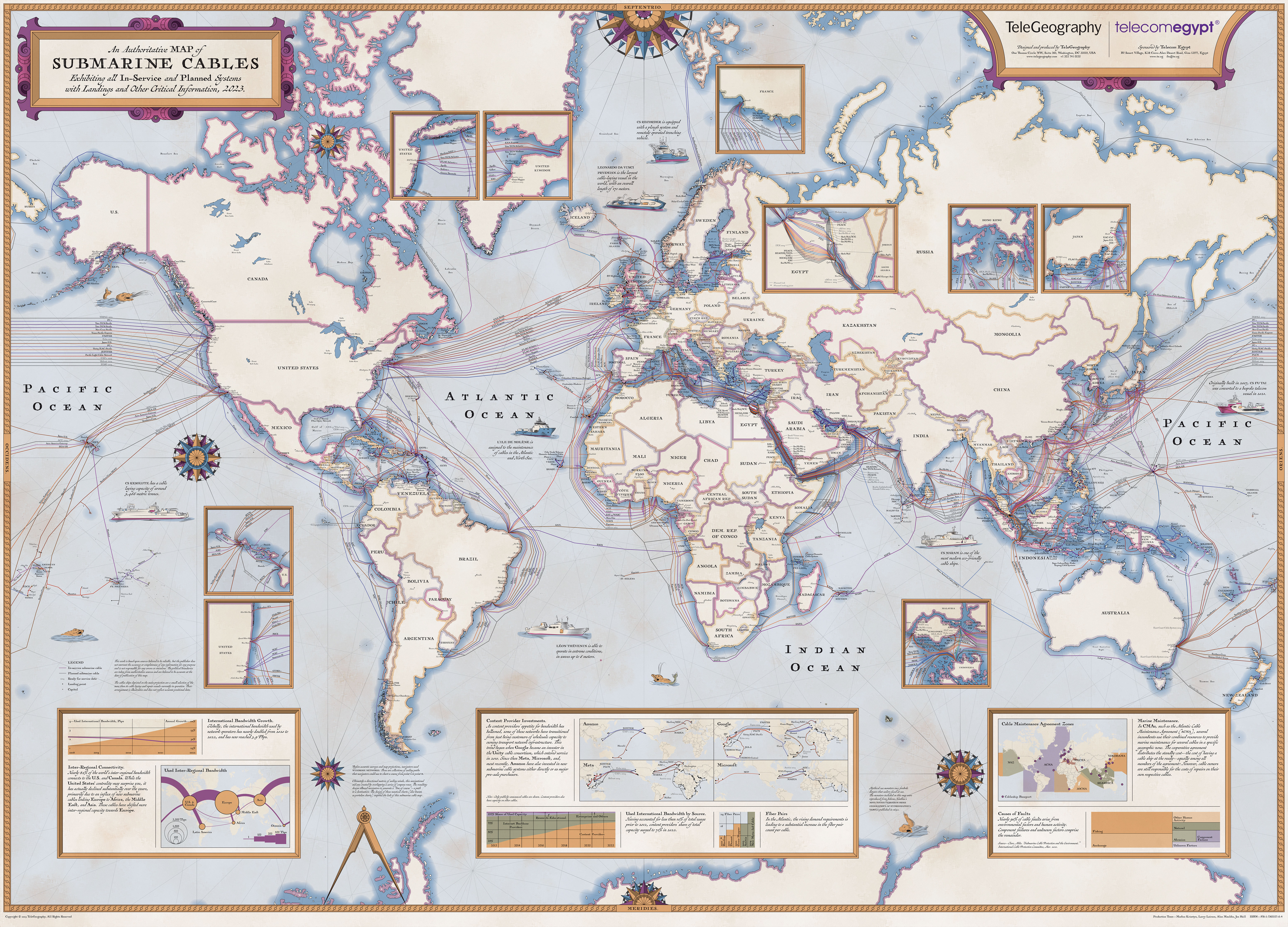
I love these maps, and I'm glad they provide downloads like [1]. I wish the resolution was a bit higher. As it is the names of the towns on the coasts can be read with difficulty.
1. Neither is Israel, despite how your news source is trying to manipulate you.
2. Those nations that do occupy lands illegally and commit war crimes are in fact listed, so that disproves any connection to your supposed reason and the real reason for eliminating the name of the state of Israel.
That would have been an acceptable explanation in the 1950s or early 60s. But after 1964 one of the sides adopted the regional name as a national identifier, thus invalidating it as a neutral name.
Too bad it's a rather shitty JPEG that's blotchy in the more uniform "white" areas. I've been able to compile a map from the png tiles for the earlier versions of this map.
Given all the compute infrastructure in Ireland, I'm surprised it still has no direct connection to continental Europe (they all go through the UK first).
But yeah, Ireland is at risk of the UK cutting most of their continental Europe capacity.
I've seen some strange investments though that don't seem to add much more on top of what's already there, like this company's: https://crosslakefibre.ca/network/ But maybe despite ample existing infrastructure, the incumbent providers suck so they can make a successful go at providing a bypass.
There are repeaters on the cable every ~50-200km (depending on technology), powered by DC power carried on the cable. There are branching units powered the same way -- I believe they handle branching at the fiber level, rather than waves, but not sure of the specifics on modern DWDM cables. (they can run ~80-160 different frequencies of light on the same fiber, and the cables contain multiple fibers...)
No idea of what precise sort of hardware is there, but the fact is that these cables consist of a bunch of fibers. Dozens of them typically, quick search suggests up to 144, but I doubt that's a physical ceiling. So I suppose they make a branch when needed, with some number of fibers going to another direction.
Is it safe to assume that there exists a lot of cables that
we are not supposed to know about or at least that are not
public and not on such amps?
I have long been thinking that the NSA must have some high capacity
"black" cables to help the surveillance of the internet.
Primarily to capture data, sending all the captured data back
through the public internet would be counterproductive.
A 5eye private subsea network?
I would assume other countries have some for similar reasons
Well, SOSUS had cables that people knew fed into landing stations on the coast but what exactly they were for remained classified until like the 1980s. So those are literally classified government cables. If you mean secret Internet cables, I have no clue, but hey, history teacher had a history answer so… hi. :)
It's amazing how many cables there are routing through the Suez Canal, especially directly connecting Mumbai all the way through to Marseille.
I wonder how well protected they are specifically in the Suez Canal. Presumably the whole area is pretty well surveilled by the Egyptian government, but I have no clue. I just think it's really interesting how many cables are (understandably) routed this way and wonder whether there is full backup redundancy in the few cables running around south of Africa.
I was initially surprised by how highly the cable map correlates with canonical surface traffic routes, but upon reflection I guess the basic economics of trade centres drives both, so I should've expected it...
Well a random check of one cable (Gemini Bermuda) shows it was decommissioned in 2004. I wonder how up to date the rest is (based on this one entirely random check).
My understanding is most of the multipoint cables are not switched at every point, it's more of a bundle of cables where each point gets a strand or two to every other point (or selected points, maybe the anchor points connect to all others, but minor points might only connect to the anchors and not each other).
That said, Djibouti is a major cargo transport hub for Ethiopia, and is probably a network transport hub as well. Ethiopia is the 2nd most populated country in Africa and that would justify a lot of cable landings.
If the world could run power along all these submarine telecoms cables then we'd be a lot further towards solving the problem of renewable power generation. I wonder how these kinds of cables compare to HVDC cables in terms of size and cost.
They do, any cable over about 1000km has active repeaters on the seabed which need to be powered.
There is HVDC equipment on both ends and typically each end is sufficient to power the entire cable independently to allow for the cable to continue running through maintenance, shunt faults (basically something earthing out on sea water) or a single failed repeater.
This is only undersea cables. Europe and Asia have overland connections too. But mostly it's because both continents do more business over the internet with the US than with each other.
This has to be the worst possible way to present this. Just give us a, you know, MAP. With openable annotations and panning so we aren't locked in some view we didn't navigate to with tons of info about something we didn't actually seek out.
I have a 5k display and I can't even quite make the page wide enough to view the entire globe. How are people with regular displays supposed to view it? What a disaster of a presentation!
https://www.cbc.ca/news/canada/north/nunavut-cancels-tender-...
> Nunavut is the only province or territory in the country [Canada] without access to fibre internet. The project would bring fibre to both Iqaluit and nearby Kimmirut.
Right now, everything is over satellite. Too bad the big "internet cache" systems don't have sneakernet approaches to filling their caches. Unsure if their local ISP does any kind of caching. So every stream/download/update, etc. is its own "hit" over the downlink.
Thanks to Canada's terrible mobile telecom pricing and lacklustre competition, a cell phone with a dataplan in this territory is cost-competitive with the rest of the country...
https://www.qiniq.com/mobile/#plans