Hacker News new | ask | show | jobs
by polishTar 969 days ago
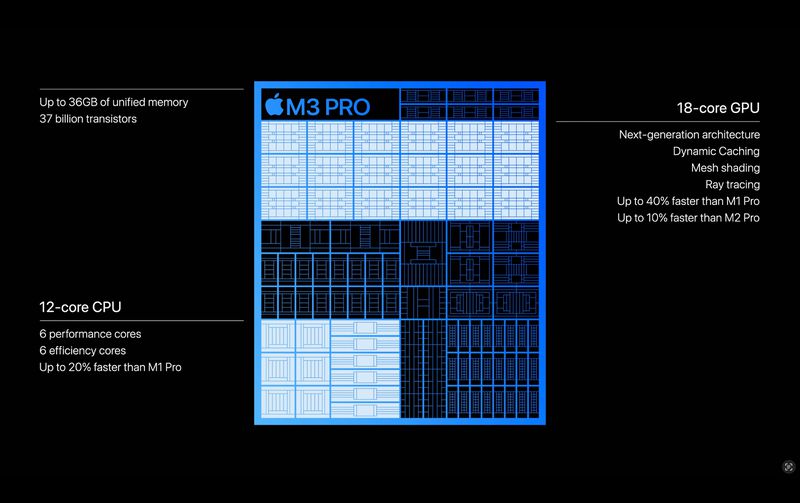
In addition to the reduced memory bandwidth, the M3 pro also loses 2 performance cores for only 2 more efficiency cores.

M2 pro: 8 performance cores + 4 efficiency cores.

M3 pro: 6 performance cores + 6 efficiency cores.

Not a great trade... I'm not sure the M3 pro can be considered an upgrade

6 comments

Depends. Is it faster? Then it's an upgrade.

Has the CPU industry really managed to pull off it's attempt at a bs coup that more cores always === better?

I thought we'd learned our lesson with the silly Mhz Myth already?

I guess we'll have to wait for benchmarks but I did find this interesting:

Apple's PR release for M2 pro: "up to 20 percent greater performance over M1 Pro"

Apple's announcement for M3 pro: "up to 20 percent faster than M1 Pro" (they didn't bother to compare it to M2 pro)

Sure, that's the title, but at least in this PR they immediately show a graph with a comparison to both.

Presumably it makes more marketing sense to compare to the M1 family up front because most people that bought an M2 last year are probably not going to be upgrading to M3. They are speaking to the people most likely to upgrade.

fwiw, i cant remember the last time i saw a company go back more than a generation in their own comparison. Apple is saying here as much as they're not saying here. M2->M3 may not be a compelling upgrade story.
The vast majority of Mac users go years between upgrades. For any other vendor it might seem weird to show several comparisons going back multiple generations (M1 and x86), but for the macOS ecosystem it makes perfect sense since only a very tiny slice of M2 users will be upgrading.
and what makes you think windows users update their devices every single generation?
It’s absolutely not, and that’s fine. The video has statements that the machines are made to “last for years” and they want to save natural resources be making long lasting machines.

I’m currently at 4 to 5 years on laptops and 3 to 4 years on phones, and even then I hand them over to kids/friends/family who get a bit more use out of them.

> they want to save natural resources be making long lasting machines.

Apple always comes from a position of strength. Again, they're saying as much as they're not saying.

Also, if they really cared about long lasting machines: slotted ram and flash please, thanks!

Given that there is a legally mandated 2-year warranty period at least in Europe, I would be surprised if any laptops weren’t made to “last for years”.

The problem with Apple, however, is that their hardware will long outlive their software support. So if they really want to save natural resources by making long-lasting machines, they should put much more effort into sustained software support.

> i cant remember the last time i saw a company go back more than a generation in their own comparison

Apple likes doing that quite frequently while dumping their "up to X% better" stats on you for minutes.

Nvidia did it when they released the RTX 3080 / 3090 because the RTX 2000 series was kind of a dud upgrade from GTX 1060 and 1080 Ti
Apple always does game comparisons like this for their conferences though. The intel era was even worse with this iirc.
Intel era there wasn’t much to game, they’re using the same chips as all the PC competitors. The PowerPC era, on the other hand…
The majority of MacBooks out there are still intel based. This presentation was mostly aimed at them & M1 owners.
Is it a problem, though? The vast majority of people skip generation and for them the relevant reference point is what they have, which is going to be hardware from a couple of generations ago. M2 -> M3 does not have to be compelling: the people with M3 devices are a tiny fraction of the market anyway.

I find it interesting how people respond to this. On one side, it’s marketing so it should be taken critically. OTOH, if they stress the improvements over the last generation, people say they create artificial demand and things about sheeple; if they compare to generations before people say that it’s deceptive and that they lost their edge. It seems that some vocal people are going to complain regardless.

Given how strong they emphasised the performance over the Intel base - who now have had their machines for 4 years and are likely to replace soon (and may be wondering if they stay at Apple or switch over to PCs), it is pretty obvious that they also want to target that demographic specifically.
That’s not what it says. Actual quote:

> The 12-core CPU design has six performance cores and six efficiency cores, offering single-threaded performance that is up to 30 percent faster than M1 Pro.

Ok, so then the M3 pro is up to 1.3/1.2=~8% faster than the M2 pro? I can see why they wouldn't use that for marketing.
Depends who they are marketing to I think is the point. If the biggest group of potential buyers are not M2 users, then it makes sense not to market to them directly with these stats.

I've got an M1 Max 64GB and I'm not even tempted to upgrade yet, maybe they'll still be comparing to M1 when the M10 comes out though.

I'm also far from replacing my M1. But if someone from an older generation of Intel Macs considers upgrading the marketing is off as well.
I was referring to the graphic they showed during the announcement that verbatim said the CPU was "up to 20% faster than M1 Pro".

https://images.macrumors.com/t/wMtonfH5PZT9yjQhYNv0uHbpIlM=/...

Plausibly they thought market is saturated with M1:s and targeted this to entice M1 users to switch.
> Depends. Is it faster?

The devil tends to be in the details. More precisely, in the benchmark details. I think Apple provided none other than the marketing blurb. In the meantime, embarrassingly parallel applications do benefit from having more performant cores.

Heh, I recall seeing many posts arguing against benchmarks when all Macs equipped with an M2/8GB/256GB SSD scored much, much lower than the M1/8GB/256GB SSD. People said the synthetic benchmarks were not representative of real world use and you'd never notice the difference. 'Twas a battle of the optimists, pessimists, and realists. In reality, 'twas just Apple cutting costs in their newer product.
> Heh, I recall seeing many posts arguing against benchmarks (...)

It's one thing to argue that some real-world data might not be representative all on itself.

It's an entirely different thing to present no proof at all, and just claim "trust me, bro" on marketing brochures.

oh absolutely, I can't wait to see the benchmarks. Per the (non-numerical data) benchmarks in the video tho - it is faster. So... until other evidence presents itself, that's what we have to go on.
> Has the CPU industry really managed to pull off it's attempt at a bs coup that more cores always === better?

I thought this at first then I realized the cost-performance benefit gained from adding more cores often outweighs just improving the performance of single cores. Even in gaming. I think this is what led AMD to create their Ryzen 9 line of CPUs with 12 cores in 2019.

That being said, I abhor the deceptive marketing which says 50% more performance when in reality, it's at most 50% more performance specifically on perfectly parallel tasks which is not the general performance that the consumer expects.

Few game devs bother optimizing games to take advantage of multiple cores
I find that frustrating with how intel markets its desktop CPUs. Often I find performance enhancements directly turning off efficiency cores...
Faster than what? M1 Pro? Just barely.
Reference should be M2 pro
I suspect it's about equal or perhaps even slower.
Based on what? The event video says it's faster.
M2 Pro was about 20-25% faster than M1 Pro, M3 Pro quotes a similar number. It has faster cores but a weaker distribution of them. Seems like a wash, but we'll see exactly how close when benchmarks are out.
2.5x is "just barely"? lol k.
> 2.5x is "just barely"? lol k.

That's only rendering speed, and M3 Max vs M1 Max (not Pro). M3 Pro is only 30 percent faster:

> The 12-core CPU design has six performance cores and six efficiency cores, offering single-threaded performance that is up to 30 percent faster than M1 Pro.

20%
Let me re-write your post with the opposite view. Both are unconvincing.

<< Depends. Is it faster? Then it's an upgrade. Has the CPU industry really managed to pull off it's attempt at a bs coup that more MHz always === better?

I thought we'd learned our lesson with the silly cores Myth already? >>

I think you're misreading the comment you're replying to. Both "more cores is always better" and "more MHz is always better" are myths.
Yup, exactly what I was saying.
Yes, but the number of cores in similar cpus do provide a good comparison. For example, with base M2pro at 6 p cores and base M3pro at 5 p cores, one would want ~20% faster cores to compensate for the lack of one core in parallel processing scenarios where things scale well. I don't think M3 brings that. I am waiting to see tests to understand what the new M3s are better for (prob battery life).
That's... the same view, just applied to a different metric. Both would be correct.

Your reading comprehension needs work, no wonder you're unconvinced when you don't even understand what is being said.

That makes less sense because the MHz marketing came before the core count marketing.

I agree with GP that we should rely on real measures like "is it faster", but maybe the goal of exchanging performance cores for efficiency was to decrease power consumption, not be faster?

Probably a balance of both tbh, as it appears to be both faster AND around the same performance per watt.
The new efficiency cores are 30% faster than M2, and the performance ones 20% faster, so lets do the math:

    M2: 8 + 4

    M3: 6*1.2 + 6*1.3 =
        7.2 + 7.8
That’s nearly double the M2’s efficiency cores, a little less on the performance ones.

They do say the system overall is up to 65% faster, and has lower power consumption at the same performance level.

You're not considering the difference in performance between the p and e cores. The math should be something more like:

  M2 pro = 8*3 + 4 =28 (the *3 representing that the performance cores contribute ~3x more to total system performance than the efficiency cores)

  M3 pro = 6*3*1.15 + 6*1.3 =28 (apple claims 15% more performance for the p cores not 20%)
> They do say the system overall is up to 65% faster, and has lower power consumption at the same performance level.

They don't claim either of those things. They claim the performance is 20% faster than the M1 pro. Interestingly, they made that exact same claim when they announced the M2 pro.

Energy efficiency might be better, but I'm skeptical till I see tests. I suspect at least some of the performance gains on the p+e cores are driven by running at higher clock rates and less efficiently. That may end up being more significant to total energy consumption than the change in the mix of p/e cores. To put it another way, they have more e cores, but their new e cores may be less efficient due to higher clock speeds. Total energy efficiency could go down. We'll just have to wait and see but given that apple isn't claiming an increase in battery life for the M3 pro products compared to their M2 pro counterparts, I don't think we should expect an improvement.

If you wanted to be even more accurate, you'd also have to take into account that most tasks are executed on the E cores, so having more of those, or faster, will have a much greater impact than any improvement on the P cores. It's impossible to estimate the impact like this - which is why Apple's performance claims[1] are based on real-world tests using common software for different workloads.

In summary, there is supposedly improvement in all areas so the reduced P core count doesn't seem to be a downgrade in any form as the OP suggested.

[1] https://www.apple.com/nl/macbook-pro/

I wouldn't trust Apple's marketing on that if it's where you got those numbers from
E cores are ~30% faster and P about 15%. So the question would be how much the Es assist when Ps are maxed on each chip. In any other situation, more/better E cores should outperform and extend battery. I’m not saying that means you should want to spend the money.
I love Apple's E cores. It just sucks that the M3 pro gains so few given the reduction in P cores.

Apple's E cores take up ~1/4 the die space of their P core. If the M3 pro lost 2 performance cores but gained 4-8 efficiency cores it'd be a much more reasonable trade.

I’m sure the difference is GPU.
I’d like to see that. Good point about die space.
Could you not resolve these questions with benchmarking?
Depends on what you consider an upgrade. As M3 cores perform better than M2 cores, I expect the M3 configuration to perform similar to the M2 one, even though it trades performance cores for efficiency cores. Apple apparently believes that its users value improved efficiency for longer lasting battery more than further improved performance.
Functionally, how does this impact observed performance on heavy loads like code compile or video manipulation? I doubt it's not much, and these are the low/mid-tier priced machines we are talking about.

If you bought a $2k M2 machine and traded it for a $2k M3 machine, you may gain better battery life with no concessions, except for benchmark measurements (that don't affect your daily work).

These are not low/mid tier machines when talking about "consumer-grade".
Yeah.

$2K-3K is what my 3090/7800x3D sff desktop cost (depending on whether you include the price of the TV/peripherals I already own).

Within the MacBook Pro lineup, they are objectively the low and mid-grade pricing tiers.
Indeed, but that's a bit of an oxymoron as any Macbook Pro is not a "low/mid-tier priced machine"
We all know what is meant by “low/mid-tier”. This is pointless pedantry. Next someone is going to come by with the throwaway comment complaint about how OpenAI isn’t “open”.
Fair enough, I was just arguing even Mac users might not have the cash or the patience to commit into another machine.

We've seen the same with Nvidia's GPUs going from the 10 to 20 series. If people don't perceive higher gains without compromises, they won't buy it.

Then why do they come with (low end) consumer level storage and memory capacity?
Different people have different needs. I certainly need a MacBook Pro for my work, but I use next to no storage. I’ve never purchase beyond the minimum storage for an Apple computer. I did however up the processor on my current MacBook Pro.

Minimum 8GB RAM is more universally egregious but I’m not going to sit here and justify my own exception whilst discounting the possibility that 8GB works for others.

The cost for adding an extra 8GB would be insignificant for Apple, though. The only reason they don’t is to upsell higher tier models
It would make them less money. /thread

To be fair– While 8GB is annoying– I've bought the M1 MacBook Air when it came out and it's remarkably resilient. I've only had it freeze a few times due to too little RAM.

I've also been using many different programs. I just have to be a tad mindful about closing tabs (especially Google tabs) and programs.

This makes going Mac Mini M2 Pro over iMac M3 feel real compelling. The respective prices of these models are in fact the same, so if you happen to have a good monitor already... (also the iMac M3 curiously doesn’t even have a Pro option.)