Sure, that's the title, but at least in this PR they immediately show a graph with a comparison to both.
Presumably it makes more marketing sense to compare to the M1 family up front because most people that bought an M2 last year are probably not going to be upgrading to M3. They are speaking to the people most likely to upgrade.
fwiw, i cant remember the last time i saw a company go back more than a generation in their own comparison. Apple is saying here as much as they're not saying here. M2->M3 may not be a compelling upgrade story.
The vast majority of Mac users go years between upgrades. For any other vendor it might seem weird to show several comparisons going back multiple generations (M1 and x86), but for the macOS ecosystem it makes perfect sense since only a very tiny slice of M2 users will be upgrading.
Windows has distinct groups: the people who buy whatever costs $700 at Costco every 10 years / when it breaks don’t care but there’s also a vocal enthusiast community who do upgrade frequently. That group gets more attention since it’s a profitable niche and gaming generates a lot of revenue.
Windows users buy whatever, from so many brands, that it doesn't matter how often they upgrade, they're likely to not upgrade from the same vendor anyway (so that the comparison to its older generations to be meaningful in the first place).
> and what makes you think windows users update their devices every single generation?
They don't, but the difference is that Windows users generally don't know or care about processor generations. In contrast, it's common for Mac users to know they have an "old" Intel-based Pro, an M1 Air, etc., and to use that knowledge to help determine when it might be time to upgrade.
You can test this by asking Windows users what CPU they have. For the few who know and who have an Intel CPU, you can ask what their Brand Modifier¹ (i3/i5/i7) is. If they know that, you can ask what the 5-digit number following the Brand Modifier is — the first two digits are the Generation Indicator¹. I'd be surprised if more than 0.01% of Windows users know this.
It’s absolutely not, and that’s fine. The video has statements that the machines are made to “last for years” and they want to save natural resources be making long lasting machines.
I’m currently at 4 to 5 years on laptops and 3 to 4 years on phones, and even then I hand them over to kids/friends/family who get a bit more use out of them.
Huh. So they used to do this, but looking at the M series chips it seems like the architecture assumes the CPU-GPU-RAM are all on the same chip and hooked into each other, which enables zero copy. Someone more well versed in hardware could explain if this is even possible.
Expandable internal storage would be nice, yeah. But I get the sealed, very tightly packed chassis they’re going for.
I have no excuse for flash, but memory can't really be slotted anymore since SODIMM is crap. High hopes for CAMM making it's way into every other machine 2024!
Given that there is a legally mandated 2-year warranty period at least in Europe, I would be surprised if any laptops weren’t made to “last for years”.
The problem with Apple, however, is that their hardware will long outlive their software support. So if they really want to save natural resources by making long-lasting machines, they should put much more effort into sustained software support.
Is it a problem, though? The vast majority of people skip generation and for them the relevant reference point is what they have, which is going to be hardware from a couple of generations ago. M2 -> M3 does not have to be compelling: the people with M3 devices are a tiny fraction of the market anyway.
I find it interesting how people respond to this. On one side, it’s marketing so it should be taken critically. OTOH, if they stress the improvements over the last generation, people say they create artificial demand and things about sheeple; if they compare to generations before people say that it’s deceptive and that they lost their edge. It seems that some vocal people are going to complain regardless.
Given how strong they emphasised the performance over the Intel base - who now have had their machines for 4 years and are likely to replace soon (and may be wondering if they stay at Apple or switch over to PCs), it is pretty obvious that they also want to target that demographic specifically.
> The 12-core CPU design has six performance cores and six efficiency cores, offering single-threaded performance that is up to 30 percent faster than M1 Pro.
Depends who they are marketing to I think is the point. If the biggest group of potential buyers are not M2 users, then it makes sense not to market to them directly with these stats.
I've got an M1 Max 64GB and I'm not even tempted to upgrade yet, maybe they'll still be comparing to M1 when the M10 comes out though.
The devil tends to be in the details. More precisely, in the benchmark details. I think Apple provided none other than the marketing blurb. In the meantime, embarrassingly parallel applications do benefit from having more performant cores.
Heh, I recall seeing many posts arguing against benchmarks when all Macs equipped with an M2/8GB/256GB SSD scored much, much lower than the M1/8GB/256GB SSD. People said the synthetic benchmarks were not representative of real world use and you'd never notice the difference. 'Twas a battle of the optimists, pessimists, and realists. In reality, 'twas just Apple cutting costs in their newer product.
oh absolutely, I can't wait to see the benchmarks. Per the (non-numerical data) benchmarks in the video tho - it is faster. So... until other evidence presents itself, that's what we have to go on.
> Has the CPU industry really managed to pull off it's attempt at a bs coup that more cores always === better?
I thought this at first then I realized the cost-performance benefit gained from adding more cores often outweighs just improving the performance of single cores. Even in gaming. I think this is what led AMD to create their Ryzen 9 line of CPUs with 12 cores in 2019.
That being said, I abhor the deceptive marketing which says 50% more performance when in reality, it's at most 50% more performance specifically on perfectly parallel tasks which is not the general performance that the consumer expects.
M2 Pro was about 20-25% faster than M1 Pro, M3 Pro quotes a similar number. It has faster cores but a weaker distribution of them. Seems like a wash, but we'll see exactly how close when benchmarks are out.
That's only rendering speed, and M3 Max vs M1 Max (not Pro). M3 Pro is only 30 percent faster:
> The 12-core CPU design has six performance cores and six efficiency cores, offering single-threaded performance that is up to 30 percent faster than M1 Pro.
Let me re-write your post with the opposite view. Both are unconvincing.
<<
Depends. Is it faster? Then it's an upgrade.
Has the CPU industry really managed to pull off it's attempt at a bs coup that more MHz always === better?
I thought we'd learned our lesson with the silly cores Myth already?
>>
Yes, but the number of cores in similar cpus do provide a good comparison. For example, with base M2pro at 6 p cores and base M3pro at 5 p cores, one would want ~20% faster cores to compensate for the lack of one core in parallel processing scenarios where things scale well. I don't think M3 brings that. I am waiting to see tests to understand what the new M3s are better for (prob battery life).
That makes less sense because the MHz marketing came before the core count marketing.
I agree with GP that we should rely on real measures like "is it faster", but maybe the goal of exchanging performance cores for efficiency was to decrease power consumption, not be faster?
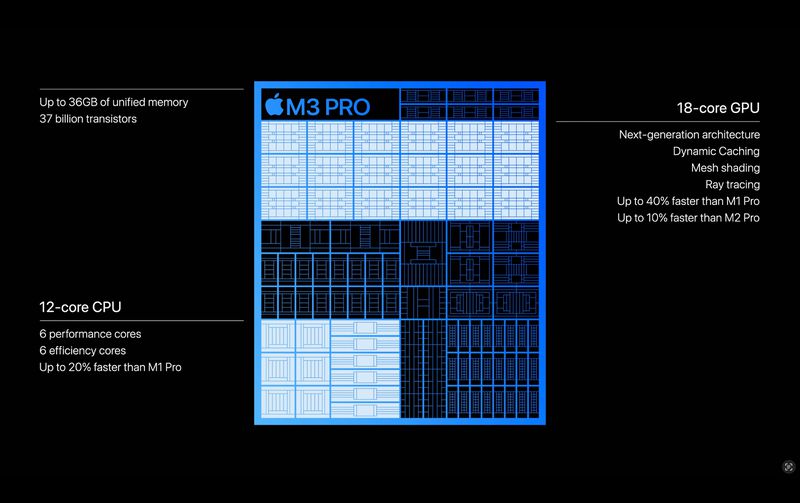
Apple's PR release for M2 pro: "up to 20 percent greater performance over M1 Pro"
Apple's announcement for M3 pro: "up to 20 percent faster than M1 Pro" (they didn't bother to compare it to M2 pro)