Hacker News new | ask | show | jobs
by eterevsky 1098 days ago
If a battery lasts a couple of days, I would much rather my phone were waterproof than be able to swap the battery. Having a power bank solves the problem of discharged phone for me, and anyway I almost never have to use it. Being able to drop your phone in the water and pick it up still working is far more valuable to me.
5 comments

> If a battery lasts a couple of days, I would much rather my phone were waterproof than be able to swap the battery.

You can have both.

> Having a power bank solves the problem of discharged phone for me

There are cases where a power bank isn't a good solution. They big and heavy. Not being able to swap in a fully-charged battery on demand means that I can no longer use my phone for certain things that I used to be able to do.

Seems like it should be possible for the phone (not the battery compartment and battery door, just the rest of the phone) to be waterproof, and for the battery to be waterproof, and the two can contact each other regardless of that contact being in a wet location. After all, we have plenty of electrical wiring methods rated for wet locations, so why not this? Water isn't the very best insulator (especially saltwater and other mineral content, which the contacts would need corrosion resistance for as well) but it should be sufficient at 4VDC.
Wikipedia says that the resistance of water is 0.2 Ω·m for sea water, 2 to 200 Ω·m for drinking water. This is very low and can drain your battery almost immediately.
Wikipedia also says that water starts conducting at 1.23V, and the common Li-Ion nominal voltage is 3.7V.

3.7V - 1.23V == 2.47V. 2.47V / 0.2Ω ~= 30W (12.5A).

You will be able the find your phone on the seabed from the bubble emanating from it.

Though the battery protect circuitry (which is inside the battery package) will most likely cut power before the battery is risks damages.

> protect circuitry (which is inside the battery package) will most likely cut power

I wonder if that's responsible for the experiences folks had way before waterproof phones were introduced: they would drop their phone into water, it would shut off and refuse to boot for a significant amount of time (enough to send them shopping for a replacement) and then they'd try it a week later only to find that it works fine. Accelerated by putting it in a bag with rice or other desiccant.

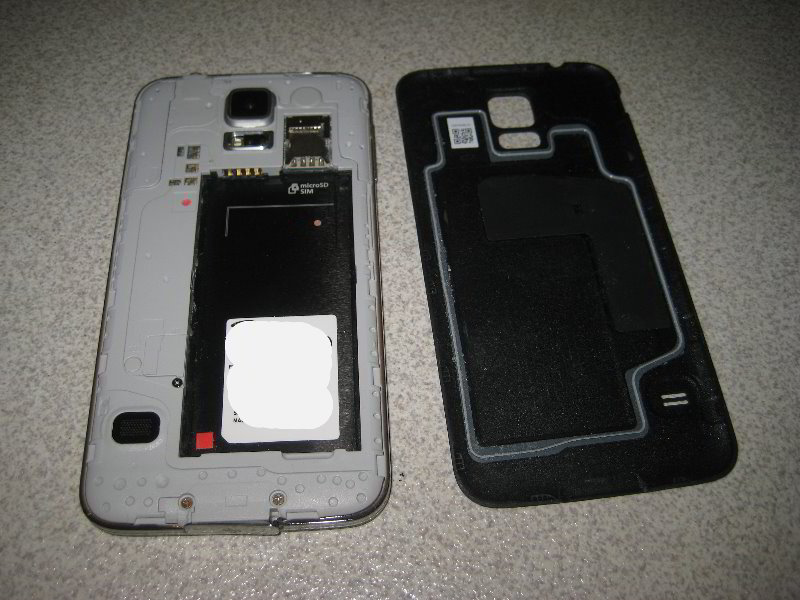
Galaxy S5 had both and at 8.1mm/0.31in was thinner than phones are now. I don't see why I should have to choose 9 years later
You’re at least the third person to say this without the disclaimer - only if the rubber flap was securely covering the ports when it was dropped in water.
You repeat this everywhere. The port requiring a flap has no bearing on the waterproofing of the battery which used an entirely separately gasket on the back cover.

You can clearly see here[0] that the gasket on the flap protects only the USB port from water ingress. The battery and sim are protected by the grey gasket on the rear cover.

The opening for the rear speakers in the back cover reinforces the fact that the flap is there to protect the interface of the USB port and its housing. The rear cover does not contact the USB port at all.

[0] https://www.paulstravelpictures.com/Samsung-Galaxy-S5-USB-Ch...

And you had to make really sure that the battery was completely secured when you replaced it. There was even a warning on the screen.

https://www.gottabemobile.com/samsung-galaxy-s5-water-test-d...

> If you remove the battery, the Galaxy S5 will remind you to make sure the back cover is back in place securely. reply

Making sure a rear cover has snapped into place is much less prone to failure than acquiring tools and applying heat to a glued on rear cover, de-soldering/disconnecting a battery and evenly re-applying and heating new glue.
I completely agree, that overall water resistance and IP rating would be more valuable.

What's stopping figuring out how the hardware can achieve both battery replace-ability and water resistance?

Phones already have holes in them, e.g. speakers and charger port, and yet are able to survive a water immersion event.

Its way easier for the speaker ports, you just seal the drivers well enough and they'll be sealed unless there's just too much pressure. The seal never experiences any mechanical wear, you can practically just glue it around the edge.

Similar thing with the charger/data port. The outside of the port can be completely sealed up with just the electrical connections going through. The port isn't ever opened, there's no mechanical wear of actually going in and out of the sealed area. Glue it all up but leave the electrical connectors exposed and its sealed.

A battery door is a whole 'nother issue. Starting off, its probably going to have considerably more perimeter needing to seal, especially if its like the doors of yore where you popped off a significant part of the back. Then, you'll need this seal to handle a lot of open/close events and be able to handle the dirt and debris which it will be exposed to. Keeping the device's profile thin gets way more complicated with all of these requirements, and the seal will probably still be less reliable than the seals for the charging port and the speakers/mics.

> What's stopping figuring out how the hardware can achieve both battery replace-ability and water resistance?

Nothing, since it wasn't all that long ago that there were phones that did this.

Waterproof phones with replacable batteries might not be waterproof after the replacement - so why don't you just keep the original battery, and have a waterproof phone? Win-win for everyone.
From my understanding, sealant used to make phones waterproof is basically glue, which precludes "easy" replacement of batteries.
I don't think you properly understood my comment. I am specifically saying: even if replacing the battery makes the phone no longer waterproof, you can just not replace the battery. Nobody comes into your house at night and forces you to install a new battery because your old one isn't good anymore.
I understood your comment. The article implies that the battery has to be _easily_ replaceable, i.e. that you could just take a battery and maybe a screwdriver out of your pocket and replace it.

I don't think it's easy to design a phone that would at the same time a) have easily replaceable battery, and b) be waterproof until the first battery replacement.

Why not?
It's very nice to be able to replace a battery in the field. I used to carry a spare charged battery and swap it for an instant recharge. That use case is still valuable to me, but isn't possible anymore.
Yes, that is why I'm arguing that even if changing the battery must necessarily break the waterseal, the battery should still be changable. In this hypothetical scenario it would be worth it to leave it open to the individual.
Galaxy S5 did it 9 years ago