Wow, 11 years to Jupiter. I wish we had better propulsion systems.
EDIT: This wasn't meant to disrespect the ESA mission. I'm just sad that the outer planets are years away, rather than the hours, days, weeks or months of science fiction.
I stand corrected. I erroneously picked up 2034 from the timeline. But the point still stands; 8 years is a depressingly long time. If we base missions on the discoveries of previous missions, there is an 8-year minimum gap between missions.
I'm just hoping we find evidence of extraterrestrial life in my lifetime, and at this rate, we'll be cutting it close..
Europa Clipper, which weighs about the same, is planned to make the same trip in five and a half years, and could have done it in less than three if it had launched on SLS:
Tony Bruno of ULA wrote a nice blog related to this recently. Most launchers are optimized for either LEO or the high energy orbits/interplanetary and are not really well suited to the opposite mission. See Figure 1 for a nice graphic.
The impact the time cost has on careers is significant. From what I've heard through science media, it's not uncommon for planetary scientists to spend half or an entire career on a single mission to the outer planets.
This was an intentional choice for efficiency and to allow more science at the destination, “the final flyby.. will be 3700 km from Earth in November 2026” [1]
Really disappointing that this is top comment tbh.
Depends on what "more science" means, but one factor is that going fast means you need to burn a lot more fuel to slow down so you can get into orbit around the target planet.
The mass of the fuel spent on breaking could be spent on other things, like extra instruments, or fuel for thrusters so you can orient more often and stay in orbit longer. For example, the Galileo[1], Cassini[2] and Dawn[3] missions ended primarily due to the probes running out of fuel. Perhaps not the best examples since they all had quite long runs, but still, more thruster fuel would probably have meant even longer missions.
Maybe slower speed means more time spent in close proximity. Moving things don't exactly stop on their own in space. Or maybe they wanted more stuff on there
One may count electric propulsion as a "better" propulsion system, but sadly it was a poor fit for Juice due to the very tight power budget.
Even with those gigantic solar arrays, energy management on Juice is extremely challenging. Once in the vicinity of Jupiter, the spacecraft will be powered by less than 4% of the solar flux it receives in earth orbit.
Also note that Juno is the heaviest interplanetary probe ever launched. It must carry quite a bit more fuel than most other missions to permit its eventual insertion to Ganymedes’s orbit – never before has a spacecraft orbited a moon other than ours.
> So a probe that's 60t fuelled instead of 6t seems not entirely unreasonable
Or, even better, fly a science payload + 2nd stage and a 1st stage and have them dock in LEO and have a rocket with some 100t of propellant from LEO + some 20t of payload
I think the very big rocket planned for launch in a few days will, if successful, help a lot with this. Chemical rockets aren't the best but if we can launch much larger payloads, we can design deep space rockets that consume a lot more fuel to get there faster. Imagine a multi stage rocket which is assembled in orbit from multiple Starship launches, and then blasts off to the outer worlds.
I don't think you would need to assemble anything in space. Starship's planned LEO payload is about a third of the entire mass of the Ariane 5 rocket that launched Juice. If you have that kind of mass budget at orbit, your delta v capability is pretty massive for a space probe.
You are right that it could be a lot faster with a bigger rocket. There will be quite a few "slingshot" or gravity assist maneuvers along the way, it's not like they are blasting straight out to Jupiter orbit.
I agree, it would be so cool if we could get there in a couple of weeks.
At least once the spacecraft arrives, it will (assuming everything goes well) do some very interesting exploring. So something to look forward to, even if it takes a long time.
Low altitude nuclear detonations generate EMPs on the ground; high altitude ones may generate enough of an EMP to take out higher altitude satellites. Also, radiation will be trapped by magnetic fields like the Van Allen belts, making those larger and more dangerous. There may also be fallout concerns, but I don't think those would be significant
Your question got me curious so I did some googling.
The current international agreement is (best I can tell) UNITED NATlONS: GENERAL ASSEMBLY RESOLUTION AND PRINCIPLES RELEVANT TO THE USE OF NUCLEAR POWER SOURCES IN OUTER SPACE [December 14, 1992]
> In order to mlnlmlze the quantity of radioactLve materzal in space and
the risks Involved, the use of nuclear power sources in outer space shall be
restrxcted to those space mLssions which cannot be operated by non-nuclear
energy sources in a reasonable way.
and
> (a) Nuclear reactors may be operated: (i) On interplanetary missions; (ii) In sufficiently high orbits as defined in paragraph 2 (h); (iii) In low-Earth orbits if they are stored in sufficiently high orbits after the operational part of their mission.
So it seems like nuclear reactors are restricted, but not completely banned. For an interplanetary mission to Jupiter, it would probably be allowed.
That's a non-binding UN resolution. There's treaties about nuclear weapons in space that have the force of law (ratified by US & USSR), but there's nothing for nuclear reactors AFAIK.
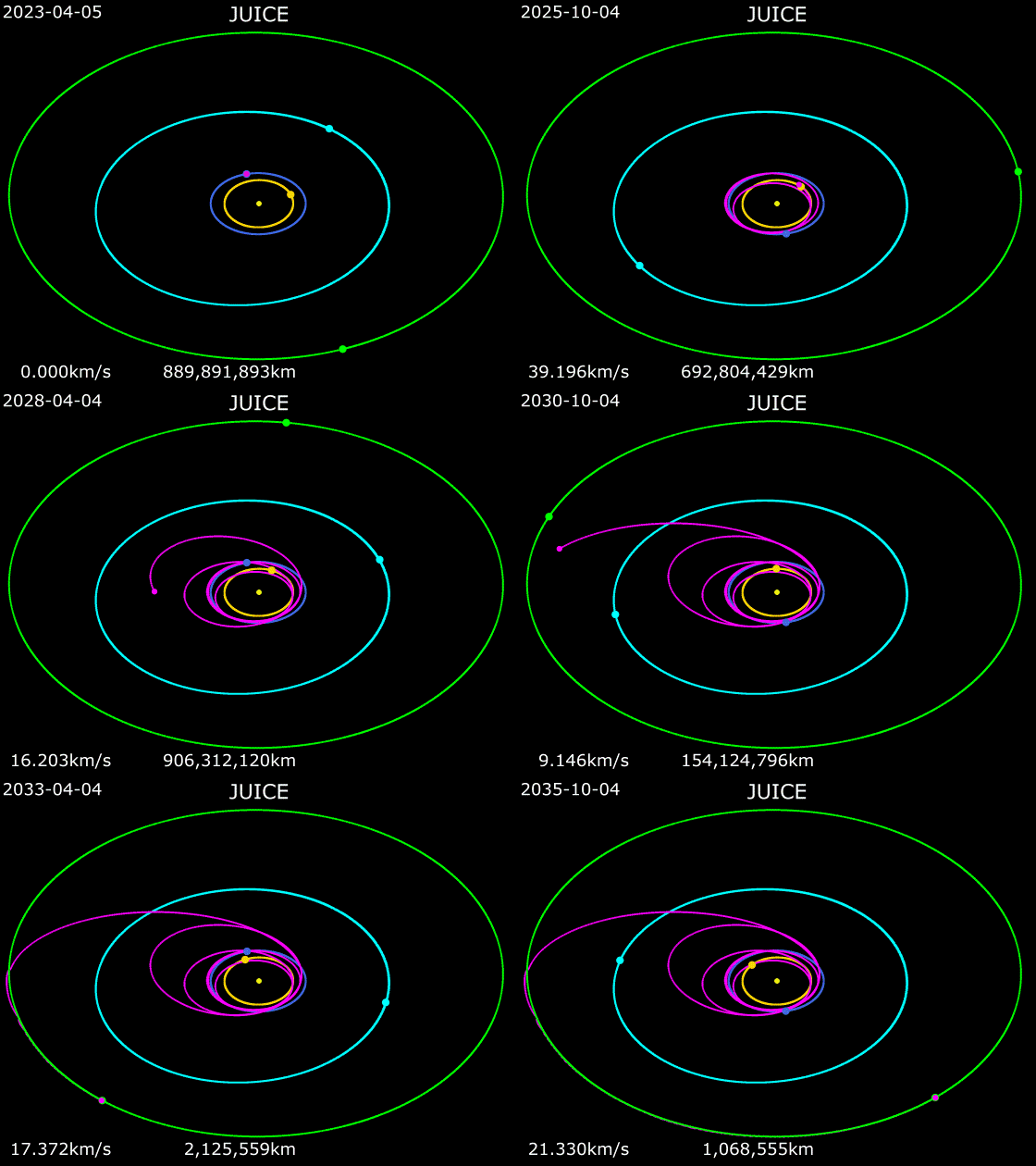
> Arrival at Jupiter - July 2031
https://www.esa.int/var/esa/storage/images/esa_multimedia/im...