Hacker News new | ask | show | jobs
by lexandstuff 1163 days ago
The definition of a continent is a continuous expanse of land. So technically, Australia is a continent, and Oceania is a region [1].

It seems that parts of the world refer to regions as continents.

[1] https://en.wikipedia.org/wiki/Region

8 comments

> The definition of a continent is a continuous expanse of land.

That is both vague and by no means the only definition of a continent. A continent is basically defined culturally - different places say there are 4,5,6 or 7 continents.

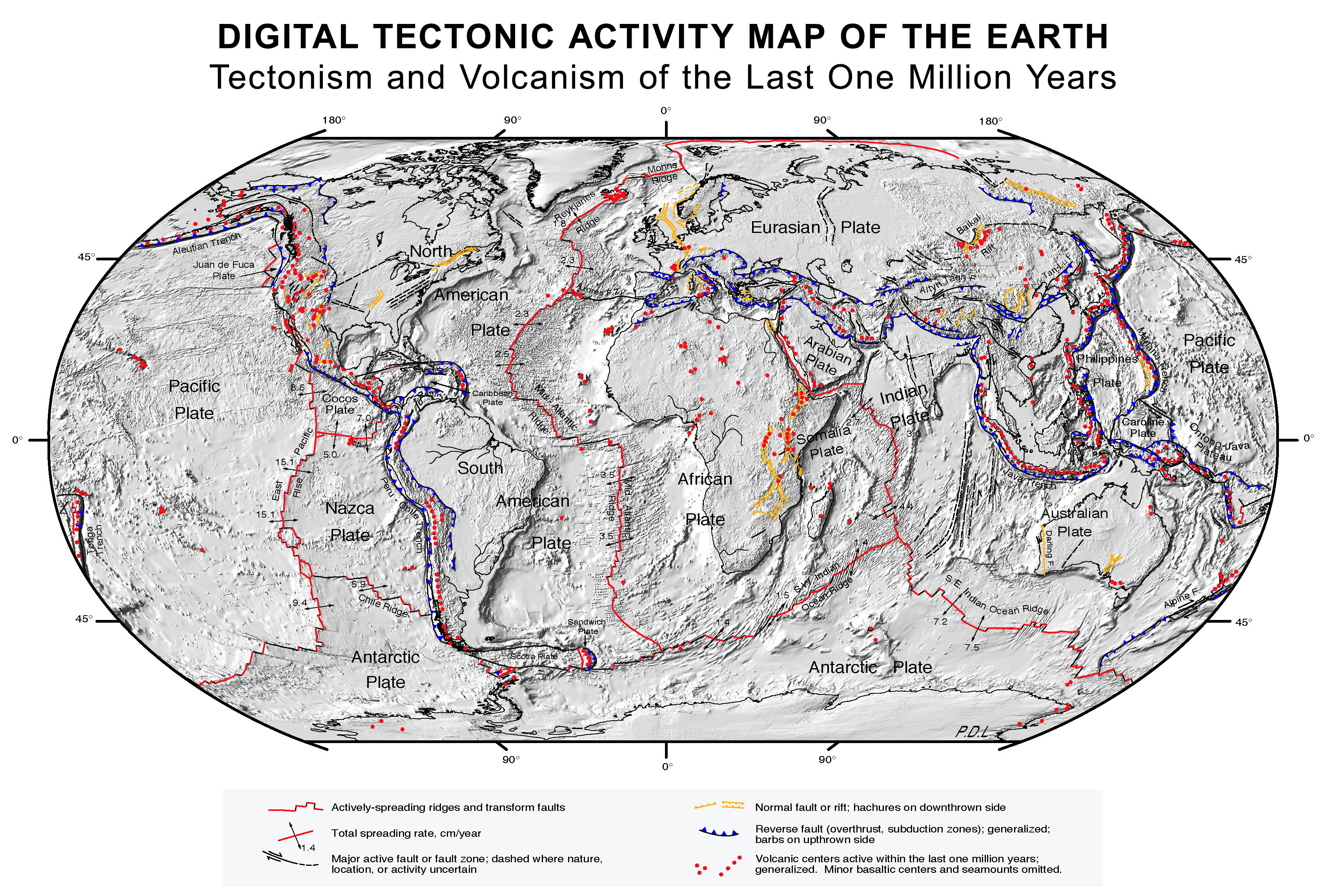
The closest to a good scientific definition is 'the largest landmass of a continental plate' (which would include Australia but not greenland, but then arguably India, east Africa, Arabia and Central America are really also on their own plates)

Perhaps the most challenging problem with the plate definition is that it would place northern Honshu and all of Hokkaido in North America. Treating the Caribbean, India and Arabia as continents is basically consistent with how we talk about them anyway.
I like having a clear definition like basing it on continental plates, though a map of the plates seems to raise its own set of questions. How small is too small of a plate to count? What of parts of what we call continents that are actually on a different plate?

https://upload.wikimedia.org/wikipedia/commons/b/b4/Plate_te...

I think continent, in the general usage, is really more of a cultural/political definition than an an objective standalone concept.

Yeah then Pluto is a planet as well. We defined it more precisely and demoted Pluto. Continents are just not defined in detail.
I mean, Pluto is definitely still a planet in the cultural imagination. There can be exceptions to rules. Even if there are some exoplanets that resemble Pluto, we can still say that Pluto is a planet and those other nameless things aren't.
I cannot understand why the cultural understanding of planet wasn't respected, while still making whatever nuanced distinction scientists wanted.

My solution would have been:

Planet = any standalone body in space, formed around a star or brown dwarf, large enough for gravity to mold it into a sphere, but not massive enough to enable any fusion. (i.e. exclude stars and brown dwarfs).

Then:

Major planet: Planet that has cleared the neighborhood around its orbit. We have 8 of these.

Minor planet: Planet that has not cleared the neighborhood around its orbit. This would include Pluto, Ceres, and many extra-Pluto bodies.

The current scientific definition is tortured. I.e. a "dwarf planet" is not a "planet", which is just unintuitive nomenclature grammatically, as well as violating the regular use of the word "planet".

I wish science would come up with a better definition. Just like we no longer have Pluto as a planet (there were other definitions they considered with different results - the important thing is a useful definition)
That won’t happen, largely because continents are BS scientifically but useful colloquially and in geography. Politics also uses them too, but the usefulness of that I’ll leave as an exercise for others.

If you want science, you want plate tectonics and geography focused around the boundaries of plates and volcanic science. If you want to know what a continent is, whatever model you were taught in school is good enough for government work. The important thing is to know what that land over yonder is if you’re on a boat.

The funny thing is that in other languages, you are not right. I thought I was remembering correctly, so I looked - here is what Swedish has to say:

https://sv.wikipedia.org/wiki/V%C3%A4rldsdelar_och_kontinent...

So - in Swedish, "kontenent" is a "continuous expanse of land". But a "världsdel" (which translates to "part of the world" roughly) is I guess "region". So - if you look at the table, "Europe" and "Asia" are both individual "världsdel", but they are one "kontinent" Eurasia. This certainly flies in the face of what I was taught in school - Europe was definitely a continent, as was Asia. Also notice, Oceana is a "världsdel", Australia is a "kontinent". But Google translates both words to "continent" in English, but the words are different.. kontinent is "geographical", but världsdel is "cultural".

I think this is what causes the issue - the definition of the 7 traditional continents in English is not universal. This page seems to imply it is very dependent on where you live (sorry, in Swedish again): https://www.geoguessr.com/seterra/sv/p/hur-manga-varldsdelar (this is google translates version: https://www-geoguessr-com.translate.goog/seterra/sv/p/hur-ma... )

"continuous expanse of land" would imply at least that any island is its own continent, but perhaps even that each bank of any river (while water is in it) would divide continents. So that does not seem right.

Wikipedia actually contradicts you in the first two sentences in the "Continent" entry [0]:

> A continent is any of several large geographical regions. Continents are generally identified by convention rather than any strict criteria.

[0]: https://en.wikipedia.org/wiki/Continent

An island is not an expanse of land, and the presence of a river doesn't make an expanse of land discontinuous.
Greenland and Madagascar would disagree. But yes on second thought, you are correct with the river.
> An island is not an expanse of land

Sez who (and why)?

If you define the continent as a continuous expanse of land, then the Americas and Afro-Eurasia are continents, albeit divided by the Panama Ithsmus, Suez Ithsmus, and...Ural Mountains?

Panama and Suez are divided by a canal, but those are artificial with a floor higher than sea level. If you stopped maintenance on the canals for a geologic blink of an eye and it would return to a land bridge, but it's narrow...I can see arguments both ways.

However, the only argument for calling Europe one continent and Asia a different continent is that Eurasia would be too big if it were a continent. Afro-Eurasia is right out!

Technical point: The Suez canal is a sea-level waterway, and even has a slow rate of flow. There are no locks.

The floor of the canal is definitely below sea level. There's a 1.2 m difference in sea level between the two ends, and the canal is 24 m deep.

That said, without maintenance it would indeed revert to a land bridge.

What if I was to count to 5 instead of 3?
Something does not add up for me here. If you say that Australia is a continent, but Oceania a region.. then how is New Zealand classified? Shouldnt it count as a continent too? (What is probably wrong)

I think all those things are quite cultural: after all Europe and Asia are connected, arguably with Africa too. Same for both Americas which could be counted as one big thing. On a side note does: Panama canal work as a real divide between both Ameican continents? Similar question for Suez Canal

> Something does not add up for me here. If you say that Australia is a continent, but Oceania a region.. then how is New Zealand classified? Shouldnt it count as a continent too?

Why would it have to? Oceania is a region that consists of one continent and a bunch of islands, done, problem solved. There's nothing that says "a region" can only consist of continents or islands, is there?

I wouldn't say the definition is all that clear-cut either: https://en.wiktionary.org/wiki/continent#English

> generally regarded as seven in number, _including their related islands_, continental shelves etc.

Ok so the bulk of Great Britain is a continent, Northern and the Republic of Ireland form a continent, the Isle of Wight is a continent, ...?

Or for the NA readers: the bulk of NA&SA form a single continent, not two, Russia and continental Europe sometimes join it, Hawaii is a continent, ...?

"continuous expanse of land" Is United Kingdom a part of Europe?
Oh, you don't want to get into that discussion my friends. Many men have died in the context of "answering" that question...