Hacker News new | ask | show | jobs
by twelvechairs 1163 days ago
> The definition of a continent is a continuous expanse of land.

That is both vague and by no means the only definition of a continent. A continent is basically defined culturally - different places say there are 4,5,6 or 7 continents.

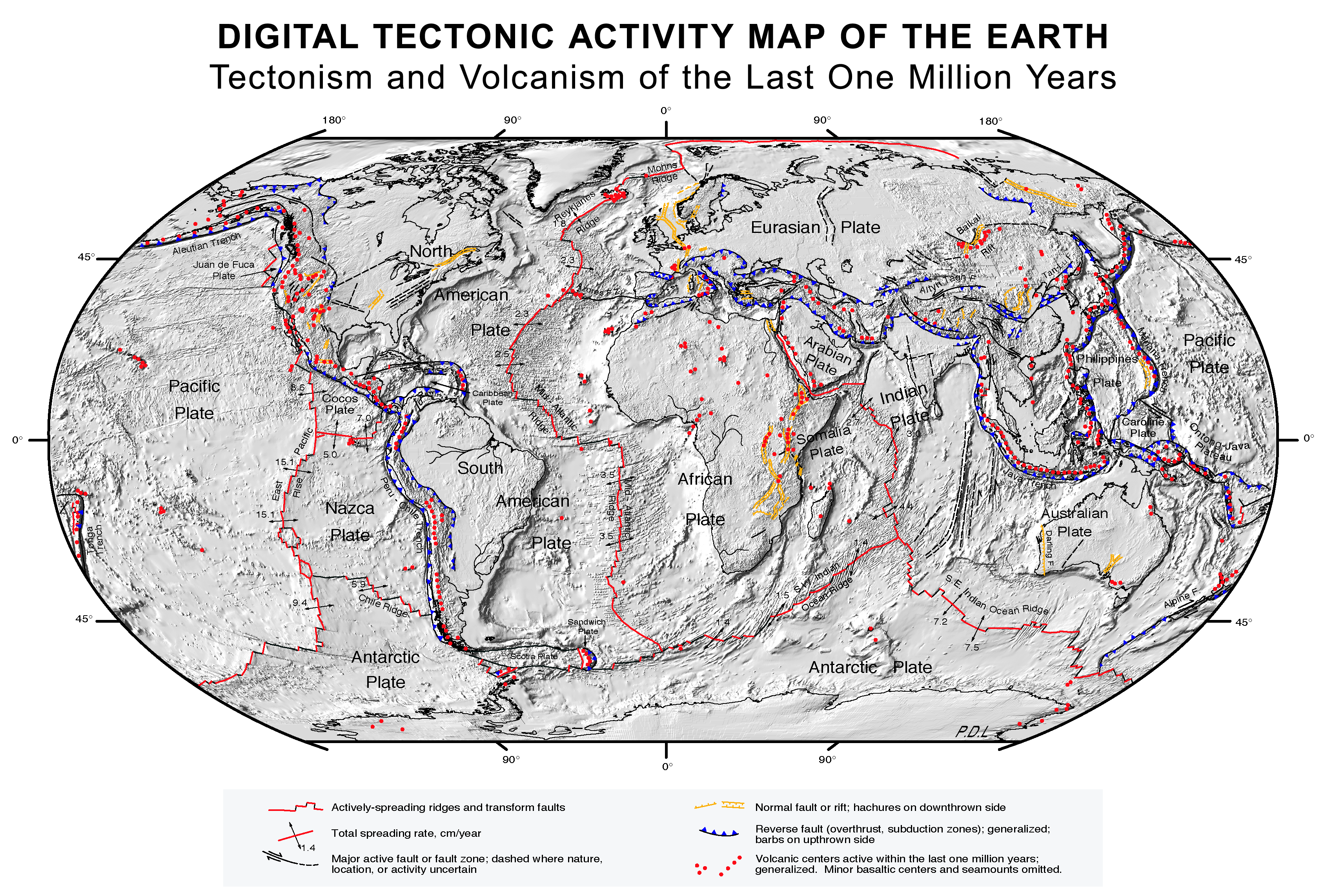
The closest to a good scientific definition is 'the largest landmass of a continental plate' (which would include Australia but not greenland, but then arguably India, east Africa, Arabia and Central America are really also on their own plates)

4 comments

Perhaps the most challenging problem with the plate definition is that it would place northern Honshu and all of Hokkaido in North America. Treating the Caribbean, India and Arabia as continents is basically consistent with how we talk about them anyway.
I like having a clear definition like basing it on continental plates, though a map of the plates seems to raise its own set of questions. How small is too small of a plate to count? What of parts of what we call continents that are actually on a different plate?

https://upload.wikimedia.org/wikipedia/commons/b/b4/Plate_te...

I think continent, in the general usage, is really more of a cultural/political definition than an an objective standalone concept.

Yeah then Pluto is a planet as well. We defined it more precisely and demoted Pluto. Continents are just not defined in detail.
I mean, Pluto is definitely still a planet in the cultural imagination. There can be exceptions to rules. Even if there are some exoplanets that resemble Pluto, we can still say that Pluto is a planet and those other nameless things aren't.
I cannot understand why the cultural understanding of planet wasn't respected, while still making whatever nuanced distinction scientists wanted.

My solution would have been:

Planet = any standalone body in space, formed around a star or brown dwarf, large enough for gravity to mold it into a sphere, but not massive enough to enable any fusion. (i.e. exclude stars and brown dwarfs).

Then:

Major planet: Planet that has cleared the neighborhood around its orbit. We have 8 of these.

Minor planet: Planet that has not cleared the neighborhood around its orbit. This would include Pluto, Ceres, and many extra-Pluto bodies.

The current scientific definition is tortured. I.e. a "dwarf planet" is not a "planet", which is just unintuitive nomenclature grammatically, as well as violating the regular use of the word "planet".

I wish science would come up with a better definition. Just like we no longer have Pluto as a planet (there were other definitions they considered with different results - the important thing is a useful definition)
That won’t happen, largely because continents are BS scientifically but useful colloquially and in geography. Politics also uses them too, but the usefulness of that I’ll leave as an exercise for others.

If you want science, you want plate tectonics and geography focused around the boundaries of plates and volcanic science. If you want to know what a continent is, whatever model you were taught in school is good enough for government work. The important thing is to know what that land over yonder is if you’re on a boat.