Hacker News new | ask | show | jobs
by activitypea 1174 days ago
There are no words for how much this sucks. If you are outside the US/EU, reasonably priced books in english aren't easy to find. CompSci literature in English? Forget it, buddy. Book Depository had decent prices with free international shipping to most of the world. Sure, I have to wait a month and sometimes they have to reship because it got damaged in transport, but if I need a book immediately Library Genesis is right there. Book Depository built out my home library for both fiction and non-fiction, and I will miss it dearly. Salute o7
10 comments

+100

I'm really pissed off. I live in Europe outside EU and this is the most convenient way to get books in English. Often a translated book does not exist here at all, so Book Depository was a blessing in these situations.

Seems like nothing is sacred to the corporate quarterly reports. If a corporation made a little less profit this year compared to the last one (did not have losses!), it apparently justifies shutting down an online book store that ships a ton of titles at reasonable prices with free shipping to 160 countries in the world!

> I live in Europe outside EU

I had to think on this portion of your comment for a moment. It's obvious in hindsight but the first time I've ever heard it phrased in this way.

I'm inside the EU (Ireland) and "reasonably priced books in English aren't easy to find" unless you're buying pre-owned books and in most cases I can't find what I'm looking for specially when it comes to tech books. As an island, we're very much dependent on Amazon.co.uk for books.
If you're in Dublin then Chapters has a fantastic, on-going (closing down, perhaps?) sale on fiction. I can't find books cheaper on Amazon than there. For tech books, I get the ISBN from Amazon and then order them from Books Upstairs. It is more expensive, but not excessively so.
They don't have everything when it comes to tech or more niche material, but Kenny's (https://www.kennys.ie/) is very good and offers free (and often fast) shipping.
That also looks like a good alternative for the EU and some other countries, with delivery at €1 per book. (Just not the USA, which is €9.50 for some reason.)

https://www.kennys.ie/delivery-details

https://www.bigwords.com/

That strange site helped me get tons of books for college.

While Book Depository definitely had some of the lowest prices, I wouldn't say we're very much dependent on Amazon - I've found that almost everything I've looked for can be found in a handful of bookshops around Ireland (Chapters, Kennys, Charlie Byrnes, Easons, Books Upstairs, Vibes and Scribes) - it's been a good few years since I've had to rely on book depository for a book
Book Depository had decent prices with free international shipping to most of the world

wordery.com (based in the UK) also gives free worldwide delivery.

Looks neat, but most of the books I have are showing as "currently unavailable" :(
Seems reasonably similar range, but pricing is definitely higher than BD.
I located in the EU, but from a small country, and still Book Depository was the only way to get English books at a reasonable price.
Book Depository is still the best way to get reasonably priced books not in English too. I have managed to get a number of books in Swedish that were stupid money from other vendors or would not ship outside of Sweden (Adlibris, I am looking at you!)
Probably a bit nitpicky, but there is at least one place outside the US/EU where it is very easy to find books in English.
You might be surprised. Good luck finding reasonably priced books in Australia. Book depository has been excellent.

I had no idea this was coming. I didn't know they were owned by Amazon. This is terrible and it just goes to show that we can't have nice things.

I had been ordering books from there since 2015 :(

You're right, let me rephrase.

> I feel like there are no words for how much this sucks for me personally. It seems to me that if you are in most countries outside the US/EU, potentially excluding strong US/EU-adjacent economies such as Canada, UK, and Switzerland (Switzerland technically not being a part of the European Union), books in english can be hard to find for some people. Book Depository had what I consider to be decent prices with free international shipping to most of the world. Sure, I have to wait around a month and sometimes they have to reship because it got damaged, possibly in transport, but if I would like to have a book at that very moment I can use Library Genesis. Books ordered from Book Depository make up a large part of my personal library, with a few exceptions course.

Britain, Australia, and India would be my guesses. And Canada if we haven’t annexed it yet.
Poor New Zealand, not even on the map in Risk.
Wasn't there a "reasonably priced" bit also? See peer comment regarding pricing in Australia.
I know of at least two off the top of my head: UK and Canada.
It's not so bad. I used to order from book depository in an attempt to use an amazon competitor. Then I found out amazon owns it. Closing it down makes it more obvious to everybody that there is none, not in a really serious way, for online books outside the USA
In Poland there is a whole ecosystem of resellers who sell various books on Allegro (which is basically polish equivalent of Ebay + Amazon). I am not sure exactly how do they get the book info, but it is quite clear that they get the inventory off Amazon, who ships the books to the resellers first, who repack them and send them to direct customers. Of course you can ask, "why not buy at Amazon (or Ebay) directly"? Well, for many years Amazon was simply not available in Poland, it also required a full credit card (not only a debit card), while Allegro allows many more payment systems.

I tried buying some really obscure books on Amazon - and the interface is pure garbage. When I looked for random items, those often looked like cheap knock-offs?

Generally once per year I try to look at various "best books of 2022" lists [did hacker news have one?] and then try to get the obscure books. Often it feels easier (but not cheaper) to get them through those third party sellers than search on Amazon that offers 10 options of used books, semi-used books, PDFs - I genuinely dont know how to exclude the things that I dont want.

This reminds me how EBAY tried to enter the Polish market and their launch was so damn bad and the website so damn poor, that after 2 years they licked their wounds and simply exited the market.

I wish more people know Allegro, which has its own share of problems, but is so much better (I think most problems came when venture capital came, bought it and now tries to squeeze money out of it).

In Poland you buy something on Allegro and usually in 1-2 days you get it to a parcel locker machine. Which is like a machine that stores the packages for you in a safe way. I never understood why those dont exist in USA. As I understand the delivery drivers throw the packages on your garden, where they can be stolen, damaged by rain or so on.

I think Germany also has parcel lockers + the concept was introduced to UK due to all the Polish diaspora ( https://en.wikipedia.org/wiki/Parcel_locker ), but when it comes to number of machines per capita Poland probably wins.

Thank you for sharing a glimpse of the ecosystem in Poland!

By the way, Parcel lockers do exist in the US (at least for Amazon package deliveries) https://www.amazon.com/gp/help/customer/display.html?nodeId=.... The US also has Post Office (PO) boxes that you can rent for a nominal fee a month (these are basically lockers for all types of mail including parcels).

Parcel lockers are a very interesting concept. It's generally something quite straightforward - something that stores items for your at a location (and you get an email / SMS notification + can open it via code, or app). The idea probably was invented in many places, but I think Germany had them first. They are incredibly popular in Poland, because they are very reliable. Towns are full of them and in last years, basically even the smaller villages get them.

This all happens at the expense of couriers (who are more expensive) and 'regular' post (who is run by the state and sadly was quite unreliable. In fact it was so unreliable, that they bought a private company just to handle the packages. The bought company called POCZTEX is now very reliable, but 'regular' post used to send mail lost a ton of market share).

I wonder if Amazon copied the idea from Allegro, or possibly German post, or perhaps Korea (who also has them I think?).

Now Poland is a place of an interesting battle, where Inpost parcel lockers have most of the market share and locations, but multiple other service providers (Polish post, Allegro, Amazon, Aliexpress) try to build their own networks. There are of course also multiple courier companies. Normal post office is becoming more and more unprofitable - despite good locations. They deal with the low margin letters. The parcel market has much better margins (even despite being cutthroat).

US mail has been using parcel lockers in new neighborhoods for decades..
Is there any notification via email or SMS? "Decades" suggest that they are just physical lockers that you have to go and manually check for mail. We have these too in rural areas, where delivery to every single farmhouse is too expensive and time-consuming. But modern parcel lockers are different. They are networked computers connected to solenoids that operate door locks. You get a code via mail or SMS when a parcel arrives, and when you go pick it up, you enter the code and a door automatically unlocks and opens.

Sending a parcel is similar: you can prepare a shipping label at home and print it out. When you arrive at a locker, you just scan label's barcode, a door opens, and you pop your parcel in there. Or you can prepare the label at the parcel machine, it will print out a sticker for your parcel. Stick it on, scan the code, door opens, put your parcel there.

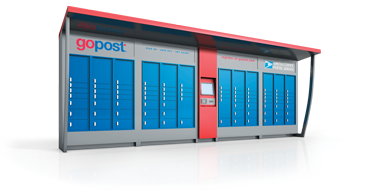
A standard parcel locker looks like this: https://i.imgur.com/X5Gj4JQ.jpg

Different size doors are for small / medium / large parcels. Center section has touchscreen, payment card reader, barcode scanner and a printer for shipping labels and receipts.

Such parcel lockers have been around for approximately 15 years, but usage exploded somewhat later.

"Decades" suggest that they are just physical lockers that you have to go and manually check for mail.

The USPS parcel lockers were around long before the internet. Back then when you had a package, the postman would stick a sticky note to your door to let you know to go pick it up.

Today, the USPS will email you a list of all the mail and packages with photos you are getting that day.

It doesn't notify you upon delivery, unless the sender requests it. But once you have the package ID number (which comes with the email), you can put it into any number of free or paid apps that will alert you immediately upon delivery.

A standard parcel locker looks like this: https://i.imgur.com/X5Gj4J

The one you show looks like a bog-standard parcel locker operated by any of dozens of delivery companies, office buildings, apartment buildings and retail stores around the country for years and years.

Nothing special. Here's the USPS version, which has been around since 2011: https://gopost.usps.com/media/images/gp/USPS-gopost-unit.png

Does 1967 count as decades? You decide.

They put a key in your personal mailbox that corresponds to a specific locker. You use the key to open the locker. You cannot remove the key once it’s used to open the locker. I’ve personally used these arrangements since the 1990s.

https://faq.usps.com/s/article/What-is-a-Cluster-Box

https://en.wikipedia.org/wiki/Centralized_mail_delivery

I'm in the Baltics and Allegro is a good option where available, but I'd really like them to expand as not all items can be shipped here. I don't really understand the logic of what can and cannot as I've bought small items and large items (headlights), but quite a lot of things are not available. Last year they added English translations on the site, but searching for items in Polish returns many more results so it's not a great experience.

The market here is really ripe for a big seller as if I buy the typical "I'll just buy it from Amazon" products locally they are very overpriced - I joke that it feels like the distributor in Germany (or whatever other European hub it comes from) adds 30%, then the person who brings it here adds another 30%, and then the person who sells it here adds another 30%. For example last week I bought some insect screens from Amazon DE, they were 3 for €16. If I buy locally the cheapest price is 1 for €20.

Amazon DE ships here, but they have a €10 shipping fee so I save up until I have many items in the cart, and then it still takes a week to arrive. AliExpress is a good option now they've started charging VAT (no customs to deal with) but it takes 1 to 2 months for items to arrive from China.

Which is like a machine that stores the packages for you in a safe way. I never understood why those dont exist in USA.

They do exist, and have existed since at least 2010, when I first used one.

There are many thousands of them in cities big and small. Many are run by Amazon, but not all.

I can think of six locations within a few blocks of my home.

Sucks for some of us in the US too. Many of the niche military history books I buy come from BD.

PS: Print tech books are dead in the US anyway. They're out of date before they're ever edited, never mind hitting paper.

What about abebooks?
Some online booksellers that aren't quietly owned by Amazon include:

* Alibris (aggregator like AbeBooks)

* Better World Books (B Corp)

* ThriftBooks

* Bookshop.org (benefits local bookstores)

You can also connect directly to nearby independent booksellers on https://www.indiebound.org/

For those interested, here is a Userscript that marks Amazon-owned stores in the bookfinder.com search results: https://greasyfork.org/en/scripts/464153-outline-amazon-owne...
Bookmarked all of them, thank you.
Thank you. It’s very hard to escape amazon and not feed the monster.
Also: biblio.com

I think it's run out of Charlotte.

An “extraordinary and unprecedented” global protest from antiquarian booksellers has forced the Amazon-owned secondhand marketplace AbeBooks to backtrack on its decision to pull out of several countries.

AbeBooks had told bookshops in countries including Hungary, the Czech Republic, South Korea and Russia that it would no longer support them from 30 November, citing migration to a new payment service provider as the reason for the withdrawal. The move prompted almost 600 booksellers in 27 countries to pull more than 3.5m titles from Abebooks’ site, putting them on “vacation” as they cited the motto of the International League of Antiquarian Booksellers, “Amor librorum nos unit” (love of books unites us).

https://www.theguardian.com/books/2018/nov/08/amazon-abebook...

Amazon owns it so who knows how much longer that stays around.
abebooks too?

<drops into depression>

It's really bad. We probably want to not have monopolies like Amazon moving forward. So much so that we could probably pass laws to prevent it. Just in case we forget.
Pretty sure the US has laws about it. But their interpretation has changed since the famous AT&T breakup.
It’s a complex area - any time I read into the history of “antitrust” etc in the US I get lost in a quagmire of details.

Overall the US seems to be incredibly open to monopsonies, monopolies, and oligopolies, and very hostile to any restraint on such things. Though, the merest hint of success from a non-US entity seems to invoke bipartisan terror and pleadings for sanctions and new regulations. Funny that.