Hacker News new | ask | show | jobs
by rvba 1168 days ago
Parcel lockers are a very interesting concept. It's generally something quite straightforward - something that stores items for your at a location (and you get an email / SMS notification + can open it via code, or app). The idea probably was invented in many places, but I think Germany had them first. They are incredibly popular in Poland, because they are very reliable. Towns are full of them and in last years, basically even the smaller villages get them.

This all happens at the expense of couriers (who are more expensive) and 'regular' post (who is run by the state and sadly was quite unreliable. In fact it was so unreliable, that they bought a private company just to handle the packages. The bought company called POCZTEX is now very reliable, but 'regular' post used to send mail lost a ton of market share).

I wonder if Amazon copied the idea from Allegro, or possibly German post, or perhaps Korea (who also has them I think?).

Now Poland is a place of an interesting battle, where Inpost parcel lockers have most of the market share and locations, but multiple other service providers (Polish post, Allegro, Amazon, Aliexpress) try to build their own networks. There are of course also multiple courier companies. Normal post office is becoming more and more unprofitable - despite good locations. They deal with the low margin letters. The parcel market has much better margins (even despite being cutthroat).

1 comments

US mail has been using parcel lockers in new neighborhoods for decades..
Is there any notification via email or SMS? "Decades" suggest that they are just physical lockers that you have to go and manually check for mail. We have these too in rural areas, where delivery to every single farmhouse is too expensive and time-consuming. But modern parcel lockers are different. They are networked computers connected to solenoids that operate door locks. You get a code via mail or SMS when a parcel arrives, and when you go pick it up, you enter the code and a door automatically unlocks and opens.

Sending a parcel is similar: you can prepare a shipping label at home and print it out. When you arrive at a locker, you just scan label's barcode, a door opens, and you pop your parcel in there. Or you can prepare the label at the parcel machine, it will print out a sticker for your parcel. Stick it on, scan the code, door opens, put your parcel there.

A standard parcel locker looks like this: https://i.imgur.com/X5Gj4JQ.jpg

Different size doors are for small / medium / large parcels. Center section has touchscreen, payment card reader, barcode scanner and a printer for shipping labels and receipts.

Such parcel lockers have been around for approximately 15 years, but usage exploded somewhat later.

"Decades" suggest that they are just physical lockers that you have to go and manually check for mail.

The USPS parcel lockers were around long before the internet. Back then when you had a package, the postman would stick a sticky note to your door to let you know to go pick it up.

Today, the USPS will email you a list of all the mail and packages with photos you are getting that day.

It doesn't notify you upon delivery, unless the sender requests it. But once you have the package ID number (which comes with the email), you can put it into any number of free or paid apps that will alert you immediately upon delivery.

A standard parcel locker looks like this: https://i.imgur.com/X5Gj4J

The one you show looks like a bog-standard parcel locker operated by any of dozens of delivery companies, office buildings, apartment buildings and retail stores around the country for years and years.

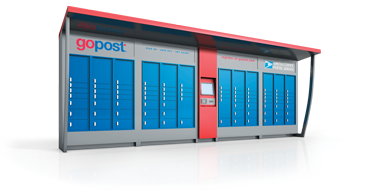
Nothing special. Here's the USPS version, which has been around since 2011: https://gopost.usps.com/media/images/gp/USPS-gopost-unit.png

Does 1967 count as decades? You decide.

They put a key in your personal mailbox that corresponds to a specific locker. You use the key to open the locker. You cannot remove the key once it’s used to open the locker. I’ve personally used these arrangements since the 1990s.

https://faq.usps.com/s/article/What-is-a-Cluster-Box

https://en.wikipedia.org/wiki/Centralized_mail_delivery