Hacker News new | ask | show | jobs
by vages 1186 days ago
If increased productivity equaled job loss, there would be two programmers alive today, doing the same job as the fewer than 10000 programmers using punch cards as we entered the year 1950.

A lot of projects today are not even greenlit because they would be too expensive to make. For instance, there are a lot processes in almost every country that require you to file paper forms, even though we have had web forms and databases for 25 years. This goes even for rich countries. If one programmer is able to do the job of 5 others, we will probably have 5 times as many systems to tend to now that businesses and institutions can afford them.

7 comments

This is true for other domains also. My wife translates for an ecommerce business. A lot of what she does is very automated. The software she uses remembers all phrases she has translated and uses a word bank she manages for special parts and uses DeepL for new translations which are then only proofread and fine tuned. It's amazing how much stuff she can translate that way in a day (no idea how many thousands words). She is kind of managing and overseeing an AI (DeepL) and sanity checking the work. If this was 20 years ago one would probably need a translation department of 10-15 people to do the same work. However, her company would have never been able to justify that kind of cost. So, in my view: Software and AI made translators probably more than 10x more efficient in the last 10 years, however the amount of stuff that gets translated also increased 10 fold during this time.
Yep! I think this is both the optimistic case, and the version of the future that seems most likely to me.

I'm still a bit bummed about it, because just writing and structuring code is something that often brings me joy (and maybe your wife feels similarly about the actual translation work...), but at the end of the day, I realized well before all this AI craze that it really isn't the most valuable thing I do in my job.

Something like 97% of all jobs have been eliminated since the Industrial Revolution started ~250 years ago.

And instead of the 97% unemployment our intuition tell us would happen, we're instead 30x as productive.

The same will happen when/if AI makes writing software far more effective.

> … instead of the 97% unemployment … we’re instead 30x as productive.

Economic productivity simply means output per worker. So, we could make 97% of the US population permanently unemployed tomorrow, and as long as the AI replacement labor yielded equal or greater proceeds to the remaining 3%, we’d see a colossal increase in “productivity.”

That would be in the interest of the 3% to do (or attempt), which is what makes the scenario so scary.

But that’s never happened in the past. Why should it happen now? The Industrial Revolution is used as an example because it was the biggest spike in productivity, but the general trend has been the same since the invention of tools. Agriculture, another perfect example, lead to others having time to produce things instead of hunting/gathering. It’s easy to grasp with the agriculture example that “unemployment” wasn’t even really a risk.

Sure, there will be niche sub-industries that will be erased by LLMs, and people who have those niche skills will suffer. This has always been the case with technological advances. And always, it has not disrupted the economy.

> Why should it happen now?

What are S-curves.

Perhaps the quantity of labour utilizing each new technology through time is a (n-shaped) parabola that intersects with the technology it replaced.

The fear that technological advances will cause mass unemployment and destroy labour markets has been common throughout history. Yet here we are at full employment. Maybe this time is different?

It is different this time. In the past automation effected some domains more and some domains not at all. People moved to those other domains. AI can run all the domains humans do and more that they can't.

https://www.youtube.com/watch?v=7Pq-S557XQU

>If increased productivity equaled job loss there would be two programmers alive today, doing the same job as the fewer than 10000 programmers using punch cards as we entered the year 1950.

The only reason it's not the case in this example is because computers at the time were a tiny early adopter niche, which massively multiplied and expanded to other areas. Like, only 1 in 10,000 businesses would have one in 1950, and only big firms would. Heck, then 1 in 100 million people even had a computer.

Today they've already done that expansion into all businesses and all areas of corporate, commerce, and leisure activities. Now almost everybody has one (or a comparable device in their pocket).

Already cloud based systems have made it so that a fraction of programmers and admins are needed. In some cases eliminating the need for one altogether.

There are tons of other fields, however, more mature, where increased productivity very much equaled job loss...

Have no doubt, we will find new places to put computers. In the 80's and even the 90's everyone said the same thing, "Why do I need a computer? I can do everything I do already without a problem?" Well, turns out with computers you could do 12 more things you can never considered. Consider the interoffice memo: it'd take what, 1-2 hours to get a document from one floor to another through the system? Cool, you can work on 2-3 projects at a time maybe, because that's all the bandwidth allowed. Along comes email and ups that to 5-6 because now the communications can be pretty consistent. It's still not perfect, because what if you're at lunch or the gym? Then came Blackberries and all of a sudden its 12-15 projects at once. Then Slack because you don't even have to think. Now add this.

Notice that during that time there weren't all of a sudden less programmers, or managers or sysadmins, if anything there's more. If anything everyone is even more stressed with more to do because of the context switching and 24/7. That's why this will do, I'd bet money on it.

I dunno, I feel like we've been trying to find new places to put computers for a couple decades now, and the effort is kind of losing steam. Every week there are threads about how useless a lot of these efforts are.
You just don't hear about all the computers, that's all. There's one on your car's key fob, and likely 100 more in the car. Your coffee grinder has one. So does your dishwasher. And your electric blanket.
There are 100-150 CPUs in a modern car.

...And also over 100 bugs in the spec that governs communication between car systems: https://youtu.be/hXnS_Xjwk2Y?t=899 (around 15 minute mark)

>In the 80's and even the 90's everyone said the same thing, "Why do I need a computer? I can do everything I do already without a problem?" Well, turns out with computers you could do 12 more things you can never considered

Yeah. Also, unfortunately, it turns out those people in the 80s and 90s got it right. They didn't really need a computer - they'd better off without one. But as soon as we got them, we'd find some things to use them for - mostly detrimental to our lives!

If increased productivity equaled job loss, there would be two programmers alive today

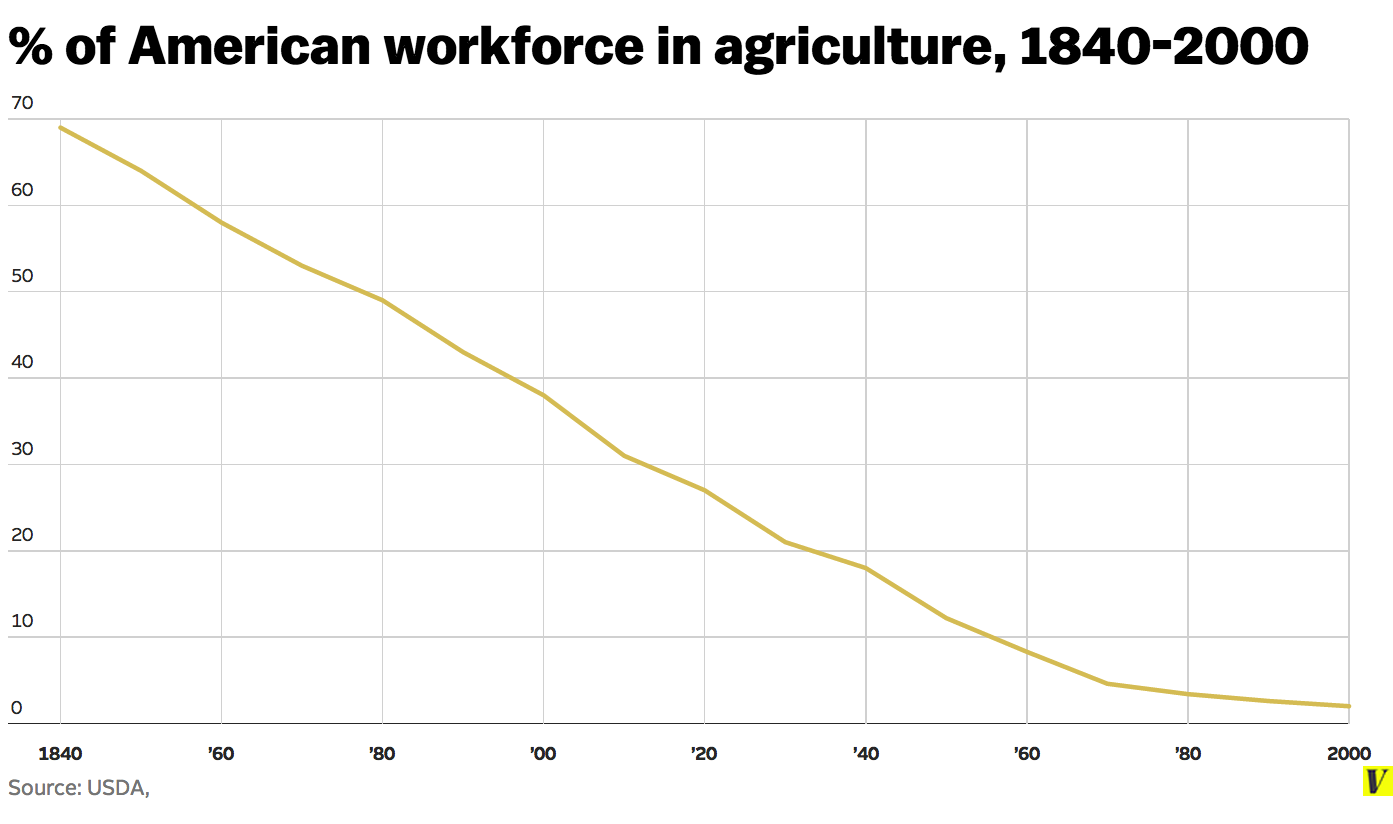
Increased productivity doesn't necessarily lead to overall job loss, but it will eventually in the area where the productivity is realized. Agricultural employment is a very clear example.

https://cdn2.vox-cdn.com/assets/4565243/Ag_workforce.png

otoh the rise of ATMs seems to have increased the number of bank tellers
Well, yes, it got down, but only from 12 mln to 5.5 mln people in agriculture.
Agriculture is still automating and the population has increased what, 4x since then
The US population increased about 15x in that period and one of the major reasons for that is the increase of productivity in agriculture [0]. Higher productivity created more demand.

[0] https://en.wikipedia.org/wiki/Green_Revolution

> If increased productivity equaled job loss, there would be two programmers alive today, doing the same job as the fewer than 10000 programmers using punch cards as we entered the year 1950.

Yeah. The problem is that there’s only one of me. All the rest of you are filling in for the other guy.

Correct. This is pretty much Jevons's paradox: https://en.wikipedia.org/wiki/Jevons_paradox
yup just literally talked a client out of a nice little mobile project by telling him my rate. lets say I had AI by my side - I'd be quoting the same rate, but number of hours would be lower. project might be a go then.