Hacker News new | ask | show | jobs
by umutcankus 1268 days ago
"How many holes exist in a straw?"

Any time I asked this question it produces some joyful brainstorming. It doesn't matter if it is a room full of highly technical people(engineers, mathematicians) or a family dinner.

I've already heard most of the arguments from the topological definition of a hole to difference between a hole, a cavity and a hallow but it is still very fun for me to watch people getting excited over such a boring looking question. (:

3 comments

You might enjoy https://andrewmbailey.com/dkl/Holes.pdfb on some related issues concerning holes, though IIRC it doesn't discuss anything equivalent to your question, which I think is as much mathematics as philosophy.

(I think I count holes, when in a rigorous sort of mood, by counting independent homotopy/homology classes of 1-dimensional loops in the complement of the object, so a straw has one hole, the surface of a ring doughnut has two, and e.g. a sock in good condition has none if you ignore the structure of the fabric it's made from. But meaning is contextual and I'm happy to talk about a "hole in the ground" which typically isn't a hole at all in this sense, and if someone said "did you know there's a big hole inside Mars", presumably meaning a cavity, I wouldn't object but would then be thinking of a different sort of topological hole.)

Thanks! But the url returns 404.

Also, probably I'm too engineer to understand the phrase "independent homotopy/homology classes of 1-dimensional loops in the complement of the object" so I don't know how this definition covers the case but an interesting extension to question is adding "holes" to the straw sideways. (exactly face to face or randomly located?, different sized if face to face?)

If you put a single extra perforation in, from the "outside" of the straw to the "inside", you add one hole according to my definition. If you drill all the way through from "outside" to "opposite outside", you add two holes.

Brief explanation of the mathspeak:

You could run a thread from the top of the straw, down its inside along its length, and back up, and join it up to form a loop. This loop is, so to speak, genuinely tangled up with the straw: without breaking either it or the straw, you can't separate it from the straw and scrunch it up to a single point.

If you have a loop like that, any continuous deformation you can do to it is called a "homotopy". (The word comes from Greek roots and means something like "same place".) The loops before and after deformation are said to be "homotopic" or "homotopy-equivalent". Anything homotopy-equivalent to (i.e., deformable into) a "trivial" loop of size zero is called "null-homotopic". The loop we constructed in the previous paragraph is not null-homotopic.

There are other genuinely different loops we can make. For instance, we can go down through the straw, up again on the outside, down again on the inside, up again on the outside. This is genuinely different from the previous one, but not very interestingly different: it's just two copies of the previous one, "one after the other".

It turns out that every loop you can make, in a universe containing just this straw floating in space, is homotopy-equivalent to some number of traversals of the loop we constructed earlier. (The number might be negative, if we're traversing it in the other direction. It might be zero, for a "trivial" loop.) So in this world, there's only one "independent" kind of nontrivial loop, and I accordingly say that the straw has one hole.

If we put one more perforation in the straw, some other kinds of loop appear, but it turns out that if we call our original loop "A" and (let's say) one that runs from the top down the middle of the straw as far as the new perforation, out through that, and back up the outside "B", then every possible loop is (homotopic to) some combination of As and Bs. (And backward-As and backward-Bs.) So there are only two independent kinds of nontrivial loop here, and the straw-with-perforation has two holes.

If we consider all the possible loops "up to homotopy", we get something with the grand-sounding name of "the fundamental group", which tells us about what sorts of paths there are within the space we're looking at (which in this case is ordinary three-dimensional space minus the straw). If you take (say) a sheet of paper and put n holes in it, the fundamental group of (space minus that sheet of paper) is what's called the "free group on n generators", which basically means you can take a loop L1 that goes through just the first hole in the "obvious" way, and a loop L2 through the second hole, and ..., and a loop Ln through the nth hole, and then all the possible loops are (again, "up to homotopy") just the things you can get by doing some sequence of Ls and backward-Ls, and the only cases in which two of them are equivalent are the ones where you can see the equivalence just from looking at the sequence of Ls and backward-Ls.

The notion of "independence" I'm appealing to there is a little bit subtle, which is why I also mentioned "homology" which gives you another (closely related) way of "counting the dimension" of the set of all possible loops, but in this case what you get is that the possible loops now correspond to sequences of n numbers -- think of the k'th number as saying how many times you go through hole k -- which is an n-dimensional thing in a simpler sense.

If I haven't already bored you to tears and you want to know more about this, the magic words are "algebraic topology", but be warned that formal presentations of the topic are going to be full of formality and abstraction and may be painful to read if your background is more engineering than mathematics.

Definitely, I will take a look to sources you share. Just want to thank you for your effort and time to write down this response. This answer alone is an evidence to my initial take on the christmas topic, this question never disappoints no mather where you ask it (:
Not GP. But that link had a typo with a “b” after the pdf filename. The working link is https://andrewmbailey.com/dkl/Holes.pdf
There’s a typo in the link you shared (an extra “b” at the end) that leads to a page not found. The working link is https://andrewmbailey.com/dkl/Holes.pdf
As a couple of people have pointed out, I somehow fat-fingered an extra character into that URL -- the "b" on the end should not be there. Too late to edit the comment now. Sorry about that!
What's a hallow (as full a definition as you can provide without recourse to external references, please)? And, where are you from; what's your native tongue?

Thanks.

Honestly, I cannot give you a satisfying answer because I have no idea. I don't even know if there is a difference thinking in English.

I've transleted it from Turkish which is my native language. If the purpose of the question is to get some insight, I can give my intuition about it but that will be the opposite of "a full definition" (: When I see the word hallow ("oyuk" in Turkish) I think there is a opening in the structure otherwise has a solid body.

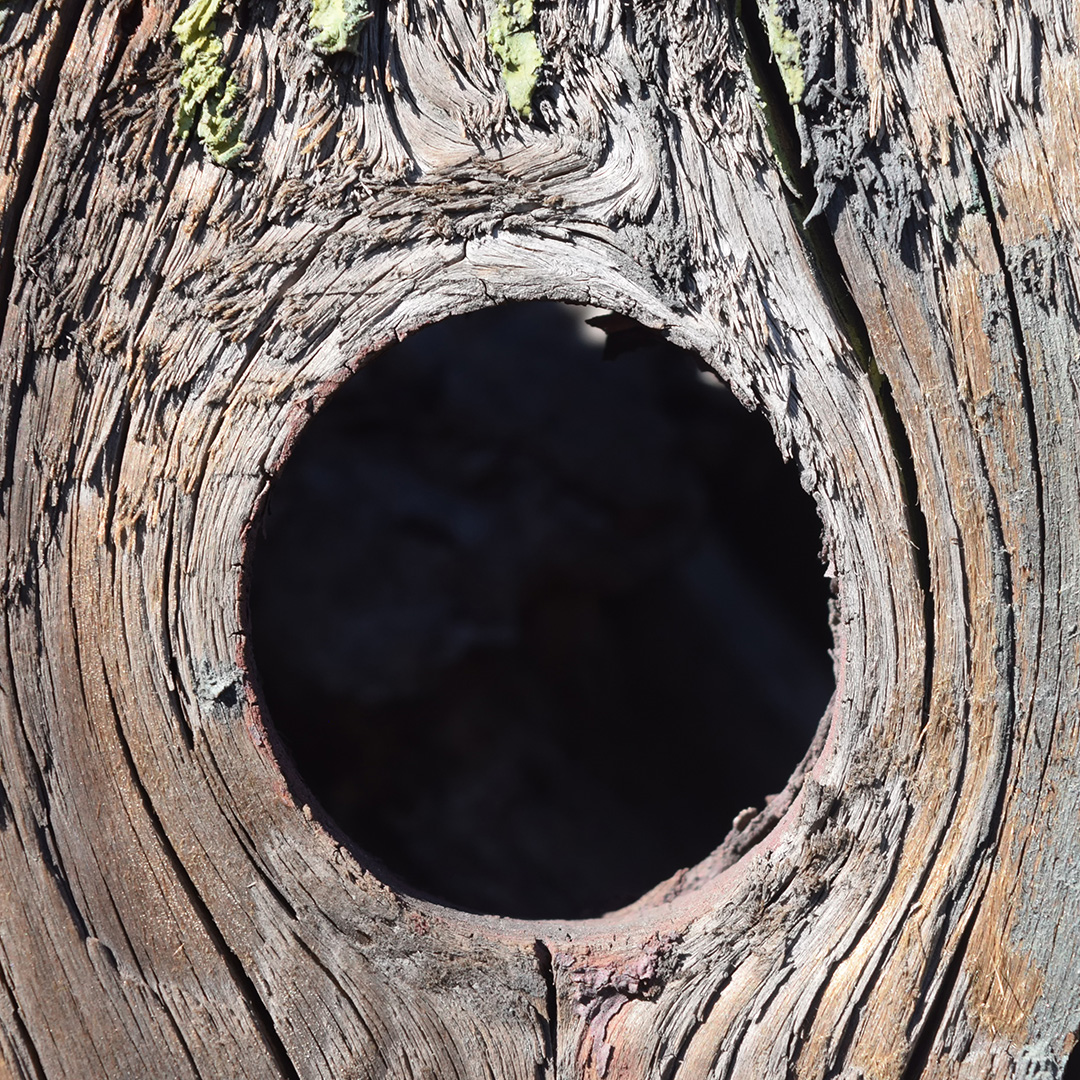
For example, a tree can have a hallow(hollow?)like this: https://www.elitetreecare.com/wp-content/uploads/2019/11/tre...

But it seems there is no strict boundary between the words, so if you say it is a hole I won't oppose that.

I don't know how to spell tushekyeredarim, but thanks!

I only recently came across the word "hallow" and assumed it was a misspelling or US-Americanism for "hollow". Thanks for a full answer.

This is awesome! Does anyone have a collection of similar kinds of fun questions?
Getting confused over holes has been a fun past time in academic philosophy for the past few decades, so trawling through the SEP for interesting topics can't hurt.
Thanks! Referring to "Stanford Encyclopedia of Philosophy" I suppose? (: