Hacker News new | ask | show | jobs
by Lammy 1380 days ago
I realize "Plasma" is the name of the KDE presentation layer across all platforms, but it's mildly awkward to see in this context considering plasma TVs have only been a dead technology for six years or so: https://en.wikipedia.org/wiki/Plasma_display
7 comments

Frankly it's disappointing that most of the comments on HN so far have been focused on the "marketing" and the website. The FAQ states that this project is still in very early stages and not yet intended for use as a daily driver. So if you actually read the website, it's clear why it's not consumer grade. I would much rather they focus on developing than marketing at this stage.

The basic thing going on here is simply that the KDE guys are working on a 10' experience and that's great, there is no good 10' experience today on Linux. Unless you count Steam Big Picture mode I guess? But a desktop environment which knows what to do about 10' would be really exciting.

Edit: for anyone who's interested, this appears to be the repo for the Bigscreen project: https://invent.kde.org/plasma/plasma-bigscreen/activity

The distro images on the website may be out of date.

The splash screen makes it look like this is something you can simply install on a television of your choice.

It is perfectly reasonable to criticise the marketing when it gets in the way of the message. Having to find and read the FAQ to discover that it is basically just a prototype desktop environment for existing distros is a bit silly.

I will admit that at first glance I thought this was a firmware hack for TVs, and I immediately started digging around the site to try to find a list of compatible TVs...

Once I found out what it was, it was still quite cool and I am curious to follow development, but I agree the site design/layout/copy is confusing at best, misleading at worst.

> I would much rather they focus on developing than marketing at this stage.

Totally reasonable to feel this way, but personally I think naming is so important that it transcends any technical merit a project might have.

For my own projects, I never write a single line of code until I come up with a name I truly love. Some times it takes weeks, but then the project has an identity which keeps me motivated over the long term and actually inspires my technical choices of what to build.

Compare to the “Yet Another” naming scheme which (to me) feels like a preemptive apology for a project’s mere existence: https://en.wikipedia.org/wiki/Yet_another

> Frankly it's disappointing that most of the comments on HN so far have been focused on the "marketing" and the website.

Or it's a strong signal toward the creators that their clever idea for naming was only clever in their heads and nowhere else?

I too got confused and was wondering "is this a project to revive old plasma TVs somehow?".

The marketing screenshots aren't too attractive honestly. It seriously seems to be lacking in consistent margins and padding. Look at the menu bar for example-- those icons are far too large for the space they fill. They look super cramped.

This is, somehow, typical in most Linux software I've used. They just don't care. :/

> there is no good 10' experience today on Linux.

What about Xbmc/Kodi? Works great on a raspberry pi hooked up to my TV... Has been doing that since the early 2000's when it ran on my brothers Xbox (original) but that was pre-Linux.

Edit: spelling

100% CPU redrawing the screen continuously. Or was, last I checked.
Here's a link with a lot more information. The big news today is that the UI component for Bigscreen has just gone live as a part of the KDE 5.26 beta, which is relatively straightforward to install on any Linux distro (or image to a USB stick): https://kde.org/announcements/plasma/5/5.25.90/

Maybe the post's main link should be changed to this one? That Bigscreen website seems to be confusing and out of date.

It makes me happy Big Buck Bunny is still being used for demonstrations.
What is a "10' experience"?
https://en.wikipedia.org/wiki/10-foot_user_interface

There are 10' experiences for Linux (Kodi, Plex, and Steam Big Picture are what I know of), but these aren't integrated into the desktop, they are focused on TV/movies and gaming respectively, so KDE focusing on this problem is something new.

I've never heard this term. Thanks for the great explanation.
It’s the common term for a user interface that’s large and legible to users sitting across a room from the display: https://en.wikipedia.org/wiki/10-foot_user_interface
Sitting three metres from the screen I presume.
No way. that would be a 9'9" experience, I believe..

Although I think your point is correct.

I'd say 10' is within the margin of error considering how many significant figures they gave in their estimate.
Is this essentially Lineage for smart TVs?

Can the vendor OS be wiped from these devices?

If so, is there a list?

I think that's close to, or part of, their vision: https://plasma-bigscreen.org/vision/

What they have in the Downloads section now is basically a variety of distro images which you can run on a Pi, or a device that supports pmOS, etc. There's a long way to go before you could buy any random smart TV and flash this onto it. Though maybe less long if you have a smart TV with an embedded Pi which might be a thing these days?

Yup. I wandered around page for about 20 seconds before realizing it wasn't some sort of open source hardware plasma TV.
I only realized it after reading this thread. Seems like a very confusing name chosen.
In combination with "Bigscreen" for sure.
Plasma (display) TVs are mostly dead - or at least no longer mainstream.

On topic: I'd love to have my TV run an open source OS that can run all the streaming apps to avoid OEMs snooping on what I'm watching

I'm pretty sure you'll only ever be able to have either an open source TV or all the streaming apps. No reason for Amazon, Netflix, YouTube, or the others to support this platform.
The biggest hurdle is the DRM. Plasma Bigscreen ship with it's own browser but you still need the proprietary blob for the DRM running on an ARM device instead of the usual one for intel/amd. Making things worse, even on intel/amd the video quality is often limited to 1080p on Linux.
Funny, since DRM is never an issue if you play pirated content. Arrgh maties!

But ironically, DRM is only a huge annoyance for paying law abiding customers.

Did you pay Ubisoft $50 10 years ago for Assassin's Creed 2, am amazing game? Great, because now you can go f*ck yourself instead of playing the game since Ubisoft took the server running the DRM for that game offline. Did you pirate the game? Great, because now you can play it for free indefinitely.

And there are countless horror stories of paying customer bases getting shafted on the products they (used to) own via DRM.

You have HDMI port, there are RPis and others, I don't think TVs are running image recognition on HDMI input (yet).
They do, which is why you should never connect them to the internet.
Seriously? Well not connecting them to the internet works less and less, Amazon is rolling out their 900Mhz mesh with echo devices and there's LTE-M, NB-IoT and such.

The idea of not letting a device connect to the Internet is slowly becoming a thing of the past unless you live in a faraday cage (which is becoming more and more tempting). Oh, correction, thanks to mesh networks like that of Alexa living in a Faraday cage is not actually enough if at least one device is connected. Yay.

LG WebOS TVs are capable of image + sound fingerprinting at OS level! Not only can they identify what you're watching, it's accurate enough to tell which scene you on and provide "handy" information overlays.
I'm pretty sure they do perceptual hashing of all displayed output.
The name is generally really unfortunate, and I wish they would switch back to KDE for the Desktop Environment (and call the framework Klibs or KDElibs or something).

Many people have positive associations with KDE, but associate Plasma with bloaty QML based desktop widgets from the KDE4 era. If they even associate it with KDE, and not with plasma TVs or blood plasma.

Literally what I thought the thread was about, and actually why I avoided clicking into it so long.
People who know KDE hardly need marketing - they already know what is what and what they want. So they could name it whatever way, I only care about how well does that name integrate in the whole namespace of Linux apps/libs/packages. At the same time, for non-techies or people coming from other OSes Plasma automatically sounds cool, doesn't it?

Nevertheless, as for what I personally feel, I agree - I like KDE better.

Admittedly i thought this as well. was hoping for a new plasma tech! Not that i think it's better, just nostalgia - it was the first 'new gen' tv I owned back in 2007. Heavy but well worth it at the time.
Still running my Panasonic 50" Plasma from that era. So heavy. And yes they are power hogs, but in reality, ours really isn't on that often. Three, maybe four hours a week, on average.

But oh, the picture quality back then, compared to LCDs and rear projection. No comparison, and even today, it holds up well.

I'm still rocking my 12 year old plasma TV, the thing won't die!
I connected a simple energy meter to my old (inherited with a house purchase so don't know exact age) 720p non-smart plasma TV to an energy meter just to get an idea of its power consumption. It was pulling between 350-400W! For comparison my 10 year old 1080p LED smart TV pulls about ~90W.
That's a benefit during winters in Canada, when it's on, I don't need to turn up the heat...
This trope is getting tired, heat pumps exist.
Maybe give it up, the energy savings associated with replacing it with a LCD/LED TV will quickly add up, environmentally and economically. Depends on how much TV you're watching though.
I still have a 50" 720p Toshiba plasma, from 2006.

Won't die... Been wanting to upgrade to a newer larger tv for years, but this thing keeps running along without issue...

I don't understand why people think electronics are supposed to die. Even if they do, it's often just some capacitors that died in the power supply. An easy fix!
this is about justification. The current thing works fine but I would like the new expensive thing. I cannot justify expense of replacing working thing, but if it would die, then it's justified expense.

it isn't about that it's more economical purchase when it dies, but I even saw people breaking stuff just so they "had to" buy new thing that they want.

Perhaps you’ve noticed this already but having bought my last TV in 2008 I had no idea how cheap they’ve gotten! Checking Amazon right now I see a 50” 4k Samsung for $450.
Expense doesn’t always mean purely financial. There is an environmental cost to buying something new as well, and a social cost in supporting the manufacture of electronics that may have less than perfect supply chain ethical standards.

I’m not saying this to be snarky or judgemental - your comment genuinely made me think about the issue and this was my response.

An inevitable consequence of consumerism: https://en.m.wikipedia.org/wiki/Throw-away_society
Back in the day, there was a strong public perception/rumor that plasma screens would fail much sooner than other kinds. Maybe it was just a FUD campaign, after all.
Plasma did have an issue with 'burn in' on static images. If you did a lot of gaming on them, you could see it. Same with banners on news programming.

If you watch a lot of movies, it isn't an issue. Plus, the TVs came with a 'burn in' reduction program that you could run a couple times a year, but that operated by sweeping an intense white bar across the screen, so you were effectively 'wearing' the pixels down to a similar level to reduce the obvious burn in. If you ran that cycle to often, it would kill the maximum brightness.

Could have been FUD from manufacturers looking to push thier LCD TV over the competition plasmas.
Depending on how much it's on in a day, and the price of energy the cost of replacing it with an LCD might pay for itself.
wouldn't LCD be downgrade? i never owned plasma tv, but AFAIK biggest advantage are perfect blacks, so I guess OLED should be more natural upgrade path?
OLEDs have very good blacks, but as soon as a pixel needs to emit any light at all, it will be significantly brighter than what a regular IPS pixel can emit at it's lowest brightness.
LCD with full-array local dimming can get really close. It also gets much brighter than OLED. It's a much tougher decision than it used to be.
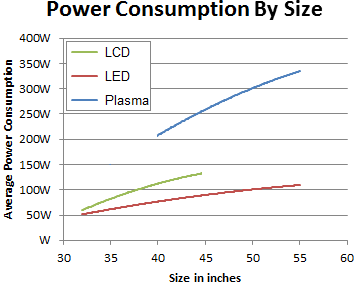
Also depends on the TV you upgrade to: replacing a 50" plasma with an 84" LCD will do nothing to decrease your energy usage.

While plasma uses a bit more energy than LCD it's not that big of a deal (especially if you've got one of the last gen plasma panels) if you don't use it as some sort of moving wallpaper but just turn it off when not in use.

Probably still would, if you interpolate this graph: https://www.rtings.com/images/power-consumption.png

Still, wouldn't recommend buying a huge TV. Jevons paradox and all.

Depends on the generation. I've got one of the last plasma's made (2013 model), it's a 42 inch panel and has a max consumption of 180W (only when at full brightness viewing a white screen).
Also, calling a home device "hackable" is not exactly going to make it attractive to most people. I know what they mean, but most people will read that very differently.
I highly doubt that "most people" would ever change their stock TV or TV dongle OS. So it targets geek and privacy-aware auditory and geek auditory understands what that means.
Not sure in other countries, but in my country (Korea) they were called PDP and rarely called plasma TV even knowing the technology behind it. It's a bit funny thinking about "Plasma" but it should be fine.

BTW, it had been dead for 10+ years...time flies so fast.

In Russia there was definitely a period when any large flat panel TV was called "plasma".