Hacker News new | ask | show | jobs
by c_o_n_v_e_x 1378 days ago
L5 GPS will address the multipath-in-urban-canyon problem that Uber worked on.
4 comments

If you're curious which phones support L5, check out the table linked on this page (SCROLL DOWN to "GPSTest Database" for the up-to-date table, since the first one is out of date): https://barbeau.medium.com/9be4bbb83a7b
Also E5 Galileo [1]. It's such a shame that so few smartphones have support for dual frequency GPS and Galileo.

[1]: https://gssc.esa.int/navipedia/index.php/Galileo_Signal_Plan

Is it really so few? Snapdragon got support for dual frequency in Snapdragon 855 released in 2018. Use the GPSTest app to see if your phone supports it.

https://github.com/barbeau/gpstest

Here are a couple of phones that don't have dual frequency:

- Samsung Galaxy A53 5G (https://www.gsmarena.com/samsung_galaxy_a53_5g-11268.php)

- Samsung Galaxy S10 (https://www.gsmarena.com/samsung_galaxy_s10_5g-9588.php)

- Samsung Galaxy S20 (https://www.gsmarena.com/samsung_galaxy_s20-10081.php)

- Nokia G60 (https://www.gsmarena.com/nokia_g60-11826.php)

- Google Pixel 5 (https://www.gsmarena.com/google_pixel_5-10386.php)

- Sony Xperia 10 IV (https://www.gsmarena.com/sony_xperia_10_iv-11522.php)

- Apple iPhone 13 Pro (https://www.gsmarena.com/apple_iphone_13_pro-11102.php)

If you want to have this feature you have to start looking at the high end models which are of course expensive. Last time I've checked only Chinese brands like Huawei, Xiaomi or Realme seem to offer it at a more affordable price range.

According to this list[0] some Samsung Galaxy S20 does support it, as does the Pixel 5 (and 4 and 6). Google also lists both models as having L5 support[1].

Of course the best way of knowing if your phone supports it is to test it yourself.

[0] https://docs.google.com/spreadsheets/d/1jXtRCoEnnFNWj6_oFlVW...

[1] https://developer.android.com/guide/topics/sensors/gnss.html...

I suspect the main barrier is patents/licensing/product differentiation rather than the actual difficulty of adding one more PLL, mixer and ADC.

Besides, nearly every phone could receive GPS L5 with the radios in the cell modem if they had a suitable firmware update.

iPhones got it just very recently. So at least half of tge market couldn't have it until recently.
It's not a perfect fix though. Even dual band multi network receivers will "jump around" a bit in deep canyons.

Example: https://hikingguy.com/hiking-gear/garmin-gpsmap-66sr-review-...

Parent is talking about "urban canyons" which is just fancy wording for cities, while you're talking about actual canyons.
It’s the same problem.
Except the population density being different, I guess yeah.
I don’t know much about L5. How does it do so?
It has a shorter wavelength so the correlation peaks are more narrow and hence more easily distinguishable. See this illustration [0] taken from this article [1]

[0] https://insidegnss-com.exactdn.com/wp-content/uploads/2021/0...

[1] https://insidegnss.com/end-game-for-urban-gnss-googles-use-o...

To oversimplify: It's on a different frequency and so will be subject to different forms of error. You can average the results of L1 and L5 to get a more accurate position.
Not just that. It's a higher frequency so the correlation peaks are more narrow and hence more easily distinguishable than L1 frequency
That's not how it works at all. L5 at 1176 MHz has a different ionospheric delay than L1 at 1575 MHz. Since the timing data is identical, you can calculate and remove the ionospheric delay if you can receive both signals at once.

Correlation peak width is an SNR property (and to a lesser extent dependent on receiver LO phase noise), not something that really corresponds to the RF band in use. Whichever signal is stronger (taking antenna gain into account) is the one that will yield better-quality baseband data.

L5 has a 10 times higher modulation ("chipping") rate than L1/2 which does lead to a narrower correlation peak width. However, it doesn't solve the multipath problem near tall buildings.
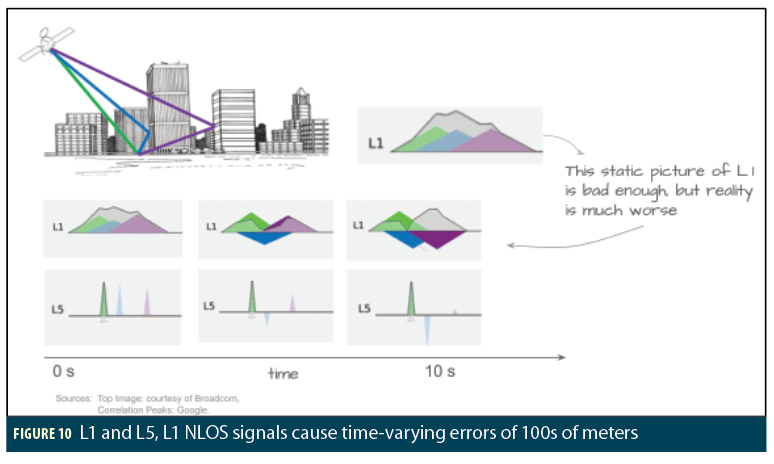
L5 is useful in many ways, but L5 really does produce more narrow correlation peaks than L1 as well [0]

[0] https://insidegnss-com.exactdn.com/wp-content/uploads/2021/0...

Yes, that's an SNR advantage due to processing gain. Works out to more or less 10 * log10(RF signal bandwidth / baseband data bandwidth) dB.

They could have done something similar at L1, but that ship has pretty much sailed.