As someone that is relying on a single high school chemistry class as a base of knowledge, why would Cl here give you pause? In other words why is the Cl here bad, but ok in say salt?
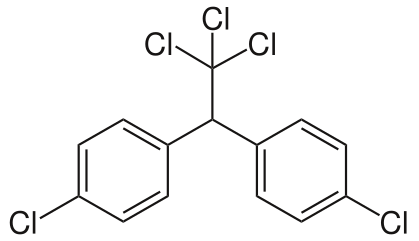
Chlorine-carbon (or halocarbons in general) bonds are somewhat rare in nature. That is not to say they don't exist, but they are a bit unusual. The problem with halocarbons (aside from fluorine, which has its own issues) is they are generally not very reactive, so they can bioaccumulate. But when they do react with biological systems, it tends to be in unwanted and toxic ways.
That said, as a former chemist, I consume sucralose, and I am not worried by it. Unlike most halocarbons, It's very water soluble, so it does not react in the ways the bad halocarbons do.
In salts and in sea water, the chlorine is in the form of free chloride ions, which is also the normal form of chlorine in your body.
In sucralose, chlorine substitutes a hydroxy group and it is covalently bonded to a carbon atom.
Most of the organic substances where hydroxy groups are substituted with chlorine atoms are more or less toxic and some are carcinogenic.
For example, substituting the hydroxy groups in carbonic acid with chlorine yields the toxic phosgene, which has been used as a chemical weapon in WWI.
> Most of the organic substances where hydroxy groups are substituted with chlorine atoms are more or less toxic and some are carcinogenic.
This kind of argument is so... "weird" to put it politely. H2O also becomes toxic if you add an oxygen atom. The safety of chemical compounds does not follow from a naive classification of bonds.
It's a heuristic. If you haven't done a randomized placebo controlled double blind exhaustive study of the compound and all you have to go on is the layout of the molecule, is it a bad guess?
That doesn't change whether or not it's a good heuristic. Whether it's a good heuristic depends on how often "extra chlorine hanging off the side" is indicative of toxicity. He didn't make a claim about one atom changes in general, and even if you did you would need to show that on average across many instances from the sample population (substances we are likely actually to run into) it's misleading.
Alkyl halides (carbon chains with halogens off of them) can be alkylating agents - basically they can bond to molecules within your body and if it's things like DNA, can cause mutations and other bad stuff.
Nitrogen mustards (highly reactive alkyl halides) are used in chemotherapy. They basically damage DNA which is used to kill off fast reproducing cancer cells (but they also kill off normal cells).
I was a little surprised when I first saw the structure of sucralose. Chlorides aren't that reactive (bromides and iodides are much more reactive), but a person might consume grams of sucralose so concentrations are high.
That said, many experiments have been done and sucralose isn't reactive at all. Due to the shape of the molecule and steric interactions, the chlorines are very difficult to knock off.
The fundamental difference is between the sugar ring (flexible, which each carbon having tetrahedral geometry, and localized electron density) and the aromatic benzene ring (flat trigonal geometry, with electrons delocalized over the ring).
If you attach chlorine to the latter, you end up with something that's very hard to break down (very persistent) and which will often (depending on exact structure) stick tightly to many biological molecules. Thus they can cause developmental disruption, odd forms of cancer, liver damage, etc. For example, TCDD (dioxin, a side product of many herbicide synthesis routes, a notorious component of Agent Orange formulations in Vietnam, etc.):
The chlorinated sugar ring is probably easier to break down but if this produces an activated chlorine species during metabolism, say in your liver, it might bind to who-knows-what and cause problems. Or it might just get excreted as a chlorine ion, no different from NaCl (table salt). I'd avoid it myself.
Some organo-chlorines (and -bromines) also occur in small amounts in many edible seaweeds, apparently often with the halide attached to fatty acids and lipids. Hence consuming large amounts of seaweed might not be the best idea either.
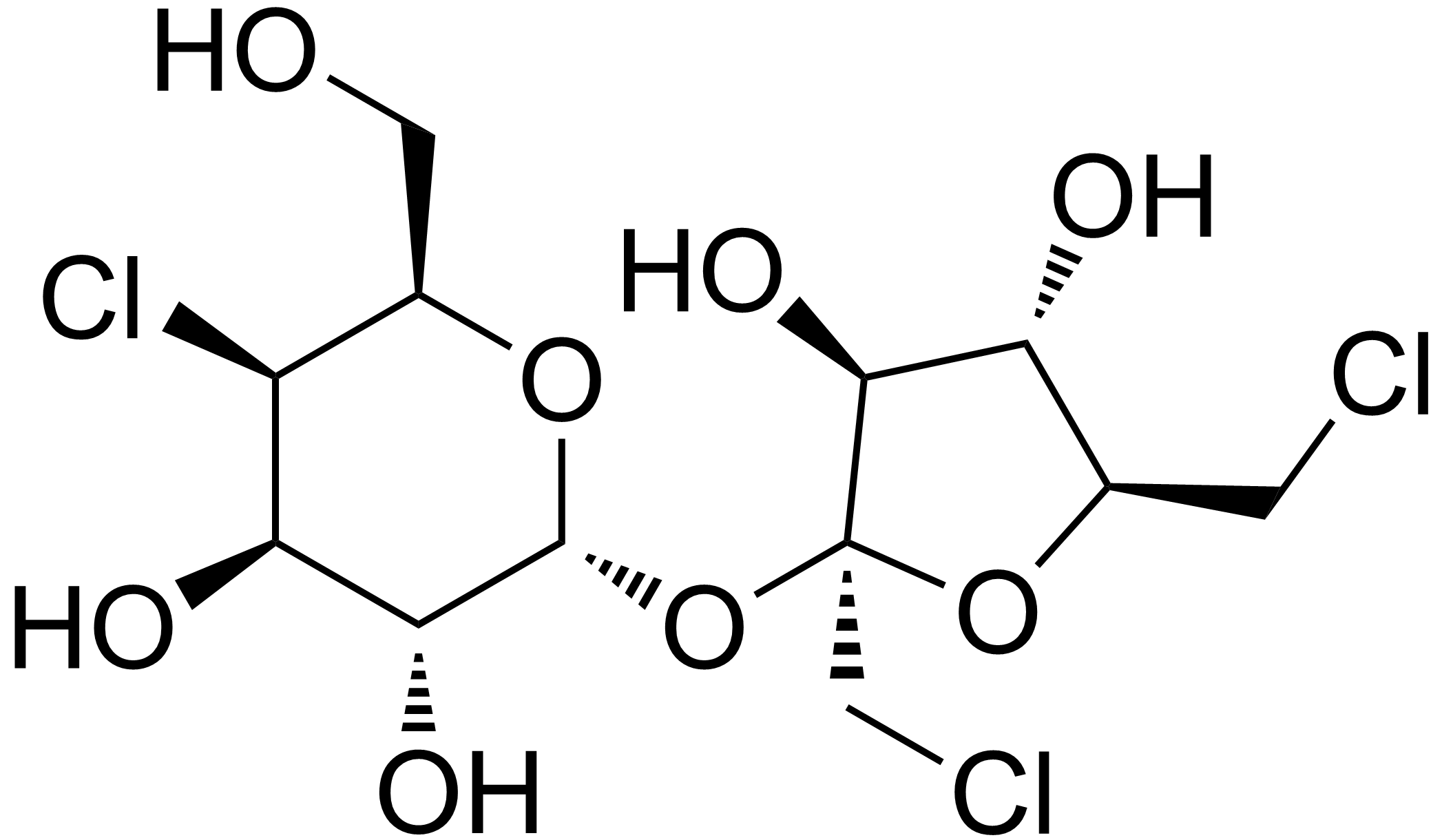
That said, as a former chemist, I consume sucralose, and I am not worried by it. Unlike most halocarbons, It's very water soluble, so it does not react in the ways the bad halocarbons do.