Hacker News new | ask | show | jobs
by emn13 1404 days ago
I think you're overstating the issues here; and it's necessary to take what you can get in hard-to-do comparisons like this. There are caveats: certainly.

The Ryzen chip's TDP is configurable between 15W and 28W, which would include the GPU (but I doubt most of these tests touch the GPU anyhow). There will be power usage differences, but the TDP difference won't be huge - most differences will be due to utilization differences, which might be large.

The RAM issue usually doesn't affect most benchmarks, but it's something to consider if there are odd outliers.

The CPU core count number represents the reality of these chips (but M2 has a 4+4 config, apparently?).

Using linux is likely far from ideal, but probably necessary for them to run such an extensive and mostly comparable set of benchmarks. It's a significant caveat, but for CPU-limited benchmarks it's hopefully merely of reasonably limited impact (on the order of 30% on average rather than 300%, say?). OS differences tend to be larger for I/O, GPU, and some niche things like context-switching benchmarks. Of course, the power scheduler stuff matters.

It's worth pointing out that phoronix itself (on different hardware and slightly older OS versions) looked at some linux vs. macos benchmarks: https://www.phoronix.com/review/apple-m1-linux-perf - and while there were a few unsurprising macos wins, there also were some (far fewer) linux wins.

I think the benchmark is very interesting for what it is. Despite limitations, it _is_ informative. You can't always get a shrinkwrapped answer to whatever question you really have; so extra data-points such as this are helpful.

You know what they say: there are lies, damn lies, and benchmarks. Or something like that; caveat lector anyhow.

4 comments

> Using linux is likely far from ideal,

This is Phoronix. Using Linux is the whole point, that's their audience.

Yep; I know. But for most people interested in this comparison that's nevertheless likely to make the comparison less representative of their workloads.

Hats off to phoronix; it's not meant as a criticism - just an expectation that the benchmark results may not satisfy everyone.

Feels like it makes perfect sense to compare performance on the same system. Is someone going to switch systems for some minor performance gains? I really doubt that. Usually it's something else that motivates people to switch.

That said people pick different manufactures for their next device all the time (at least in the Linux/Windows world) and having performance comparison for these devices on your favorite system helps you choose.

> You know what they say: there are lies, damn lies, and benchmarks.

Also, all benchmarks flawed, some are useful. This one is definitely useful.

> The Ryzen chip's TDP is configurable between 15W and 28W,

TDP isn't a relevant number since the Ryzens will exceed their "configured TDP" for an unlimited period of time.

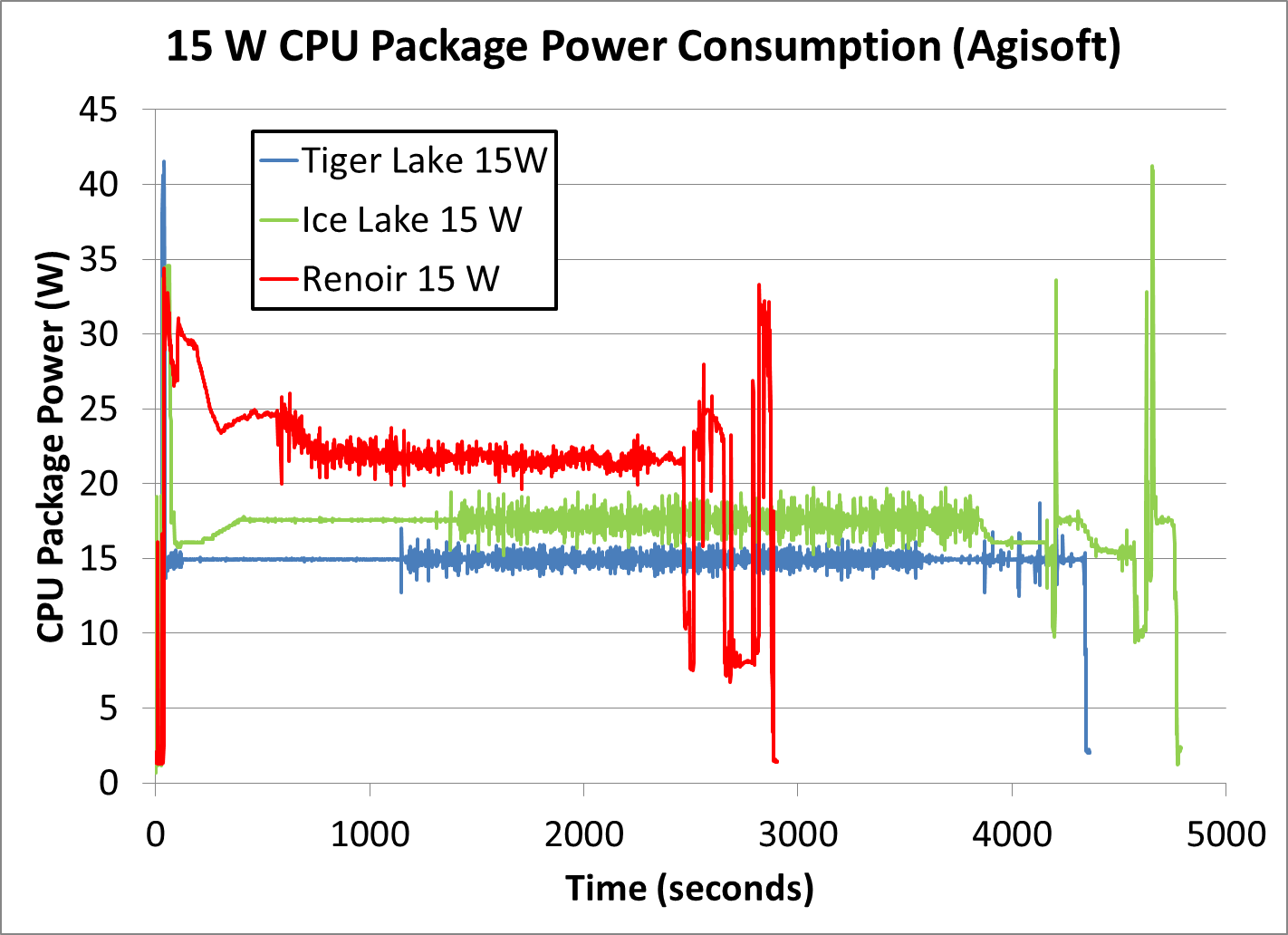
see, eg, Anandtech's Tiger Lake review where a "15W cTDP" Renoir chip pulls 23W, and it is allowed to sustain that boost for an unlimited period of time, going against Intel chips that actually obey the 15W configured sustained-power limits...

https://images.anandtech.com/doci/16084/Power%20-%2015W%20Co...

The relevant number for comparing Ryzen against Intel/Apple SKUs is what AMD calls the "PPT" which is their sustained-boost TDP. The "cTDP" number is basically pure marketing these days, nobody is running at base clocks outside of contrived scenarios.

(the Intel boost TDP is allowed to exceed the rated TDP too, but they only allow it for a limited time, it's a "sprint" feature on their chips, where AMD has just turned it into their new sustained TDP number, with the advertised TDP being essentially fake for marketing purposes it's specified at base-clocks that nobody ever runs.)

As far as I understand it, it's up to the device manufacturer to pick the exact TDP. It's by design that some devices might structurally exceed the base cTDP.

I don't know the figures for lenovo's thinkpad, which is why I quoted the full range AMD offers. And even then, TDP is just a long term target for the purposes of cooling - workload, implementation and environmental (i.e. temperature) details might leave two chips with identical TDPs to nevertheless consume vastly different amounts of energy.

In any case, we simply don't know how much power these systems used under this load. The expectation certainly is that the AMD system used more, but it's not clear how much more.

The focus on _power_, as opposed to _energy_, always annoyed me. When I'm using a notebook away from home, what matters to me is how long I can keep working.

Phoronix should have measured how long each notebook could run the benchmark suite sustained and scaled the benchmark results accordingly.

updated wording.

There is no sane universe in which we lie about how fast we can do something in order to account for differences in how long we can do it. If you have two models identical save for one having twice the battery we don't account for this by pretending the lesser endowed unit is actually only half as fast.

While these things are interrelated you actually want both pieces of data and you don't want them complected by using them to forge some number made entirely useless and incomparable by incorporating both facets in one useless whole.

15-20w is never the peak TDP. They will actually hit as much as 50-60w with minimal GPU usage just from trying to hit that insane clockspeed.

M1 maxed out at 22w according to Anandtech and the max shouldn't be too much different for the M2.

Actually Phoronix has power benchmarks for the ACPI power profiles[1]. Seems like a boost to ~28W or so with a long term average of 22-23W.

(Note that this is SoC package power instead of the full laptop though, but that is pretty typical, so no idea what the 22W was for comparison.)

[1] https://www.phoronix.com/review/ryzen7-6850u-acpi

I don't believe those numbers.

The 4800U hit north of 65w in a NUC device[0]. The 5800U hits 52w in a laptop[1]. AMD runs their chips hot.

TSMC N6 is a 7nm++ node. The even more advanced 5nm node only offers either 15% performance increase OR 30% power reduction vs N7. The 6850 clocks 10% higher, so the power shouldn't be dropping AT ALL.

The 6850H has an identical turbo clockspeed of 4.7GHz and a TDP of 45w with real-world power consumption according to other reviewers being north of 65w. The base clocks for these chips is 2.7 and 3.5GHz respectively.

In the case that they really are getting those numbers, they are certainly only at base clockspeeds (2.7GHz) which raises the impossible question of how Zen 3 suddenly got such a huge performance per clock advantage going from desktop to mobile.

The numbers simply do not add up.

[0] https://www.anandtech.com/show/16236/asrock-4x4-box4800u-ren...

[1] https://www.notebookcheck.net/R7-5800U-vs-E-2186M-vs-R7-PRO-...

As the sibling said those numbers are very configurable. e.g. around the x86 handhelds there are tinkerers running their U/P class chips at anywhere from 5W configured to 30+W configured (and with the appropriate cooling could totally go to 60W+ if configured to do so. Silicon-wise there is very little difference between AMD's U and H class chips, mainly just stuff like binning and some configuration in the firmware). Typical reasons to configure this would e.g. be cooling or battery restrictions from the OEM.

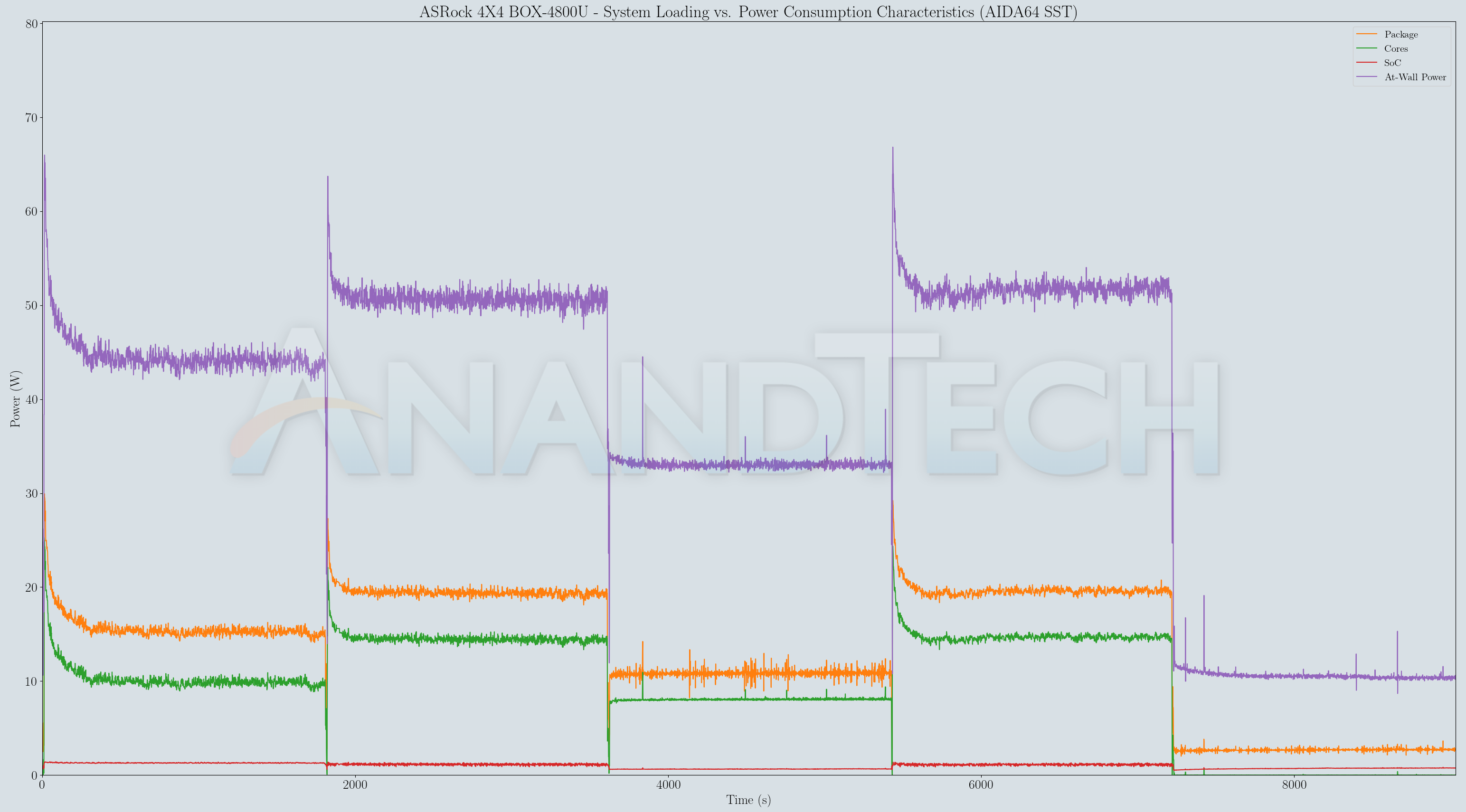
Furthermore note there is a difference between SoC package power and power pulled from the wall. That depends on the rest of the device, but 5-10W isn't unreasonable. (So e.g. at 22W package power, pulling ~32W from battery is pretty common). Looking at the detailed graph in the NUC review, that difference is particularly large though, the package only pulls <20W in steady state and maybe 30W at boost[0], but this device somehow seems to have significant power draw coming from somewhere else, this is pretty atypical wrt laptops & battery draw at least.

I'm not sure what performance per clock advantage going from desktop to mobile you're referring to? The mobile chips are slower due to the lower max boost and power limits, but due to non-linear power scaling it tends to be not that* much worse than the desktop parts.

As an aside I find the Anandtech Zen3 review[1] a pretty good resource when I want to have a clue about reasonable clock/power expectations on zen3 (though it is only a single workload)

(Also not sure where the 52W claim comes from, my searching on the linked page seems to yield no results?)

*: With the notable exception that pre-6000 series AMD had some horrible delay clocking up the cores when on battery, hitting short tests like geekbench. That said even on AC the chips should be adhering to configured power limits.

[0] https://images.anandtech.com/doci/16236/wm-aida_power.png [1] https://www.anandtech.com/show/16214/amd-zen-3-ryzen-deep-di...

If that NUC CPU is using 30w, then what else is using the other 40w? Where is that heat dissipating to when the ONLY heatsink is on the CPU itself?

What is missing in that story? Is it more likely that a mystery chip is dissipating 40w into that tiny chassis or that something isn't reported correctly?

Perhaps the answer is something to do with the chipset using a massive 40w of power. That isn't likely as even the actively-cooled desktop chipsets don't use that much power. Even if that's true, not only does the dissipation issue still go unanswered, but the SoC it is being compared to also moves everything on-chip, so adding in that power consumption is necessary for an equal comparison.

There's no suitable answer to this problem other than the reported numbers being wrong.

> I'm not sure what performance per clock advantage going from desktop to mobile you're referring to?

M2 peak performance at 3.5GHz is equal or better than desktop Zen 3 chips running at 5+GHz.

The second link you post shows the 5950X (with the best binned chiplets with the lowest power/core numbers) requiring 7.5w per core at 3.7GHz. That means you could barely get HALF your cores running at 3.7GHz at 30w. All of them at that speed (1GHz less than turbo) would take around 60w of power (by the way, 6850H has a 45w TDP and claims base clocks of 3.7GHz, so something doesn't quite match up there either).

Even hitting 8 cores at 2.7GHz seems to be a stretch within that 28w TDP limit. EPYC with it's top-binned chiplets requires around 4-4.5w per core to hit 2.45GHz base clocks.

Adding between 700MHz and 1GHz to the clockspeed plus a well-known 60% faster per clock design plus cutting cache in half for Zen 3 mobile (which increases total power usage too) makes the benchmark results super fishy as they would require massive increases in IPC (or massive crippling of the M2 chip). This is of course not true, which indicates something is wrong somewhere.

Firmware can set the power limit to whatever it wants. With the exact same processor, one computer may hit 65 W while a different one is limited to 28 W. There's also huge diminishing utility when it comes to power, so it's possible that the chip is only slightly slower at 28 W than at higher power.
That diminishing return is much more true at 150w than at 50w.

https://www.anandtech.com/show/16214/amd-zen-3-ryzen-deep-di...

When you look at per-core performance of desktop chips, things aren't rosy. Looking at the 5950 (most power efficient per core), it's taking almost 7.5w PER CORE to hit 3.7GHz. It hits 4.7GHz (peak frequency of 6850U) on just 4 cores while using 110w to do it. That's almost 23w per core.

Based on these numbers, taking 8 cores up to 3.7GHz would require 60w of power and that's just to hit the "base" frequencies of the 6850H which they say can be done with a TDP 25% lower than that (maybe dropping half the L3 cache makes that possible, but at an overall performance loss as moving stuff from RAM takes more energy than keeping it in L3 and I don't know that losing half the cache saves more energy than the addition of a GPU adds back to the chip).

Even if we assume a 12% energy efficiency bump (two thirds of the 18% transistor reduction and roughly inline with the 30% efficiency at N5 with a 45% transistor reduction), we aren't doing anything multithreaded anywhere near peak frequency. In fact, we aren't doing anything multithreaded past those terrible 2.7GHz base clocks at best.

Meanwhile, the M2 TDP didn't really increase. They can hit 3.5GHz on 4 cores while using 60% less energy than those AMD cores at 3.7GHz despite being about twice as wide and over 60% faster per clock. Back of the envelope calculations seem to indicate that 4 M2 big cores at 3.5GHz should be more than 2x as fast as 8 Zen 3 cores at 2.7GHz without even using little cores and completely ignoring Amdahl's Law.

Of course, all this just goes back to the question of how questionable this entire article really is.

If I remember correctly, benchmarks of the ryzen 6800u (not quite this chip, but close) showed that the perf/watt sweet spot was probably _less_ than 15W. Even at 28W there were clear signs of diminishing returns, and anything north of 50W is largely pointless.

The intel competition in the form of alder lake scales for much longer if you just pump more juice into it. Scaling varies from chip to chip.

Edit - I might be misremembering, because 6900HS's sweet spot was at 20W: https://www.anandtech.com/show/17276/amd-ryzen-9-6900hs-remb... But anyhow, they also noted that "going from 50 W to 80 W is a 60% power increase for only +375 MHz and only +7.7% increased score in the benchmark".

But TL;DR: 15-28W probably really is the ideal range for a chip like this. Which won't stop ODMs from pushing well beyond that, of course.

I highly doubt those 50 or 60 watt examples are representative of the power use of those U-series CPUs in a 13" laptop. Perhaps it has been configured differently in a NUC.

Anecdotally, my work laptop has a previous-generation Ryzen 7 5850U (8 cores, 16 logical) in a 14-inch ThinkPad chassis. I just tried a 16-thread xz compression on it a few times and eyeballed the average power use with powertop. The baseline power with no load (except for what little idle load there was from whatever I had open) of the entire system was around 5 W with display brightness at a minimum. The battery discharge rate rose to between 21.5 and 22.5 watts for the couple of minutes the compression took.

This was on battery since I had no tools for monitoring power use at hand otherwise. (Turbostat reports detailed per-core and per-package wattage from the CPU at least on Intel but the distro I've got for work apparently doesn't have that packaged and I'm not going to be hunting for a source package for this.)

However, the compression took pretty much exactly the same amount of time on AC, so I doubt having it on battery affected CPU clock rates significantly.

A 13" laptop chassis would also have serious trouble getting rid of 50 or 60 watts of prolonged heat production from the CPU.

Also, where did you get the 52 watts in a laptop figure? The only reference to 52 on that page w.r.t the 5800U that I can find is a results of 51.9 points per watt, whatever those points are, in some kind of a power efficiency test. The power consumption test above that reports 42.9 watts, measured with an external monitor, so probably including more than the CPU. I also can't immediately find a reference to what kind of a chassis the CPU was in, laptop or otherwise.

> raises the impossible question of how Zen 3 suddenly got such a huge performance per clock advantage going from desktop to mobile

What kind of a PPC increase did Zen 3 get going mobile? I've only read about PPC comparisons between Zen 2 and Zen 3.

That's Intel's boost behavior, AMD is much more linear. My 4750U in performance mode never exceeds 25W and settles at 23W under sustained load.
What device is that chip in and at what frequencies is it running (by number of cores in use)?
Lenovo ThinkPad Gen1 AMD, Arch Linux, acpi platform_profile = performance

When running stress-ng, measured with turbostat:

- 4.18 GHz single thread consuming 9W

- 3 GHz 16 threads consuming 25W, ramping down to 2.94 / 23W after a couple of seconds

and when compiling Linux on 16 threads it stays at 2.85 GHz / 23W

In performance mode it does run at 80 degC under sustained load, so usually when undocked I just leave it in balanced mode where it's capped at 20W short / 15W long

Also worth noting is that in low-power mode (11W / 11W) it'll still hit max single core frequency possible.

[citation needed]