Hacker News new | ask | show | jobs
by Manuel_D 1520 days ago
The goal of the Paris accords is to have zero emissions by 2050. Not just zero emissions from electricity, but all emissions eliminated: transportation, industry, and heating too. Just the electricity usages amounts to 500 GWh per hour for the US and 2.5 TW globally. Storing even just 4 hours of storage (a modest goal, many renewable plans call for days of storage) is outside the scope of anything we could deliver through existing options.

The plan for renewables is to build until saturation is reached, then burn gas while we cross our fingers and hope that an invention makes storage effectively free.

1 comments

You can repeat this until you are blue, and it will still not be true.

Also: the Paris accords are for net-zero. That means no more carbon emissions than carbon reclaimed and sequestered. (Carbon reclaimed and then burnt again does not count.)

Sequestration is an even bigger moonshot than storage. Most of the "carbon offsets" are in the form of payment in exchange for other countries to agree not to cut down forests. It isn't actually removing carbon from the atmosphere.

Actually removing carbon dioxide from the atmosphere is the stuff of scientists and PR moves. Nobody has a serious plan to remove carbon dioxide from the atmosphere at relevant scales. The only example I can find would capture only 900 tons of CO2 per year.

We'd need to build 4 nuclear plants for each one that exists in the US to have a 100% nuclear electrical grid. It's something that we've done before, we would reach this goal early if we built plants at the same place we did in the 1960s and 1970s. This doesn't rely on a moonshot succeeding.

Renewables rely on a storage breakthrough or a sequestration breakthrough (but if we have the latter we could just keep using fossil fuels anyway). Relying on any kind of breakthrough yielding a 1,000x improvement is very reckless. You can insist until your lips turn blue that we just need to some type of electrolysis invention of another breakthrough of thermal storage and it's surely right around the corner. But until storage or sequestration is on the market, there's no real plan just hope that some breakthrough will happen.

1. https://www.climatecentral.org/news/first-commercial-co2-cap...

It would take until well after 2050 to build those, and they would cost many, many times as much as renewables + storage, and produce zero kWh in the meantime. Just the money spent on coal, in the meantime, not counting nuke construction, would be more than the cost of building out enough renewables.

No "breakthroughs" are needed for storage. Everything works already. All that is unknown is which will end up cheapest.

But you already knew all of this.

> It would take until well after 2050 to build those, and they would cost many, many times as much as renewables + storage, and produce zero kWh in the meantime.

Again, no, if nuclear power plant construction was carried out at the same rate as it was in the 1960s and 70s it'd be completed on time. You might be doubtful that we'd be able to manage that pace of construction in the 21st century, but at least there's precedence for that pace of construction actually being achieved.

> Just the money spent on coal, in the meantime, not counting nuke construction, would be more than the cost of building out enough renewables.

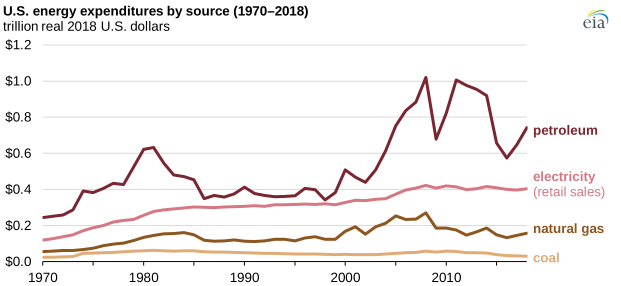
That's a very bold, source-less, claim you're making. Unfortunately the numbers don't even remotely add up. At a total of 535 million tons, and 36.14 dollars per ton for electric power consumption, we're looking at only $20 billion dollars of coal sales [1]. And that's generously assuming that all coal production went to electricity. If you're including power plant construction, that figure doesn't change much [2]. It's so small it's hard to see on the graph, but it appears to be below $25 billion dollars [3].

> No "breakthroughs" are needed for storage. Everything works already. All that is unknown is which will end up cheapest.

Right. We know something will make storage incredibly cheap. We don't know what kind of storage it will be. We don't have examples of it being delivered at that cost. But we just know it in our heart that something will save us and make intermittency a non-issue.

This is called "hope" and it's not a plan. The plan is to keep burning natural gas while wind and solar aren't producing, and keep our fingers crossed that our miraculous something will come about.

1. https://www.eia.gov/coal/annual/

2. https://www.eia.gov/todayinenergy/detail.php?id=45076

3. https://www.eia.gov/todayinenergy/images/2020.09.10/chart2.s...

You may continue posting falsehoods, and I will continue pointing them out.

We don't need "something" to make storage cheap. Storage is cheap, and is getting cheaper.

Again, we are not building storage out yet because we don't have enough renewables to charge it from yet. Instead, we are right now building out factories to make it. E.g., the factories to make iron-air batteries, $20/kWh, are under construction right now. Ammonia synthesis plants are under construction right now. Tankage for ammonia is dirt cheap. No breakthroughs needed, just build-out.

When we do get to building out storage itself, it will be cheaper than it already is.

Rather than stating that their (sourced) claims are false, perhaps you could post some sources for your claims instead? For example, it would be great to see references for the cost of storage and why storage isn't being built yet.
It would also be amazing if you posted any sources, or examples.

All we know is that France has cheap electricity (nuclear) and Germany majestically fucked up by shutting down nuclear, wanting to build renewables, and in turn ended up addicted to Russian carbon drugs.