Hacker News new | ask | show | jobs
by NoGravitas 1525 days ago
> In penmanship class, we learned a standard cursive font. I think it’s the standard cursive font, in fact.

He's wrong that there's a standard cursive. Different countries and different centuries have used a variety of different cursives. Most Americans who were taught cursive in school learned either Zaner-Bloser or D'Nealian, which both derive from Palmer. Both of them are terrible. They have indistinct letter shapes that degrade horribly when written quickly.

Cursive Italic handwriting is much more legible, if slightly slower. There are popular systems including Getty-Dubay Italic and Barchowsky Fluent Handwriting. Both of those are fine, and should be strongly preferred to 19th-20th century cursive.

7 comments

In re: different countries: students who study Russian (or, I assume, other languages that use a similar alphabet) typically learn to write Russian in cursive. The letter forms overlap with English/American cursive, but not perfectly, and of course there are OTHER letters, too, that we lack.

(Russian cursive is also notoriously hard to read for non-native speakers owing to a few idiosyncrasies: some letters are entirely different written vs. in print, and the letter forms can lead to ambiguity -- certain letter combinations are effectively identical.)

A near-universal phenomenon among people I've spoken with who took Russian in college is the unconscious blending of the two letter sets. Students, myself included, would routinely find themselves using Russian letters in English script while writing without realizing it, and sometimes even reading it later without realizing the presence of Russian letters.

I knew it was happening to me, but it wasn't until I loaned my political science notes -- ostensibly in English! -- to a non-Russian-student pal that the prevalence of the swaps were really clear. "Uh, I absolutely cannot read this."

Ooops.

Anyway, it's tangential to this topic, but I thought it was interesting enough to share.

This is the first link I found with illustrations of the Russian cursive alphabet:

https://golearnrussian.com/russian-cursive/

It’s very likely that English cursive is insufficient to really write the English words - since English pretends to only have 26 letters but so many do double or more duty - sometimes distinguished by diphthongs or other mechanisms but often just assumed you’ll know which pronunciation is right.

I wonder if the Russian cursive slips in because it has sounds that are closer.

"It’s very likely that English cursive is insufficient to really write the English words"

That is a very, very weird assertion.

In any case, the letters that would get swapped in were 1-for-1 replacements for the English ones, though, so I don't think that's the factor.

What fascinated me when learning both Russian and English cursive is that Russian cursive makes writing in Russian much much faster, whereas English cursive (the one taught in school) just slows you down and is absolutely counterintuitive.. Also, I am yet to meet a person who is not confused by the cursive English G..
This is a good comment. I do have a contrary opinion however as I generally recommend a spencerian derivative over an italic one to new learners these days. One could say simple Spencerian derivatives are like Rust with a steep learning curve to inculcate the core shapes into muscle memory but have lesser overhead during runtime owing to their dependence on muscle memory. Italic derivatives otoh more like Go, easier to pick up initially, but relative to penmanship variants have a higher runtime overhead. This is a silly analogy, but drawing from my experience teaching penmanship and calligraphy to people of different age groups is what I’ve seen to be true, mostly in younger age ranges. Older people usually do better with italic variations. A good reason, I recommend spencerian/penmanship derivatives is that they let one write more efficiently with higher precision during flow moments as letting muscle memory do the work helps with learning the task at hand.

A small nitpick, Zanerbloser doesn’t derive from palmer script, but they both absolutely do belong to the same family.

Great point about muscle memory, I found it fascinating to learn Spencerian as it kind of distills the essence of writing to a surprisingly low number of forms (7 or 8 I think?), a kind of local optimum for Latin-based cursive. The hardest thing for me to learn about it, with which I still struggle, is keeping the arm posture correct and using the upper, rather than lower, part of the arm for control.

I also found it really interesting to discover that the prescribed 52 degree writing angle for Spencerian is almost exactly what you get matching the diagonal on an 8.5" by 11" piece of paper (I'm surprised that's not more widely known!). Thus, rather than a difficult and seemingly arbitrary requirement, it's a super easy way of attaining consistency by simply rotating the page so its diagonal goes straight away from the writer. (If you're using US Letter paper, anyway)

> The hardest thing for me to learn about it, with which I still struggle, is keeping the arm posture correct.

It’s great that you recognize this handicap as dealing with it sooner rather than later is a good; bad posture is indeed harder to correct later as we know. The first measure you can take is course correcting yourself over shorter intervals i.e.Move The Paper towards yourself with no shame, even during the length of a line, as often as need be. Even Louis Madarasz did it, so don’t hesitate. But I think your fix becomes a habit, it becomes a non-issue later.

> ... the proscribed 52 degree writing angle for Spencerian is almost exactly what you get matching the diagonal on an 8.5" by 11" piece of paper

If this is true, you just blew my mind, thanks for sharing the discovery.

> If this is true

  arctan( 11 / 8.5 )
What Spencerian derivative(s) can you recommend?

Asking because I think I've got about as much benefit as I'm going to from having used a fountain pen exclusively for the last five or so years, so I'm looking at this point to learn a proper script. It sounds like you're considerably more familiar and may know some good places to start, and I'm hoping to get the benefit of your experience.

Not the OP, but I learned by reading and practicing alongside Spencerian Key to Practical Penmanship[0], by Platt and Henry Spencer themselves. It goes into an astonishing amount of detail; while there are probably newer adaptations I think you'd be hard-pressed to find a more comprehensive treatment.

[0]https://archive.org/details/cu31924029485467/page/n47/mode/2...

This is good. Good penmanship and the pursuit of it is a very enjoyable and rewarding practice. Since you mentioned you experience with fountain pens and a desire to learn a spencerian derivative, I want to give you a heads up that fountain pen experience doesn't necessarily translate but you still have an edge of course.

As far as recommendation goes, I think you should see if you would be content with learning something like the afore-mentioned D'Nealian method, which involves a lot of printing and shape reproduction, and stick to it. You can get far using a fountain with this.

However if you have the desire to reach for something more, I would recommend looking into a good "Business Writing" hand. There should a introductory book on a decent business hand produced by Ziller Inks on the Apple book store. I'd get that, it was pretty affordable last time I checked.

The business hand is a beginner friendly entry into the spencerian family and let's you carry your progress into more refined spencerian hands when you are ready for them later. Download a copy of the book "C.C.Canan - Collection of Penmanship" to see the kind of spencerian hands you could aspire towards.If you chose this path, it's a long journey so it depends on your personality like most hobbies.

Penmanship is a weird hobby, it looks both simple and intimidating at the same time. If you feel like you could use some personal advice, leave a comment and I'll reach out to contact info on your profile. I'm not an expert(I've seen what experts do and boy am I not one) but generally enjoy sharing penmanship learning advice so I don't mind a consultation or two.

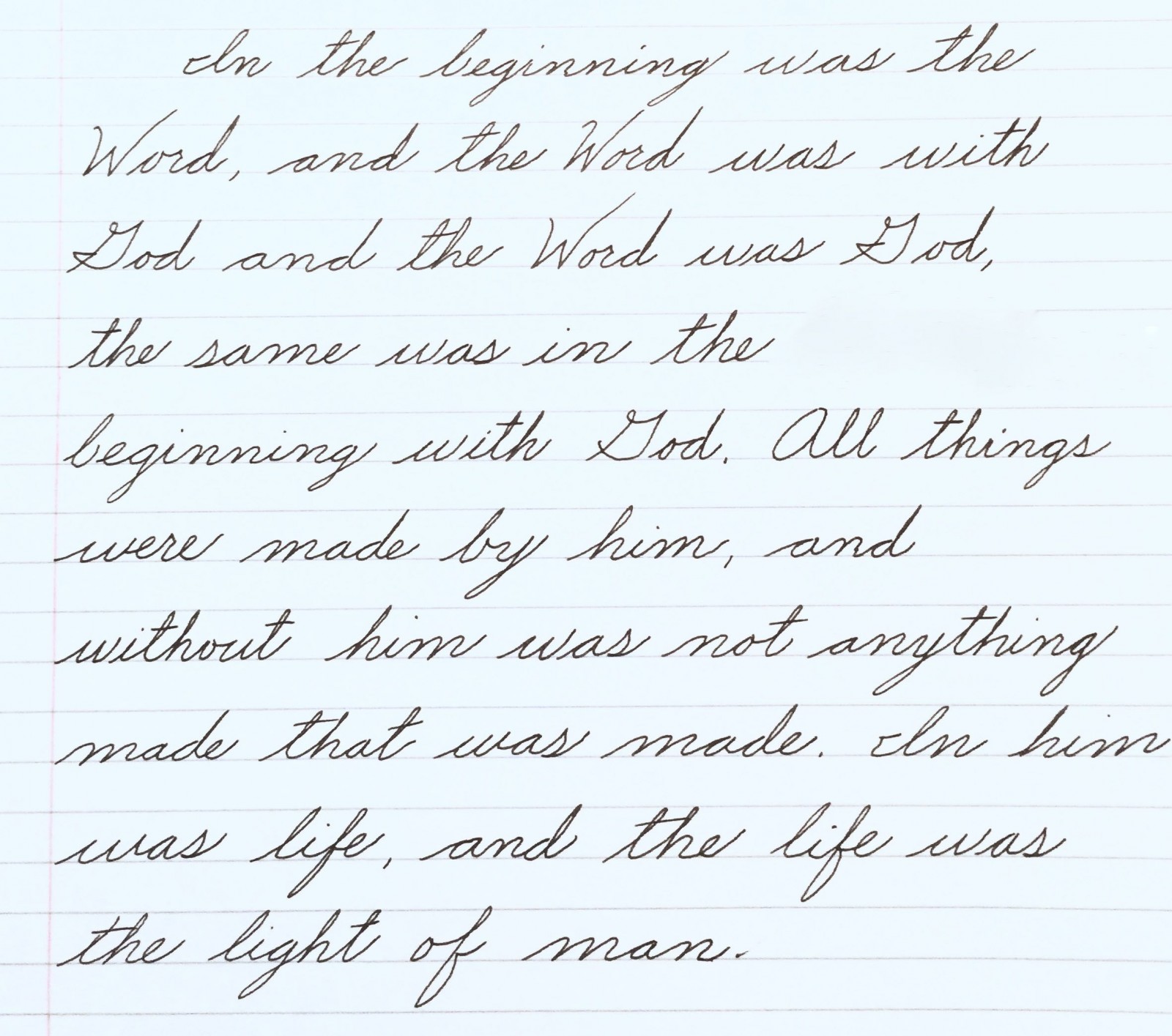
This Spencerian example looks like what I learned in U.S. (Northern Utah) schools in the 80's. It doesn't say what it's called other than "Early American Spencerian".

http://www.richimages.net/wp-content/uploads/2015/07/spencer...

That one is a little bit simplified, and as such is very close to something like D'Nealian which is what I learned in school. Technically in Spencerian the letters "d", "t", and "p" have the same basic stem height and are somewhat shorter than other full-height lower case characters. Basically instead of two heights for lower case letters, you get three.

But adapted into business script AFAIU the simplification into two heights, and the shrinking of the "p" stem, is pretty common. I'm definitely not used to making "p" taller than "q" and I am not always consistent about it.

Here’s an image comparing the systems mentioned by the parent (excuse the .ru…)

http://www.calligraphy-union.ru/EditorFiles/image/news/66315...

Nice. I learned cursive italic from a different source, but my handwriting looks almost exactly like that sample of Barchowsky Fluent.
A few years ago I made a conscious effort to improve my handwriting and got a few fountain pens, to me transitioning from D'Nealian to a Spencerian variant was pretty easy and I think the latter is faster, more legible, and more comfortable to write. Although the differences are more significant IMHO if using a fountain pen.
I'd toyed with fountain pens on and off for twenty years. In 2019, I dug an old Waterman Expert out of my closet, watched some videos for how to use bottled ink and converters and off I went into the hobby.

I still use traditional late 20th century American cursive (D'Nealian, I think), but all the practice with fountain pens has made my handwriting more legible than it's been in a long time.

Cursive came about because writing with quill and dip pens required you keep the nib on the paper for as long as possible, lest it dry out, or the ink drop to the page. Fountain pens aren't as bad in this regard, but still do better when the ink is flowing than just waving about in the air.

I happily take work notes all day long with fountain pens (today I have a Pilot Custom 74 inked up). I wouldn't want to give them up.

Likewise! And if you've yet to try a Vanishing Point or a Decimo, you've got a pleasant surprise in store, I think - I've found them nearly perfect for work notes in particular thanks to their speed and ease of one-handed operation.

(The Vanishing Point was admittedly a little too big and heavy for comfort, but a Decimo has the same nib and mechanism in a lighter, narrower body. Looks a lot more elegant, too, with the smoother rounding of the shoulder.)

The Decimo is a great form factor, it's also just about the most inconspicuous fountain pen possible so you won't get weird looks from people who've never seen a fountain pen before. That said I have one as well as a Custom 74, both in EF, and somehow I like the 74 a lot more in that size. The Decimo nib seems finer and is noticeably softer (18k vs 14k), and I'd prefer it with a medium nib for maximum smoothness. I think it also dries out a little bit, something that I've never had with the Custom 74.

On the other end of the spectrum I have to recommend the Lamy Safari and Kaweco Sport for their utilitarian design and timeless aesthetics.

The award for utilitarian and timeless has to go to the Lamy 2000.

The Safari is very good as a starter (though I'm partial to the Pilot Metropolitan or TWSBI Eco for starters). I don't have experience with the Kaweco Sport, though I hear only good things.

> Zaner-Bloser or D'Nealian, which both derive from Palmer.

This is not accurate. Zaner predates Palmer.

> Both of them are terrible. They have indistinct letter shapes that degrade horribly when written quickly.

I would more attribute this to...

  1. Unskilled modern penman
  2. An eye that's unaccustomed to reading old script
... rather than something intrinsic to the style. Business penmanship was, after all, created to be fast & legible. Historical pieces of penmanship are most often legible, particularly when written by skilled penmen.

Source: was professional penman, specifically studying 1860-1920 American penmanship.

I'm almost certain I was taught Palmer in Christian school when I was a kid. I still hate how certain letters look but it's hard to change how I write now. 34 I've been at odds with the letter "r".
I like cursive italic a lot.

+ beautiful; consistent letter forms between printing and cursive

- better with chisel vs. round tips; joins are still somewhat complicated