Hacker News new | ask | show | jobs
by srik 1526 days ago
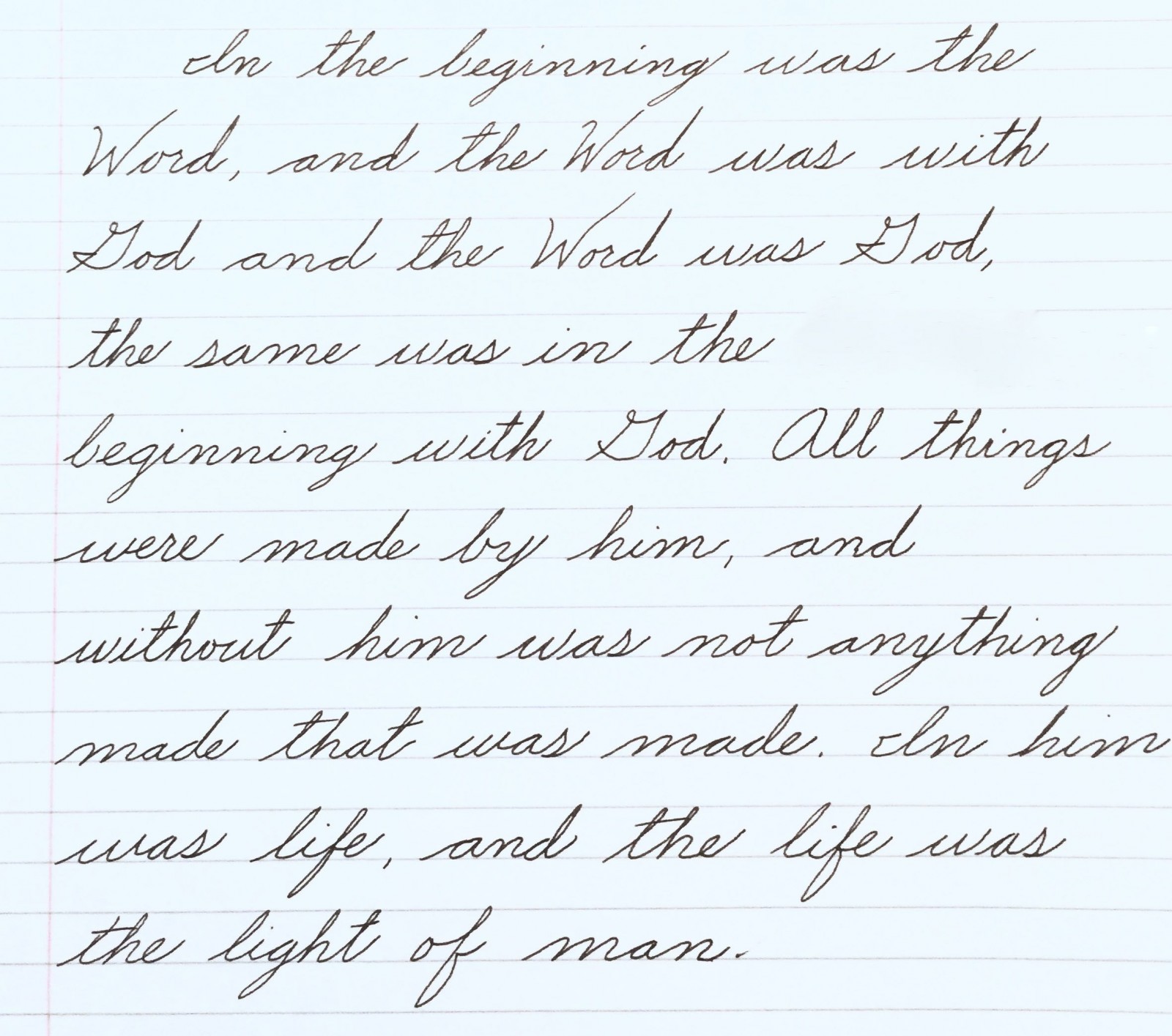
This is a good comment. I do have a contrary opinion however as I generally recommend a spencerian derivative over an italic one to new learners these days. One could say simple Spencerian derivatives are like Rust with a steep learning curve to inculcate the core shapes into muscle memory but have lesser overhead during runtime owing to their dependence on muscle memory. Italic derivatives otoh more like Go, easier to pick up initially, but relative to penmanship variants have a higher runtime overhead. This is a silly analogy, but drawing from my experience teaching penmanship and calligraphy to people of different age groups is what I’ve seen to be true, mostly in younger age ranges. Older people usually do better with italic variations. A good reason, I recommend spencerian/penmanship derivatives is that they let one write more efficiently with higher precision during flow moments as letting muscle memory do the work helps with learning the task at hand.

A small nitpick, Zanerbloser doesn’t derive from palmer script, but they both absolutely do belong to the same family.

3 comments

Great point about muscle memory, I found it fascinating to learn Spencerian as it kind of distills the essence of writing to a surprisingly low number of forms (7 or 8 I think?), a kind of local optimum for Latin-based cursive. The hardest thing for me to learn about it, with which I still struggle, is keeping the arm posture correct and using the upper, rather than lower, part of the arm for control.

I also found it really interesting to discover that the prescribed 52 degree writing angle for Spencerian is almost exactly what you get matching the diagonal on an 8.5" by 11" piece of paper (I'm surprised that's not more widely known!). Thus, rather than a difficult and seemingly arbitrary requirement, it's a super easy way of attaining consistency by simply rotating the page so its diagonal goes straight away from the writer. (If you're using US Letter paper, anyway)

> The hardest thing for me to learn about it, with which I still struggle, is keeping the arm posture correct.

It’s great that you recognize this handicap as dealing with it sooner rather than later is a good; bad posture is indeed harder to correct later as we know. The first measure you can take is course correcting yourself over shorter intervals i.e.Move The Paper towards yourself with no shame, even during the length of a line, as often as need be. Even Louis Madarasz did it, so don’t hesitate. But I think your fix becomes a habit, it becomes a non-issue later.

> ... the proscribed 52 degree writing angle for Spencerian is almost exactly what you get matching the diagonal on an 8.5" by 11" piece of paper

If this is true, you just blew my mind, thanks for sharing the discovery.

> If this is true

  arctan( 11 / 8.5 )
What Spencerian derivative(s) can you recommend?

Asking because I think I've got about as much benefit as I'm going to from having used a fountain pen exclusively for the last five or so years, so I'm looking at this point to learn a proper script. It sounds like you're considerably more familiar and may know some good places to start, and I'm hoping to get the benefit of your experience.

Not the OP, but I learned by reading and practicing alongside Spencerian Key to Practical Penmanship[0], by Platt and Henry Spencer themselves. It goes into an astonishing amount of detail; while there are probably newer adaptations I think you'd be hard-pressed to find a more comprehensive treatment.

[0]https://archive.org/details/cu31924029485467/page/n47/mode/2...

This is good. Good penmanship and the pursuit of it is a very enjoyable and rewarding practice. Since you mentioned you experience with fountain pens and a desire to learn a spencerian derivative, I want to give you a heads up that fountain pen experience doesn't necessarily translate but you still have an edge of course.

As far as recommendation goes, I think you should see if you would be content with learning something like the afore-mentioned D'Nealian method, which involves a lot of printing and shape reproduction, and stick to it. You can get far using a fountain with this.

However if you have the desire to reach for something more, I would recommend looking into a good "Business Writing" hand. There should a introductory book on a decent business hand produced by Ziller Inks on the Apple book store. I'd get that, it was pretty affordable last time I checked.

The business hand is a beginner friendly entry into the spencerian family and let's you carry your progress into more refined spencerian hands when you are ready for them later. Download a copy of the book "C.C.Canan - Collection of Penmanship" to see the kind of spencerian hands you could aspire towards.If you chose this path, it's a long journey so it depends on your personality like most hobbies.

Penmanship is a weird hobby, it looks both simple and intimidating at the same time. If you feel like you could use some personal advice, leave a comment and I'll reach out to contact info on your profile. I'm not an expert(I've seen what experts do and boy am I not one) but generally enjoy sharing penmanship learning advice so I don't mind a consultation or two.

This Spencerian example looks like what I learned in U.S. (Northern Utah) schools in the 80's. It doesn't say what it's called other than "Early American Spencerian".

http://www.richimages.net/wp-content/uploads/2015/07/spencer...

That one is a little bit simplified, and as such is very close to something like D'Nealian which is what I learned in school. Technically in Spencerian the letters "d", "t", and "p" have the same basic stem height and are somewhat shorter than other full-height lower case characters. Basically instead of two heights for lower case letters, you get three.

But adapted into business script AFAIU the simplification into two heights, and the shrinking of the "p" stem, is pretty common. I'm definitely not used to making "p" taller than "q" and I am not always consistent about it.