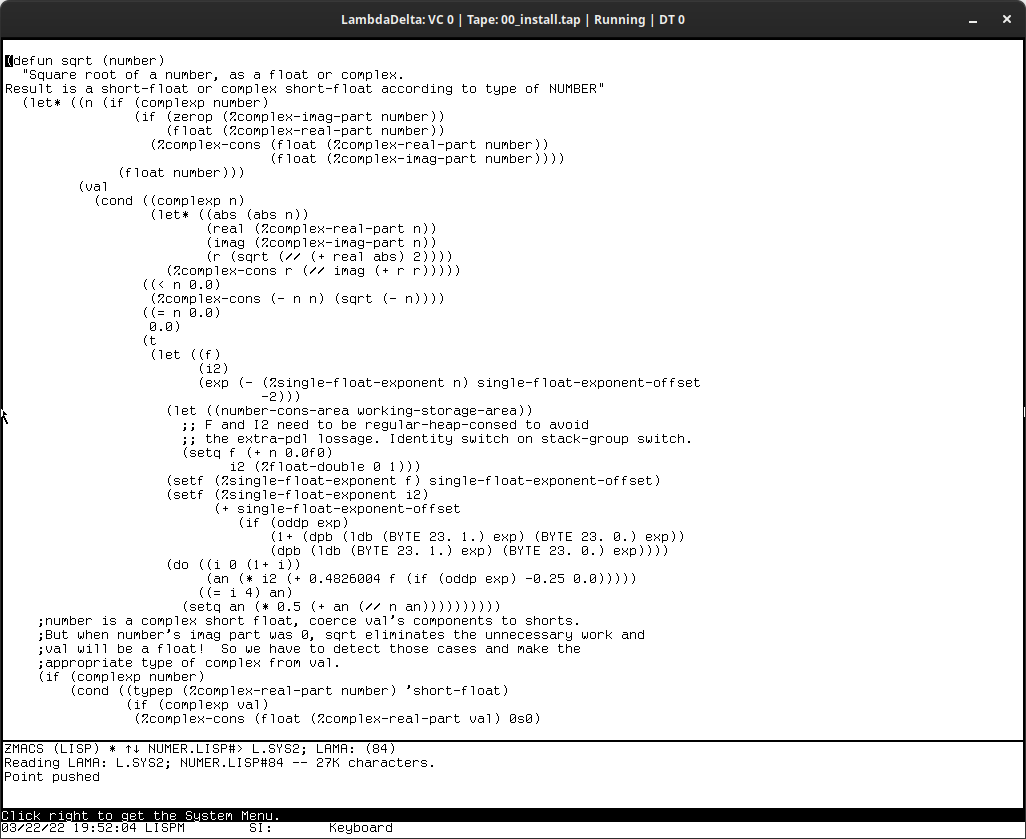
| The key thing about those type of systems was the ability to reach down into the system and edit the code of the system currently in operation. Here's a demonstration of Symbolics Open Genera (TM) 2.0, demonstrated running in a virtual machine. It is noted by the author of the video in the first minute or so that even in emulation, it is much faster than the original machines. - https://www.youtube.com/watch?v=o4-YnLpLgtk Oberon also had a similar attribute, in that they kept the names of functions to operate on objects visible. The same was true of the Canon Cat, Hypercard, Ted Nelson's Xanadu project, Smalltalk, and a number of other early computing systems. The main feature common to all of these systems is that they all preserve context. In Genera, Oberon, Canon Cat, Hypercard, and SmallTalk the source was always available. (as far as I know). In Xanadu, the main functionality of the web was present, but it wouldn't allow the broken links (and lost context) that now plague the web. I think a future platform could take code in a number of languages, compile it to an abstract syntax tree, but preserve the context required to recreate the source. In fact, it's reasonable that you could import a routine in a language you aren't familiar with, and reverse the compilation to get it expressed in an equivalent (but less elegant) form in your language of choice, along with the original comments. There's nothing stopping an open source project from taking elements of these existing systems and moving forward from that basis. It might be profitable to include ideas such as Coloring of the Source text to label intent, such as in ColorForth. Also, consider "Literate Programming" - Literate programs are written as an uninterrupted exposition of logic in an ordinary human language, much like the text of an essay, in which macros are included to hide abstractions and traditional source code. You could also add the ability to store graphics and other data along with the source code. Of course, if you are required to run code you didn't write and don't trust, your operating system must provide means to run it only against the files or folders you wish to let it operate on. The principle of least privilege needs to be supported at a fundamental level. This is one of the big shortcomings of the Unix model. Sorry it was a bit of a ramble, but this seemed to be a call for ideas, so I ran with it. PS: In the past, getting your vision of Computing required building a machine, and then getting it manufactured. Now it just requires that you make it work in a VM, Raspberry Pi, or web browser window. It is MUCH easier to try out and/or create alterative systems now that it has ever been in the past. |
Now if Windows team would get over their COM worship, it would be even better.