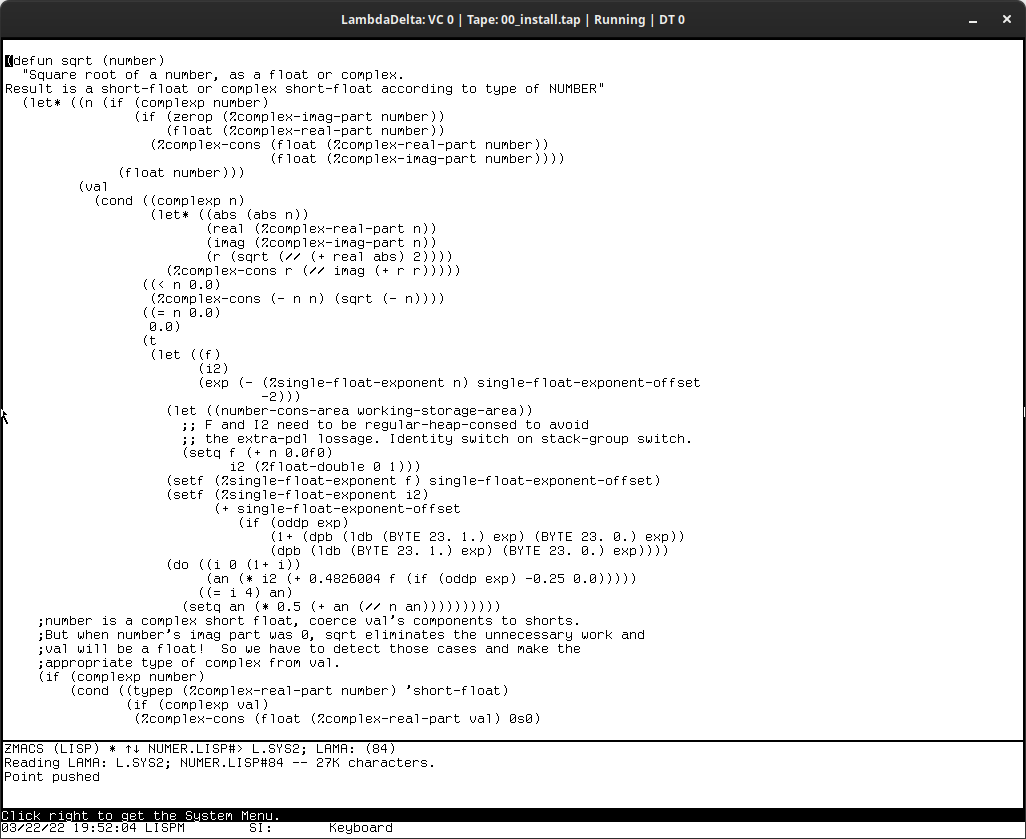
| Why would you reach down into the system and edit the code of the system currently in operation? Because it doesn't already do what you want. Isn't it a bit pathalogical to start by building a system which doesn't do what you want, then building in the tools to let you fix it, so you can use those make it do what you want? Why not skip all the middlemen and make what you want in the first place? If you arrive at "we can't do that because everyone wants different things", you're in this weird place where you can't build one system to suit everybody so as a fix for that you will ... make one dev system to suit everybody? Why is that going to work out any better? If people are going to have to build the system they want anyway, why not skip all the middlemen and leave people to build the system they want from scratch their own way? "Well we can't do that, having to build everything from scratch is hard, people don't want that. And we don't know what people want (and can't be bothered to ask) and won't try to build it for them, but we can give everyone Our Blessed System and Our Blessed Tooling which we presume they will want to use, while we abandon them to have to build what they actually want using it". It's patriarchal and preachy and still unhelpful. The kind of person willing to put up with your system and language and its edge-cases and limitations instead of making their own, is quite likely the same person who would have put up with your spreadsheet and its edge-cases and limitations if only you'd built it. It's the "all progress depends on the unreasonable person" meme; you need the person who can't tolerate a system which isn't perfect and demands to be able to tune it to their perfection, but is simultaneously fine with a customizable-system built by someone else for someone else's ideas. Then you say "ah but they can rebuild as much of the system as they want!" they're now having to build it themselves from scratch but based on what you built, which is even more work for them, not less. And the whole thing says little about working with other people/organizations; everyone building their own thing isn't great for that. One could argue that Microsoft did a lot of good for the world by strongarming companies into .doc and .xls formats for interchange, in a similar way that HTTP/HTML did (but more tyrannically). Microsoft-Word-documents-over-email should probably go down in history as one of the big enablers of distributed human organization, like the telephone. Moreso than SMTP alone or TCP/IP alone which enabled computers to connect, not people. More than HTTP/HTML which ordinary people can't use without setting up a webserver and publishing first. > "I think a future platform could take code in a number of languages, compile it to an abstract syntax tree, but preserve the context required to recreate the source. In fact, it's reasonable that you could import a routine in a language you aren't familiar with, and reverse the compilation to get it expressed in an equivalent (but less elegant) form in your language of choice, along with the original comments." Would that even work? What about "code is primarily for people to read"; loss of indentation, of alignment, of variable names if you're changing language with different variable naming rules, loss of separate files/folder/module-context of how it was built in the first place, and loss of idiomatic patterns from changing one language to another, or to languages with different scoping behaviour. Look at the image in The Article for the square root code[1], can you decompile the syntax tree for a language which doesn't have a complex number type? What about one which doesn't have a short-float for the result, or has different floating point precision assumptions? What does "F and I2 need to be regular-heap-consed to avoid the extra-pdl lossage" mean for JavaScript or Python or Clojure? What's the magic 0.4826004 for, without any comments next to it? And that square root function alone is a screenful of code, the very idea of being able to rebuild the system to your desires falls out the window if it's going to take you a lifetime to do that, and if not then we're back to my original paragraph where you're building a massive programmable system so someone can tweak one or two tiny things occasionally, which seems hella overkill. > "Of course, if you are required to run code you didn't write and don't trust, your operating system must provide means to run it only against the files or folders you wish to let it operate on. The principle of least privilege needs to be supported at a fundamental level. This is one of the big shortcomings of the Unix model." The XKCD comment that malicious code can ransomware all my documents and upload them to the cloud, but at least it can't add a new printer. One of the big shortcomings of the principle of least privilege is the effort of carefully and precisely describing the privileges needed - see the complexity and quantity of SELinux rules for a whole system. Even then you get immediately to the point where "my editor can edit all my text files" and that's now a large blast radius. [1] https://cdn.substack.com/image/fetch/w_1456,c_limit,f_auto,q... |
Because what you want is not set in stone for all time. Needs and desires change, and often what you think you want is different from what you actually want, but discovering that can take time.
I spend so much time trying to work out things like "when I click this button in the UI, what does that actually end up doing in the backend?" I wish I could right-click on a UI element and it would take me directly to the backend code which actually implements it. And a system like that should be much quicker to change – it should be much quicker for a new developer to get up to speed with it and start implementing things, rather than spending days (even weeks) trying to understand how it all fits together.