Hacker News new | ask | show | jobs
by 1in1010 1557 days ago
Jake, you say you want to help the retail investor... Then why are you only pointing them into buying individual stocks?

Most are better served with a more conservative ETF market index portfolio approach. Picking individual stocks can be part of one's portfolio at some point but it is a hard place to start.

4 comments

Hi! I agree 100% that stocks are not the only investment vehicle, and you're right it's not meant for everyone to buy.

Also, we are developing support for viewing ETFs as I type this (well, Nick is today). Which will be released in the next couple weeks.

Our MVP here, is built around communities of people who want to learn more about stocks, as well as get better research tools than what they use currently. We do not have any intention of pushing people to buy anything, the "vibe" is moreso giving as much information and education as possible, which we believe/are seeing will lead to people making more confident informed decisions with their capital. Whether that's buying stocks, or something else, no skin off our back.

This is a great topic :)

Curious for you to go a bit further here. I’d argue two links [0] [1] have all the info a regular person needs to make prudent investment decisions. Why do regular people need your research tools?

More pointedly, and I ask this as someone completely unfamiliar with Daniel’s content, but does Daniel claim to beat the market or that his audience could beat the market? If so, there’s a moral hazard here, in the opinion of folks like myself that believe such advice is fairly dangerous.

[0] http://efficientfrontier.com/ef/0adhoc/ifyoucan.pdf

[1] https://www.bogleheads.org/wiki/Three-fund_portfolio

Hi! Sry for the lag on the reply here, I didn't have time to read those through fully but I skimmed both.

I want to make one thing super clear, we don't make money off users trading, we are an investment/analysis tool and we make no claims/would never be a predatory entity that makes claims of x% returns/anything like that. We genuinely care about educating our users, and then letting them make their own decisions.

As for the links you sent (thanks for that btw!) I would bucket this with a bulk of the education out there, that's existed for a while, but hasn't been solving the financial literacy issue. The reason we believe this is the case is that education you sent is boring/static white text. Most people in the younger generations just don't learn that way. Further that education isn't inlined/when you need it while looking at financials.

A lot of our users/the founders find it much easier/more inviting/more fun & interactive to learn with the "clicky" ? modules we embed inline all over the site to define everything in small chunks. We are finding this is a way to learn where you actually remember things, but more importantly are engaged/having fun learning it. We have yet to see a tool besides ours to execute on this properly since it's very hard to create a consumer product that makes learning investing easy. Most importantly noobies feel comfortable in our tool, 99% of people who are brand new to investing get scared to death and never start when sent 20+ 10pt size font articles.

Lastly, my point isn't to say those resources aren't great, they are. But statistically people will just not read that, and/or not internalize it since it's not being applied when they need it while researching numbers/S1 filings/SEC reports/etc

How in-depth do you plan to go? Black-Scholes? Fitting volatility curves?
Definitely not that deep! I would say those formulas/complex math are not things Stock Unlock believes are necessary for 99% of people to learn.

Surprisingly, most people don't understand price ratios, whats each line of a financial report means (i.e. operating cash flow vs investing cash flow). So you can maybe label it "investing 101", "Intelligent Investor" type stuff.

Can you give more info on fitting volatility curves?
Lookup the term Implied Volatility Surface, it is a visualisation of an option's volatility and value across time (usually derived from black-scholes I think, assuming european style options, american ones use others like binomial). Find a decent textbook on quantitative finance related to options and derivatives (as in actual mathematical modeling, not candlestick horoscopes), they would be able to explain it better.
Because they need to make money, and to do that, they need less people to believe what you said. That’s my cynical point of view
Being "confident" and "informed" are not virtues when investing for middle/upper-middle class people. They simply need to put money in a good ETF or managed money-market fund with low fees, and contribute regularly. No "research" should be involved.
Hi! I have a Msc in finance and a CFA. I've worked as a professional quantitative investor, and I've never purchased a single stock for myself!

I had a view similar to yours regarding ETF and average investors until 3 months ago. For many reasons, I decided to become more active on social media in order to increase financial literacy. I was shocked by the amount of marketing the 'middle class' are exposed to. Competition is intense, and giving good financial advice is actually an uphill battle. I consider this environment to be toxic for the average individual.

Is this app perfect? probably not. However, I view this type of initiative as an improvment!

> I consider this environment to be toxic for the average individual.

So to repeat what another person said: wouldn't the most accurate advice be to ignore all the marketing and use ETFs?

If people are inundated with marketing telling them to be active investors, telling them to be a more informed active investor is not the solution.

*wouldn't the most accurate advice be to ignore all the marketing*

Your point is right, but I'm afraid that the underlying advice is not applicable. First of all few people are truly in control of their attention span, and we are all exposed to marketing wether we like it or not. You might as well ask a dog to ignore the smell of food.

*If people are inundated with marketing telling them to be active investors, telling them to be a more informed active investor is not the solution*

The problem with some popular financial apps is that the marketing is 'built in as a feature'. My banking app allows me to create a 'saving account', which sounds like a good think to do right? However if I click, I will have ''investing options'' to choose, which are all financial product sold by the institution. These types of 'financial dark patterns' are all over the industry. In Canada, I consider those to be built in by law, and are not likely to change any time soon.

Managing investor bias is not something you can achieve with a mathematical argument; it requires patience, trial and error. People who are bombarded with marketing about stock trading will avoid ETF and trade stocks. I think that a lot of them would benefit a learning environment which was not created by financial institution to sell them products in the first place. You could then introduce a feature, where the apps suggest some ETF information if the portfolio is hyper concentrated in a few stock, etc.

Hi! I really appreciate this perspective, you're not wrong, but I do think there's room for a lot of investment styles. I know a lot of middle/upper class people that enjoy analyzing stocks for long term holds in companies they believe in.

I respect we won't cater to everyone, but the numbers/data we are seeing is showing a lot of our subs are middle aged/middle class people that are loving our tool. So some people will want it, some won't, that's my take.

If you ever get curious, please think of us! Again, thanks for the insight :)

> I do think there's room for a lot of investment styles. I know a lot of middle/upper class people that enjoy analyzing stocks for long term holds in companies they believe in.

So are you investment education or are you investment data?

The former pushes people toward a certain investment style, and currently that investment style is one that loses them money (as you seem to know).

It seems that you're trying to democratize something like Bloomberg. In the hands of an individual retail investor, it's essentially a tool for gambling. I don't think there's anything immoral about that, but the veneer of "making the world better" in your posts really rubs me the wrong way.

If your goal is to educate people for the betterment of society, tell them not to look at stock market data, not to pay attention to people like Kramer, and to put their money into ETFs.

> So are you investment education or are you investment data?

Both! For example, think investopedia is great but it's not contextual education, aka it's not given to you at the right time. I was able to learn best by applying the numbers with education and actually exercising/using it. This is also why I believe that the static white text/endless pages of definitions isn't the type of education that ends up working in this case (people have short attention spans/it's boring/dry).

Responding to your other messages, I appreciate your honest concern around the gambling. I agree that when people trade/try to see patterns in charts, buy/sell within a year or two, that is gambling.

We may agree to disagree on this one, but long term stock investing, when you buy and hold great companies for 5, 10, 20 years, is what we are going for here. We believe that when you can identify a great company, and have patience/the right long term mindset to DCA into it over time, you can do well. You can do that with a small % of your capital, we are also adding suport for ETFs and I agree those are also great investment vehicles for people that don't have the time/care to truly analyze individual stocks/businesses.

He can't decide for people what the best course of action is, only give them to tools if they wish to go down this rabbit hole.

It's meant for the financially mostly-literate and curious, not your mom/dad. It's for everyone who watches Jim Cramer.

So this isn't meant to get people to the point of being mostly-literate? Like what even is a stock and how do they work?
For anyone looking for investment resource targeted towards Indian Market.

https://indiainvestments.wiki is the best resource and free for anyone to contribute to.

Most people don't need to research individual stocks as OP said.

They should learn about XIRR, excel, risk and portfolio management (which will cover insurance, emergency fund, expense management), and different types of investment instruments.

The wiki covers all of it and answers frequently asked questions related to Indian Market.

Everyone push toward trading individual stocks because it's profitable for businesses. Brokerage earn more money through those trades whereas many AMC which manage direct funds lose money on transaction cost in initial years and only make up for it via other side income. It is the case in India.

Guess what ETFs consist of...
That’s the point. Most investors are served perfectly fine by an index fund and functional broker. That’s it.

Active trading and expensive funds are your enemy as an unsophisticated investor. VTI or ITOT and chill, and as long as you have income, discipline, and an emergency fund you’ll do better than most.

https://longnow.org/ideas/02018/02/09/warren-buffett-wins-mi...

https://longbets.org/362/

https://www.npr.org/sections/alltechconsidered/2016/01/08/46...

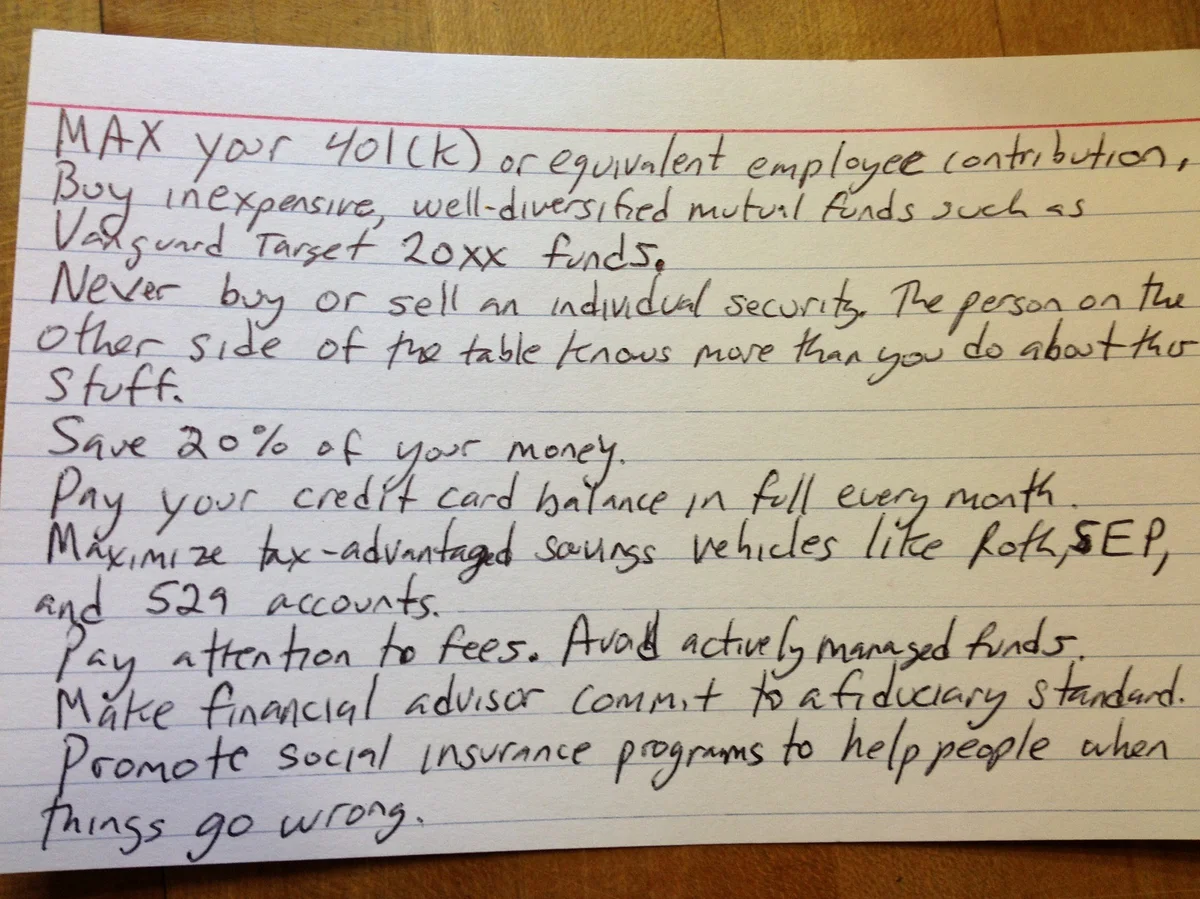
https://media.npr.org/assets/img/2016/01/07/index-67f786d0f1... (“Never buy or sell an individual security; the person on the other side of the table knows more than you do about that stuff.”)

My point is that ETFs by definition are a group of stocks, often grouped by sector unless talking about a whole-market ETF.

For example you could have invested in SPY, or QQQ, or IWM at the bottom of the bear market in 2008, and walked away with vastly different returns on Dec 31, 2021. Those are all indexes. Even from 2020 onwards, if you had picked XLE you would have had different returns till date than if you invested in XLU or some green energy ETF, or even 2020's darling, ARKK.

Just saying invest in an ETF doesn't mean anything. They are baskets of stocks, and as the macro environment changes, some ETFs will perform better than others. In effect, even an all-encompassing ETF (VTI?) will only perform well in a bull market. Just because we've been in a decades-long bull market doesn't mean stocks will keep going up forever.

Is the answer stock picking? Absolutely not. However, ETFs are not the "practically risk-free return" they are sometimes billed as.

Entry and exit points are material, but you don’t know when to enter and exit to maximize profit, hence “time in the market beats timing the market.” On average, you should come out ahead (based on available data and back testing).

These are well worn passive capital market investment principles, with copious amounts of supporting data. As an individual, it is very difficult to do better than long duration broad equities basket exposure with a low expense ratio.

"Exposure to stocks" is not the problem. Thinking you know which stocks to pick is the problem. Robots and random chance are better than human intuition, partly because of institutional manipulation of markets.
I disagree with the proposition that it is impossible to pick good companies. Anyone with half a brain could have invested in AMD as Zen 1 and Zen 2 came out, and the writing was on the wall for Intel. Same goes for other industries, if you are willing to do your homework and manage your risk.
It's easy to invest in a single stock that goes up in the longest bull market in US history.

It is much harder to beat the market, especially in a bear market.

The core tenet of investing is that you make a bet that other people see as risky. We have enormous amounts of research that active investing at an individual level can no longer beat the market in the face of widespread insider trading at the investor level, HFT, etc.

You need asymmetrical information to beat the market, and individuals just can't get it.

> It is much harder to beat the market, especially in a bear market.

This is the crux of the Warren Buffet vs Hedge Fund bet, and why it failed. Buffet quite possibly realized that a new bull market was about to begin, and the market would beat a hedge fund. When the bull market ends though, let's see if hedge funds don't start beating the market with their long-short-cash strategy.

I am nowhere near hedge fund territory, but do have some qualms about whether this bull market will just grow to the sky or have a big reset sometime quite soon, quite possibly reaching 6000 on the S&P before that.

Also, I find the efficient market hypothesis quite bullshit, so there's that.

this^ 100%

The companies and corporations that sell investment vehicles and services try to "make it cool/funny" to not understand money and that "rich people have their wealth managed for them", a bunch of bologne!

That being said, it's not simple, and people need to be serious about investing, it's very easy to get burned without the proper education/patience