Hacker News new | ask | show | jobs
by dane-pgp 1667 days ago
> There is no component of the claimed copyright infringement that Quad9 participates indirectly, nor is there any infringing data on Quad9’s servers, nor does Quad9 have any business relationship with the site in question.

We're approaching a situation where even electricity providers, not to mention OS and browser providers, can be forced to do the bidding copyright holders, to the detriment of everyone else.

6 comments

I feal like if they lose their appeal and are forced to remove the requested entries, they should additionally remove all entries for Sony as well. I know this is just being spiteful and runs counter to their mission, but it feels fitting.
This would likely do more damage to Quad9 than to Sony as it would just accelerate the pace at which people remove Quad9 from their list of resolvers because they’re unable resolve the sites they’re trying to visit.
Why do you think people would like to visit Sony ? I don't see anything special about them.
People like to use their PlayStations and TV's. You need several Sony domains to get those working right.
For some reason Germany has a history of being super hard on any possible undermining of copyright on music. Notably the ban on all public WiFi (!) until recently for fear of people illegally downloading music anonymously and 3rd parties being able to impose penalties on everyone who uses file sharing platforms ("Abmahnung").
As a dead comment said, they have GEMA which makes profits from this. Also it seems that some kind of blackmail is legal in Germany with Inkasso companies (some kind of legal money recover agencies) demanding money from people in the name of movie companies/GEMA.
When you write about "blackmail", you are refering to the "Abmahnung" process - essentially a cease-and-desist letter, which can involve lawyers fees, and a contract in which you - if you sign it - pledge to pay a high amount of money if you do go back to your infringing ways. If you do not sign, they will consider suing you.

It is meant to prevent preventable lawsuits (which would be a lot more expensive), but has been weaponised by lawyer firms specialising in copyright enforcement. After a few of these law firms were countersued for inconsistent claims, the law about Abmahnungen was tightened a bit.

I have yet to see an Abmahnung benefitting the GEMA. Law firms usually work for studios.

The organization has a proud history lol

https://en.m.wikipedia.org/wiki/GEMA_(German_organization)

It's not terribly surprising that courts with their (poor understanding of technology, unchecked belief in their own authority, and pay to play dynamic) will find that any party who can act to prevent a crime should do so. I think the only winning path is to make our protocols independent of centralized identities, such that the content cartels can technically take any participant to court and censor them, but that doing so to every participant is cost/time ineffective. Of course these protocols have to be adopted for general use as well, so that merely being a participant can't be seen as criminal activity.
When you think about it, isn’t it indeed identical situation to ask browser(s) to block domains in this matter? Just more effective to ask ISP (all in once)
Feel to me like asking mapmakers to leave out the locations where laws are being broking, or for the post office to not deliver mail to those locations.
This is why SpaceX's StarLink will be interesting because I cant see how some court bailiff can enforce actions on satellites, and what one country bans, another will disagree with.

I can see Govt's in particular NSA, GCHQ, aka 5 eyes, 7 eyes etc losing alot of control over the internet in the foreseeable future.

Starlink satalites know where they are serving, geographically. Wouldn't they just comply with local laws or risk having their ability to do business in that region disrupted?
Countries require satellite operators to obtain licenses “to land signals” in their territory. The laws treat incident EM radiation as a landing as insane as that sounds.
Starlink in its current form needs local base stations to operate efficiently. So as a practical matter they need local licenses.
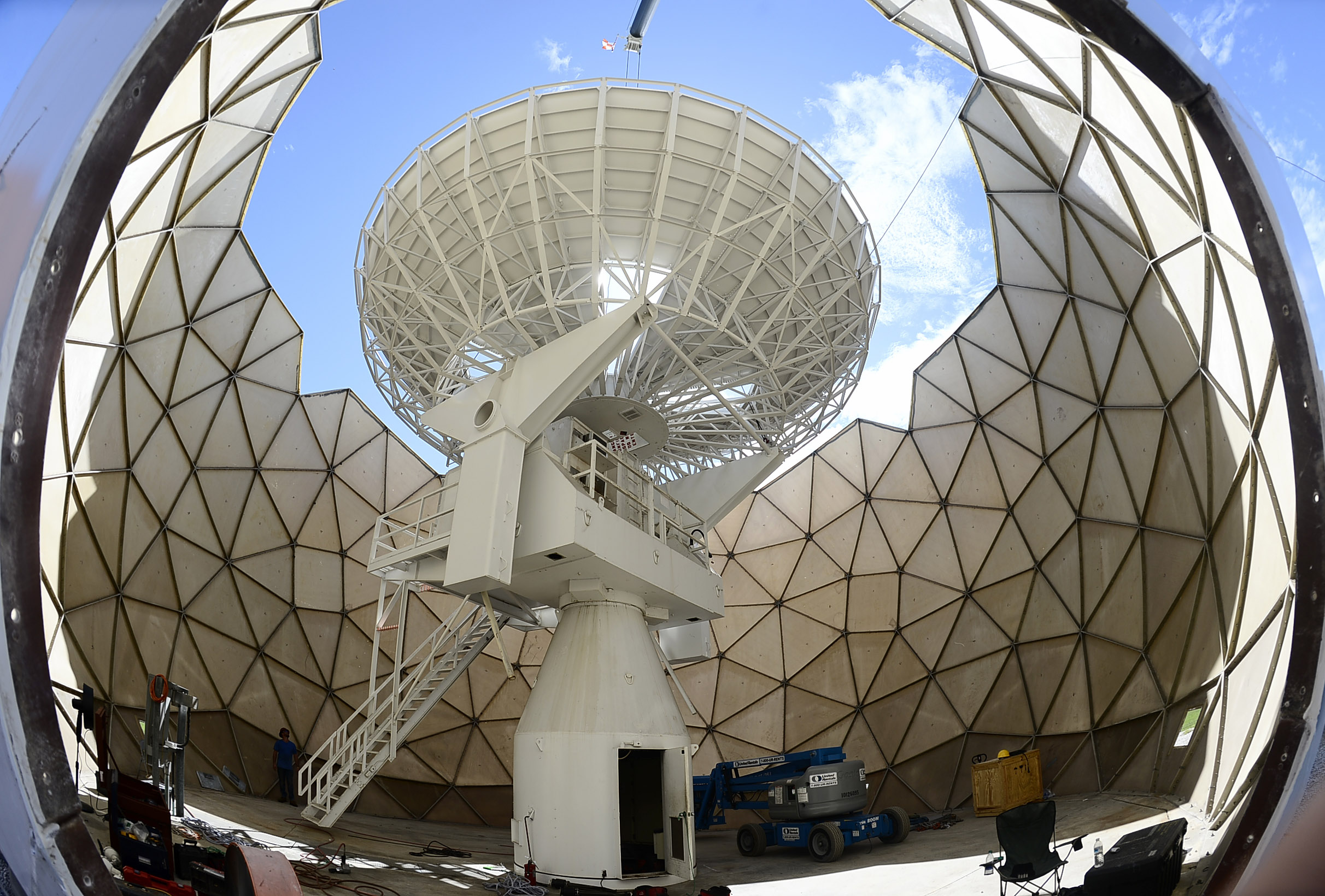
Which sounds great in practice, but do you know why the military uses those giant golf ball radomes? Its to hide where a satellite is pointing and thus where a satellite is in space. [1]

So another way to find out where a satellite is pointing would be to detect the transmissions its receiving or "landing" right?

So then the military wouldnt need these radomes as anyone near by could detect the overlapping footprint of the signal hitting the ground, unless its no more accurate than using something we can find in mediaportal to work out signal strength and quality. [1]

So then the ground could detect where the satellite is, which renders the use of the radomes somewhat unnecessary.

And then there is the fact Space has its own jurisdiction.

Now I do know HP were working as a Mil contractor in the 90's developing line of sight laser communication for the battlefield namely because it used the property of light to highlight eavesdropping, whether that has developed enough to be an uplink to satellites I dont know, but that is a lot harder to detect for obvious reasons and then the law would seem to be rather ineffective if light is being used to land signals sometime in the future. Anyway off topic so no more from me on this deviation.

[1] https://media.defense.gov/2016/Sep/16/2001635620/-1/-1/0/160... [2] https://www.team-mediaportal.com/wiki/display/MediaPortal1/S...

This is all false. The choice of whether to use spheroid radomes has ZERO connection whatsoever to do with concealing satellite locations. The parent comment is complete nonsense.

Antenna operators build radomes because they provide resistance to weather and other sources of environmental damage (birds are a big one). The spheroid/polyhedron "golf ball" shape is mostly used on large antennas because it's a structurally strong shape for the weight. It's also volume efficient for circular & spherical antennas, and handles rotating elements well.

Also, it's impossible to hide a satellite in space. Every nation with a space program tracks every orbiting object that's even remotely big enough to be a functional artificial satellite. It's mostly radar, but also visible light, IR, and UV cameras. There are no "stealth" satellites, mostly because you can't hide a launch... And once you know about the existence of a satellite, it's trivial to track it indefinitely. Civilian satellite spotters even do this with military satellites.

The only important thing you can keep somewhat secret about an orbiting satellite is it's specific capabilities. We don't know exactly what kind of telescopes or radar are deployed on Russian spy satellites, and they don't know the exact details of American equipment... But it's not even that hard for ground observers to guess at a satellite's likely mission and general capabilities, based on its orbit, visible structure, etc.

The parent comment's terminology is kinda strange, but that might just be a non-native English speaker... I'm more focused on the fact that their two "endnotes" in the parent post are just images, they don't actually cite any useful information.

> Which sounds great in practice, but do you know why the military uses those giant golf ball radomes? Its to hide where a satellite is pointing and thus where a satellite is in space. [1]

I'm unconvinced of that. Classified satellites are routinely tracked and sometimes even photographed by amateur astronomers; surely the peer competitors of governments can do better. I suspect these domes are primarily intended to conceal which satellite is being talked to.

That is exactly how it currently works, including pre-starlink satellite internet. There was an example about starlink pre-sales in India happening while they don't have a license to operate there yet and therefore can't deliver even if it was operational.
I think India has pretty strong bans over (at least foreign) satellite access. I worked at a place that made satellite equipment for various networks, including Inmarsat Global Xpress (GX). We'd sometimes get calls from customers when they were heading to ports in India because their internet would just stop working a few km off the coast.

It was one of the only places in the service area (most of the world, minus near the poles) that I know of that Inmarsat blocked out service.

(There was a way to override the GPS on the terminal to make it report to the network that you were somewhere else, but we tried not to tell customers about that - or Inmarsat obviously!)

You mean this? https://www.indiatimes.com/news/india/elon-musk-starlink-int... "Govt Asks Indians Not To Subscribe To Elon Musk-owned Internet Service Starlink"

StarLink is not licenced for use in India yet, but do you think the US mil or any other Nato mil will want some control over military coup's like when the military rolled into (Burma) Myanmar earlier this year and the internet was shut down? Not the only country to shutdown the internet or censor it when thinking about the Great Firewall of China either. https://www.bbc.co.uk/news/world-asia-55901774 https://en.wikipedia.org/wiki/Internet_in_Myanmar#Re-censors...

Presumably, but that hasn't worked out so well in countries like India. Adding insult to injury (or potentially comedy), the Indian government doesn't have an easy way to hunt down the existing Starlink users, so they're merely asking citizens not to buy them until they can strongarm Starlink into becoming a registered internet provider in India.
Strange. Currently starlink does not have sat to sat meshing yet. That means that the ground segment must be in view of the same sat while serving. India is pretty big. So they could just ban SpaceX from operating ground stations and that should stop them. Except in the border areas where they could be painted by ground stations from neighbouring countries.

But I'm not sure how big the cells are. It could be that they are as big as to cover most of India? Doubt it though.

But yeah it would be great if we had a truly independent internet provider for an affordable price.

What are you talking about? Starlink isn’t operating in India yet - why would the government need to hunt down anyone?

And if Starlink did start broadcasting in Indian airwaves without a permit (not really possible since they’d need a ground station but assume they place some ground stations around India’s borders), it would be a good opportunity for India to test its anti satellite weaponry.

> What are you talking about? Starlink isn’t operating in India yet - why would the government need to hunt down anyone?

> Reuters states that since Starlink officially registered its business in India on November 1st, it has already seen over 5,000 preorders in the country [0]

That's from The Verge's article a few days ago.

> And if Starlink did start broadcasting in Indian airwaves without a permit (not really possible since they’d need a ground station but assume they place some ground stations around India’s borders)

They don't need to. It could just as easily operate from across the border, the ground station I'm connected to is in Canada even though I live in the United States.

> it would be a good opportunity for India to test its anti satellite weaponry.

Maybe if they had a geostationary satellite, sure. Starlink is a LEO constellation though, so if they took down a satellite this weekend, SpaceX would launch 60 more by next Saturday (and service wouldn't be interrupted since there's considerable redundancy built into the system). Unless India intends to take out a few hundred satellites and be responsible for potentially catastrophic space debris, I think it wouldn't be a good opportunity for them to test their anti-satellite weaponry.

[0] https://www.theverge.com/2021/11/27/22804830/starlink-india-...

As mentioned it is under US laws and treaties so not likely going to happen. But possible some other county with less care will one day set up satellite internet and not care. Though I doubt countries like China would sit quietly if their citizens could suddenly access unrestricted internet and would probably take out said satellites. I dream of the day there is unregulated internet with not firewalls or stopping anything.
Everything lifted into space by a US entity, including StarLink satellites, are under the jurisdiction of the FAA with stringent licensing (or permitting, depending on the payload) procedures and restrictions.

SpaceX is a US entity and will be forever. SpaceX intellectual property cannot even legally be transferred to an entity not approved by the Department of Defense.

Forever? For now. Laws will be changed (if they need to be) and Musk or the next Musk will move HQ to a more favorable country because profits.
Musk has the capability to transport a tungsten godrod into orbit. He is by now as invincible as North Koreas dictator.

Same goes for Bezos, emperors from rods grace.

Urbi at orbi-tal bombardment threat. Government will play nice with a smiling face, cause everyone is happy.

"god rods" are pretty much science fiction. They're not all that practical weapons, and even launching even a single one without the government noticing is rather unlikely. And would at the same time be not that scary.
Fun game. Troll those being morons by mapping their domain names to the ip addresses of the domains they want blocked.

If anything it would be funny to see what creative means the morons come up with to try and stop them.

Yeah wasn't there a similar case recently with Cloudflare that they actually won? I was kinda surprised actually, I thought it would end up like this case. But the inconsistency is weird. https://arstechnica.com/tech-policy/2021/10/cloudflare-doesn...
Quad9 is a Swiss non-profit being sued in German court. It's no surprise that German courts might rule differently than U.S. courts.