| Which sounds great in practice, but do you know why the military uses those giant golf ball radomes? Its to hide where a satellite is pointing and thus where a satellite is in space. [1] So another way to find out where a satellite is pointing would be to detect the transmissions its receiving or "landing" right? So then the military wouldnt need these radomes as anyone near by could detect the overlapping footprint of the signal hitting the ground, unless its no more accurate than using something we can find in mediaportal to work out signal strength and quality. [1] So then the ground could detect where the satellite is, which renders the use of the radomes somewhat unnecessary. And then there is the fact Space has its own jurisdiction. Now I do know HP were working as a Mil contractor in the 90's developing line of sight laser communication for the battlefield namely because it used the property of light to highlight eavesdropping, whether that has developed enough to be an uplink to satellites I dont know, but that is a lot harder to detect for obvious reasons and then the law would seem to be rather ineffective if light is being used to land signals sometime in the future.
Anyway off topic so no more from me on this deviation. [1] https://media.defense.gov/2016/Sep/16/2001635620/-1/-1/0/160...
[2] https://www.team-mediaportal.com/wiki/display/MediaPortal1/S... |
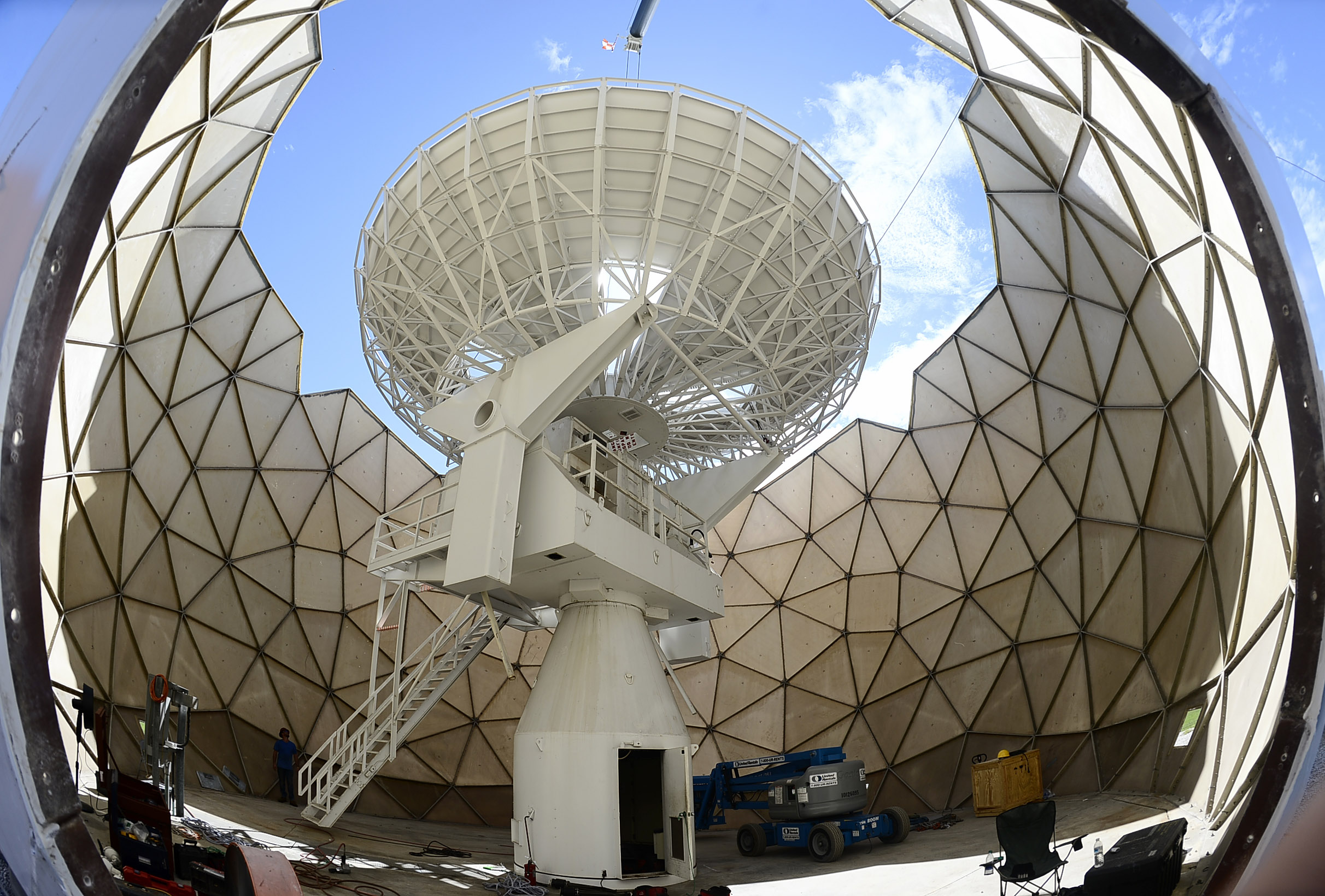

Antenna operators build radomes because they provide resistance to weather and other sources of environmental damage (birds are a big one). The spheroid/polyhedron "golf ball" shape is mostly used on large antennas because it's a structurally strong shape for the weight. It's also volume efficient for circular & spherical antennas, and handles rotating elements well.
Also, it's impossible to hide a satellite in space. Every nation with a space program tracks every orbiting object that's even remotely big enough to be a functional artificial satellite. It's mostly radar, but also visible light, IR, and UV cameras. There are no "stealth" satellites, mostly because you can't hide a launch... And once you know about the existence of a satellite, it's trivial to track it indefinitely. Civilian satellite spotters even do this with military satellites.
The only important thing you can keep somewhat secret about an orbiting satellite is it's specific capabilities. We don't know exactly what kind of telescopes or radar are deployed on Russian spy satellites, and they don't know the exact details of American equipment... But it's not even that hard for ground observers to guess at a satellite's likely mission and general capabilities, based on its orbit, visible structure, etc.
The parent comment's terminology is kinda strange, but that might just be a non-native English speaker... I'm more focused on the fact that their two "endnotes" in the parent post are just images, they don't actually cite any useful information.