Hacker News new | ask | show | jobs
by ahdh8f4hf4h8 1682 days ago
I don't think this attitude is helpful - it's going to leak out in your interactions and poison relationships.

You do need to consider the context and background of a person before you can properly understand or trust their opinions and advice. For example, a physicist may be ignorant of how car engines actually work; a mechanic may be ignorant of some of the underlying physics. You really need to get to know people and build a long term relationship to understand if their opinions on a topic are useful and informed.

I don't think there is a simple rule to working with other people - you just need to build a wide body of experiences yourself, and beware of relationships that grow too quickly or where the other person appears to have a hidden agenda.

6 comments

Yes applying and practicing the assumption that people are lazy, stupid and insane, does active damage to conversation.

The article is actively unhelpful, possibly doing harm. The section titled “What can you do to take advantage” answers it’s question with ‘Nothing, but it makes you feel good.’ That’s a pretty lazy take, and IMO pretty lazy writing. There are ways to take advantage of the negative sides of human nature, and we collectively agree they’re bad for us and sometimes should be illegal.

A friend once told me some advice that is a simple rule and can often do wonders in personal conversations, and even when commenting here on Hacker News. He said, “no matter what conclusions your brain tries to jump to about someone, always assume people have something brilliant to offer and that they are amazing in some way. Try to find it.” The article doesn’t disagree, but ironically chooses to focus on the worst. I can confirm from experience that this approach of assuming the best will statistically more often help you win friends and influence people, and that assuming the worst about people will not.

When building a product, it sure helps to not assume anyone's intelligence. Even better, assuming everyone is insane helps you consider more cases where user behavior could cause an issue. Ultimately, that saves time.
FWIW, I took my friend’s advice all the way through founding a company and building a product. I disagree about assuming everyone is insane for building a product. The more helpful way to approach this is that everyone has legitimate needs and hopes for your software, but that they are overwhelmingly different from each other. Your job is to translate and prioritize the many legitimate wishes and expectations into something that will maximize the number of people you serve.

Assuming your customers are not intelligent or that they are insane is going to prevent you from being able to empathize with what they think they want, and it’s going to make it harder for you to translate what they want into features you should build. The assume-the-worst approach can also make you come off as tone-deaf, if you never accept and never understand what people are asking for.

Assuming that user behavior can cause certain issues is a valuable angle to consider, I agree with you there, but that viewpoint needs to feed back into the product as a question about whether you actually designed your product for people who don’t know how your product was built. If the product is fine, then it needs to question whether you have sufficient training of your product. Ultimately, it needs to question your assumptions, not your customers. Assuming people are insane is going to act as a force against understanding why your product isn’t perfect.

Arguably both of the viewpoints are correct and market goes into different swings depending on where you are in history. What if we are at the cusp of the swing back to high customised products after Apple and Google had been pushing highly top-down non-customer-oriented products-that-think-for-you upon us for at least a decade now?
(Sorry for the long post, I’m trying to explain but editing lazily. It’d be more concise if I had more time.)

I’m not sure, what are you suggesting that it changes if apps become more customized or more customer oriented? Wouldn’t that only make understanding the users’ expectations and not writing them off as ridiculous even more important?

I’m not entirely sure what you mean, like why the state of design of Google or Apple apps has much bearing on how to approach what you assume about customers - apart from the fact that it’s really helpful to understand the ecosystem of software and the UX elements that people have become accustomed to. Yes it’s harder to design phone apps that behave in fundamentally different ways or using fundamentally different interaction models than what people are used to. You might understand your idea is superior to what Google did, but when people reject it, that doesn’t mean people are insane, it means the opposite, that there’s a good reason for their expectations and that you and I might be insane for trying to fight the tide.

I’m also not sure what it means to be “correct” about assuming people are insane. But to be clear, my argument is not that it’s incorrect, my argument is that it’s not helpful or constructive, and it can prevent you from self-reflection or improvement in a harmful way. Assuming people are insane is to reject a reasonable explanation, it’s a very (ironically) lazy way to rationalize not trying to understand.

Under normal circumstances, with average people, people have expectations that are completely reasonable and come from a history of their experiences. If you assume they’re insane, what you’re really doing is willfully closing your own eyes to their context and shutting yourself off from seeking out what they want.

It’s important to realize that people doing wacky things with your product is a result of differing expectations, and explore the sources of this discrepancy. Inside the gap there are a variety of reasons that include failure of the app builder to clearly state their expectations. If too many people are doing seemingly silly things, it might mean you haven’t made clear who your app is really for, and what it can or can’t do. Assuming you’ve done everything you can do, explained everything about your product clearly, assuming that it can’t be improved and that someone using it wrong is just crazy, that’s a pretty bad assumption and rarely if ever “correct”.

> I don't think this attitude is helpful - it's going to leak out in your interactions and poison relationships.

Strongly agree. Keeping ourselves humble and remembering that nobody is infallible is important.

However, taking it to the extremes this article suggests (“Everyone is stupid”) is exactly the mindset that leads people to ignore experts, discount research, and promote their own feelings above the science.

The mindset is great for an ego boost because it’s an easy way to take everyone else down a notch and make everyone feel more or less equal. But when it comes to individual topics, everyone is definitely not equally informed. Pretending they are is a mistake.

The real skill is learning to identify who to trust and who to dismiss. It’s easy to mistake confidence and slick presentation or even angry contrarianism for being right these days, but learning how to look past that is very important. Putting blinders on and telling yourself that “everyone is stupid” is not a good way to do it.

> Strongly agree. Keeping ourselves humble and remembering that nobody is infallible is important.

That's not how it works in real life from my experience.

I usually assume everyone is stupid, including myself, that's the most humble thing a person can do IMO.

But what actually happens is that other people assume that I am the only one who's stupid, because I'm open about the possibility, while they don't even consider it a thing.

It's a well known human bias, there's almost nothing we can do about it, except train or minds to see others and ourselves as fallible, instead of victims of the system.

> I usually assume everyone is stupid, including myself, that's the most humble thing a person can do IMO

It seems strange that the most humble thing you can do is to assume everyone else is stupid (even if you were to include yourself in to that mix)

if you thing you are stupid and everyone else is just like you - more or less- you're being humble IMO.

If you assume you're smarter than everybody else, you're being arrogant, if you assume everybody else is smarter than you, you're insecure.

Assuming everyone is stupid is the same thing that assuming that everybody is smart.

If everybody is smart, smart must be a common trait, nobody is special.

Someone can still be smarter or less smart than you.

But on average assuming we're all on the same level is not bad.

Except if you assume that everyone is smart, people will think that they are the only one being really smart

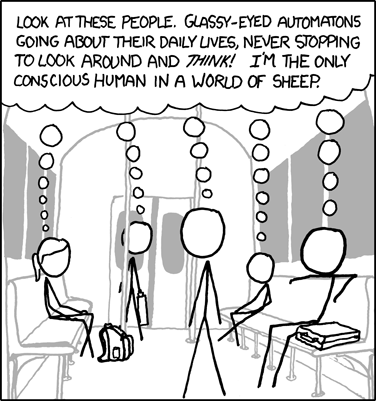
The bias works differently in the two cases: of course XKCD got this right (the XKCD guy is way smarter than me)

https://imgs.xkcd.com/comics/sheeple.png

There is also a very real possibility that someone knows a subject, but has trouble describing it in layperson terms.
> it's going to leak out in your interactions and poison relationships

As a continuous attitude, agree this advice is toxic. As a temporary place you take yourself to stress test plans, it’s valuable. (I’d add: people are assholes. How will a self-serving, morally unconstrained actor run roughshod over the assumptions your system makes?)

I think it can work when thinking about accountability and checks-and-balances in processes and roles; for example how would I detect if my CFO is stealing money from a startup, or what if a narcissist became a manager at my company? But I would apply in on a role/position level, not as a starting assumption in new relationships.
> I would apply in on a role/position level, not as a starting assumption in new relationships

Agree. My doublethink fix is to ask what could go wrong if the person in front of me were replaced by a dishonest, incompetent, narcissistic and/or venal one.

> You really need to get to know people and build a long term relationship to understand if their opinions on a topic are useful and informed.

Well, that's exactly what the article says: assume everyone is stupid (on something) including yourself.

There are 100% chances that you'll be right.

I think there is a simple rule, just be kind, and most people will do the same you get what you bring..