Hacker News new | ask | show | jobs
by paulmd 1705 days ago
This of course has the subtle implication that it’s equally easy for x86 to go as wide as ARM, and it’s not.

Yes, it’s true that x86 often relaxes pitch, that doesn’t make up for a factor of 6 perf/watt difference like Anandtech measures.

Like I said, I guess we’ll see, Zen4 and A16 will be on the same node next year. By that time the goalpost will move to something else, like this “x86 isn’t designed for power efficiency” defense.

1 comments

Why do you think x86 can't go as wide as ARM? (I predict your answer will involve something about decoders and nothing about uop caches.)

What goalpost have I moved? I have said one (true) thing: that you should judge by performance rather than by implementation details. You are falling victim to the Megahertz Myth, just the other way 'round.

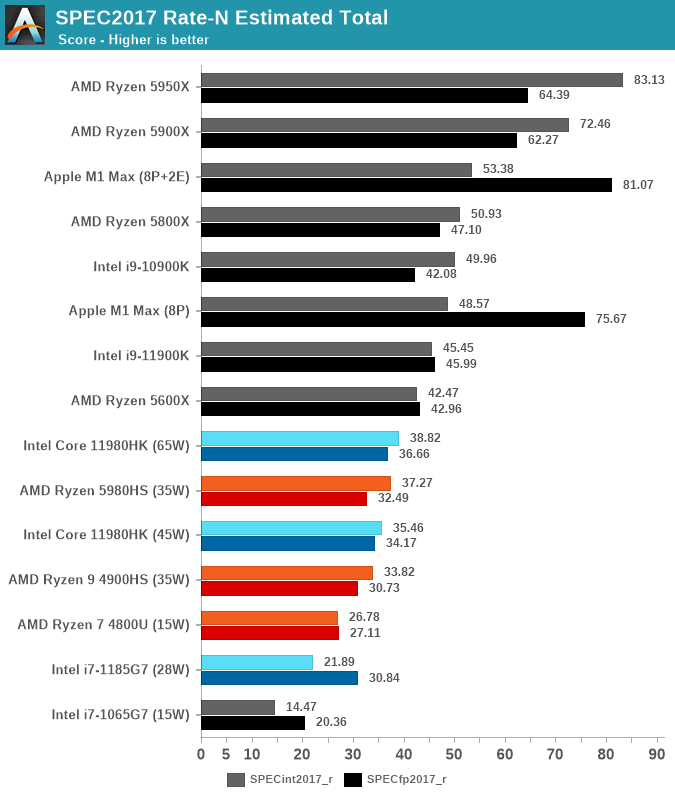
OK, here’s the performance. Factor of 2.2X over its peers (other laptop SKUs) in multithreaded performance, going head to head with 5950X in some (floating-point) scenarios.

https://images.anandtech.com/graphs/graph17024/117496.png

Why do you think megahertz myth is relevant here? Core for core A15/M1 is plainly faster than any of its peers, ignoring clocks, and it is even farther on top when you do look at clocks (i.e. IPC). It doesn’t matter at all which way you look at it, unless you are putting M1 up against HEDT SKUs like 3990WX - there are a few non-peer scenarios like that it only ties x86 in, like OP looking at task energy (3990WX gets to use 280W TDP/375W PPT and race to sleep) but that’s still an incredibly good outcome considering the loaded test, and Mac Pro with its 32+8 configuration will almost certainly be back on top in the “peer” comparison scenario.

It’s amazing how much breath was wasted on “IPC is what really matters” when Ryzen came out and now it’s “the other side of the megahertz myth” when Apple is on top. Ryzen was never even remotely close to being in the lead on IPC compared to where Apple currently is.

Even at iso-power you are looking at a factor-of-3-to-4 difference in performance - I was being generous with the “only 3x IPC” thing. That is what Anandtech measured in their review. And that still means a gap of 4x perf/watt - which is better than 6x for sure, but it doesn’t mean low-clocked x86 magically beats A15.

> It’s amazing how much breath was wasted on “IPC is what really matters” when Ryzen came out and now it’s “the other side of the megahertz myth” when Apple is on top. Ryzen was never even remotely close to being in the lead on IPC compared to where Apple currently is.

IPC is what "really matters" when all the chips you're evaluating are capping out at pretty similar frequencies. When there's a 30% difference in frequency then you need to use instructions per second, and evaluate it with the context of different wattages and different benchmarks.

Sigh. IPC matter when you are comparing within the same architecture, as that means the comparative performance vs other cores of the same architecture ends up (somewhat simplified) as IPC * frequency. It is utterly irrelevant when comparing across architectures as the instruction sets are different. IPC matter when comparing Ryzen to Intel, and between A15 and A16, but it doesn't matter at all when comparing A15 to anything x86-based.
>OK, here’s the performance. Factor of 2.2X over its peers (other laptop SKUs) in multithreaded performance, going head to head with 5950X in some (floating-point) scenarios

Finally a sensible comparison! As I said, it is quite impressive.

>it doesn’t mean low-clocked x86 magically beats A15.

Nor did I ever say it would.

What I have said is a simple truth: leading on IPC and trailing on frequency is not obviously an advantage. I don't understand what it is you think I said. Pretty much everything you are writing is a non-sequitur.

Please make your substantive points without swipes, regardless of how wrong someone else is or you feel they are.

https://news.ycombinator.com/newsguidelines.html