|
|
|
|
|
|
by paulmd
1704 days ago
|
|
|
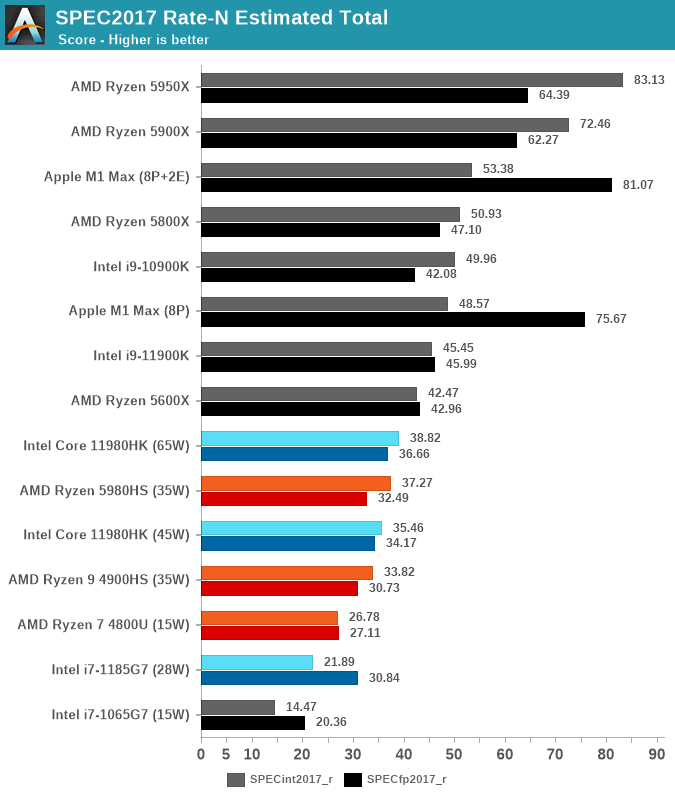
OK, here’s the performance. Factor of 2.2X over its peers (other laptop SKUs) in multithreaded performance, going head to head with 5950X in some (floating-point) scenarios. https://images.anandtech.com/graphs/graph17024/117496.png Why do you think megahertz myth is relevant here? Core for core A15/M1 is plainly faster than any of its peers, ignoring clocks, and it is even farther on top when you do look at clocks (i.e. IPC). It doesn’t matter at all which way you look at it, unless you are putting M1 up against HEDT SKUs like 3990WX - there are a few non-peer scenarios like that it only ties x86 in, like OP looking at task energy (3990WX gets to use 280W TDP/375W PPT and race to sleep) but that’s still an incredibly good outcome considering the loaded test, and Mac Pro with its 32+8 configuration will almost certainly be back on top in the “peer” comparison scenario. It’s amazing how much breath was wasted on “IPC is what really matters” when Ryzen came out and now it’s “the other side of the megahertz myth” when Apple is on top. Ryzen was never even remotely close to being in the lead on IPC compared to where Apple currently is. Even at iso-power you are looking at a factor-of-3-to-4 difference in performance - I was being generous with the “only 3x IPC” thing. That is what Anandtech measured in their review. And that still means a gap of 4x perf/watt - which is better than 6x for sure, but it doesn’t mean low-clocked x86 magically beats A15. |
|
|
IPC is what "really matters" when all the chips you're evaluating are capping out at pretty similar frequencies. When there's a 30% difference in frequency then you need to use instructions per second, and evaluate it with the context of different wattages and different benchmarks.