| Macs are still a relatively small (but profitable) chunk of the computing world. The ground Intel has lost in desktop and mobile is more than made up for by their utter dominance in server. Intel also has a lot of plays that should bear fruit in holding or retaking ground on consumer compute in the next few years: 1) Arc GPUs. Looks like they will be seriously disruptive. 2) Hedging their process node bets by using TSMC too. The only magic in the wins AMD and Apple have had the last few years have been in them being effectively a manufacturing process node ahead of Intel. 3) Intel will likely be first to market with getting a large set of on-package memory that serves as a bridge between CPU cache and DRAM in terms of latency. Think 8GB+ I am no Intel partisan. My core interest is actually more in seeing performant, open (that is, blob-free [1][2]) hardware. RISC-V and Power10 [3][4] are what I am looking at in that regard. I expect the reports of Intel's impending descent to be largely exaggerated. Still, it is good drama to fuel a hearty compute war. That is to the benefit of all, so have at it. 1: https://raptorcs.com/content/base/faq.html
2: https://www.osnews.com/story/133093/review-blackbird-secure-desktop-a-fully-open-source-modern-power9-workstation-without-any-proprietary-code/
3: https://en.wikipedia.org/wiki/Power10
4: https://www.hpcwire.com/2021/09/08/ibm-introduces-power10-based-server-the-power-e1080-targets-hybrid-cloud/
|
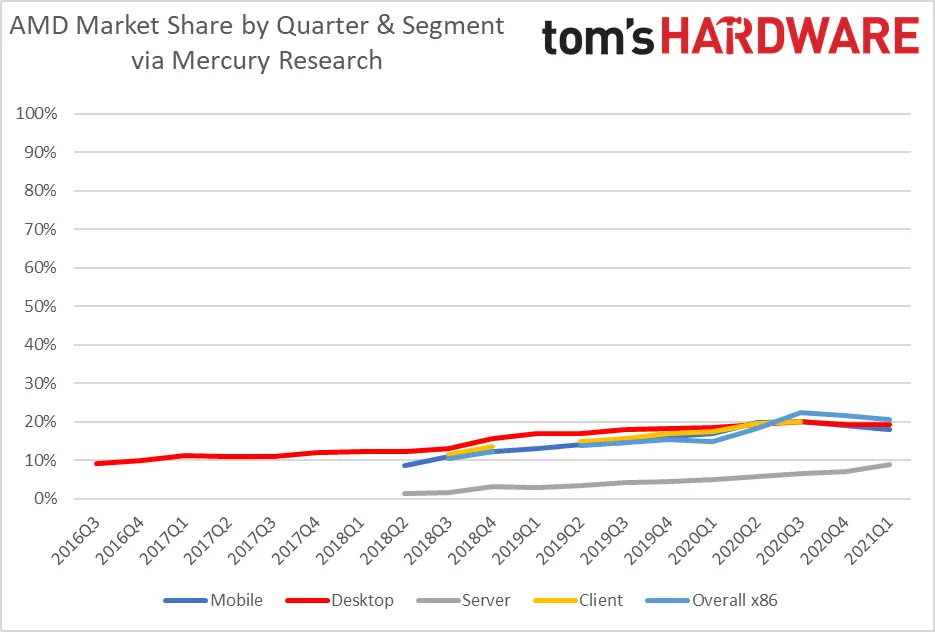
The basic problem is that Intel hasn't lost ground in mobile, it's not even on the playing field, a huge strategic blunder. That leaves it defending its dominant positions on server and desktop / laptop. At the same time billions of $ pour into TSMC from mobile and those same facilities are now being used to make desktop and server CPUs that compete with Intel.
Its execution has been poor too but this massive strategic issue is a bigger problem.