> Modern software’s humdrum lack of identity has resulted in users craving more interesting, opinionated tools, tools that feel like us — or a better, more interesting, wackier version of us.
The above is the kind of sentence that you'll see in almost any fashion or arts magazine.
Pretty fluffy stuff. Not really the kind of thing we're used to, in the engineering community.
That said, I firmly believe that there's always a place for good graphic and interaction design, in technology.
I don't feel that it's a problem. Some companies will stick to "the classics," while some will go overboard with the "chrome"[0], so to speak.
So I read the first sentence and my immediate reaction was "Well I don't. And I'm not sure anyone has ever expressed that opinion to me" and I stopped reading.
Well, here's that opinion: today's flat UIs all look the same, boring, and bland. I wish there was more quirkiness too. Perhaps not to Kai Power tool's levels, but I enjoy the functional quirkiness of many VST UIs.
Now you can continue reading. Seldom anybody learned much, when they stopped reading at the point they disagreed with.
I want my UI’s to be usable. I want it to be immediately obvious what I need to do. I want them to become invisible in the same way good tools do. I don’t want my hammer to be quirky, I want it to be an extension of my hand.
EDIT - Yeah. I have a certain fondness for Kai’s. But I had time to get used to them. It’s one UI in a thousand where I have time to get bedded in with it’s quirks. For all the rest - be boring.
The opposite could be argued as well: it's design supposed to focus on function alone (after all that was their pitch: put the content front and center, remove aesthetic touches from the "skeuomorphic" UIs, etc.) but with no redeeming aesthetic qualities (which are also important for actual human users).
So, it's not exactly form over function (besides thought into form is necessary for function - you can have a real world lever that is e.g. thin and crooked and it will still function as a lever, but a good lever also has good form -- e.g. be designed to have a good grip).
It's "design ideology and novelty for some manager's sake" over form and function.
There's a bit of truth. The era of extremely engineered everything gave birth to flat design for instance. I'm not pro skeumorphism but I remember how odd software felt good in a way. As long as it was fun (good boards, useful programs) you ended up liking the quirks.
I don’t disagree but I didn’t get any of that from that opening statement. It seems to be arguing for diversity in UI which I happen to think is usually a terrible idea.
> It seems to be arguing for diversity in UI which I happen to think is usually a terrible idea.
I have to agree with this sentiment. I loved KPT, but that was more for the "adventure" aspect. I actually had difficulty using a lot of functions (don't ask me to remember which ones).
It's frustrating, designing innovative UI that also follows convention. It's a joy, when it works.
I have this iOS widget that I wrote[0]. It's really, really cool. Works a charm, and is easy to implement.
But I keep on not using it in my projects. It's too "in your face." I think that UI needs to get the hell out of the way, and just let the user do what they want to do.
I have a couple of more, more conventional widgets, that I use all the time[1], [2].
KPT was "in your face," like no other UI I have ever experienced.
I am going to make a claim as someone who works in both the crossroad of devwork and design that there is not one piece of software that caters truly for the artist.
Every piece of software for artists / designers is not intuitive. It’s sliders, knobs, modals and panels. Programmers making design software is Not A Good Idea.
The way forward is something like ProCreate, so just the software and the pen, and maybe more auxiliary devices (a color palet for instance) to become more analog again.
No advanced art process can avoid some amount of engineering, because the demand that is made is to measure and select with precision that which is to be edited.
When we use a mark-making tool like a pen, all that's happening is that we select the area being pressed to be darkened. Technique with those tools takes years to develop, and their full use comes in tandem with additional tools like rulers, prospekt, and stencils.
So when we add knobs and sliders and modes we are simply trying to describe those kinds of intents within a precise abstraction instead of a collection of simpler tools. It does go overboard in that nobody's going to adjust every knob presented.
What do you want, an AI that reads your mind and generates the exact art you want? Barring that, a perfectly intuitive tool is impossible past a certain point of complexity. If you want something in front of something else you're going to have to learn what a layer is. If you want something at just the right transparency you're going to have to adjust the transparency.
Maybe some kind of virtual art studio in VR would be helpful for people who want a more physically intuitive experience with some extras like undo and saving copies, but even then you're still going to have to learn a thing or two about the tool to use it, like any tool.
The Apple Pencil, and the iPad Pro (esp. the latest of each), is awesome. They did a really good job on that.
I don't use ProCreate, but that's mostly because I'm not really that kind of graphic designer.
I remember looking at "paintbox" tools for video effects, in the 1970s. We've come a long, long way, and real artists have some really nice tools at their disposal.
It’s the intuitive way you can draw without endlessly dialing knobs, tweak panels and so on. It’s fluent, which I feel, a lot of apps lack. I love to see more UI / UX creativity.
Can we also talk about how everyone’s clip art looks so much alike? All those tubular-limbed primary-colored simple sausage people make me wince. I guess when you’re making the 10,000th SaaS you just want to be like the others.
“The style appears to serve as the illustrative arm of an intentional deployment of cheerful minimalism to mask the insidiousness of multinational tech corporations with friendliness and approachability.”
https://eyeondesign.aiga.org/dont-worry-these-gangley-armed-...
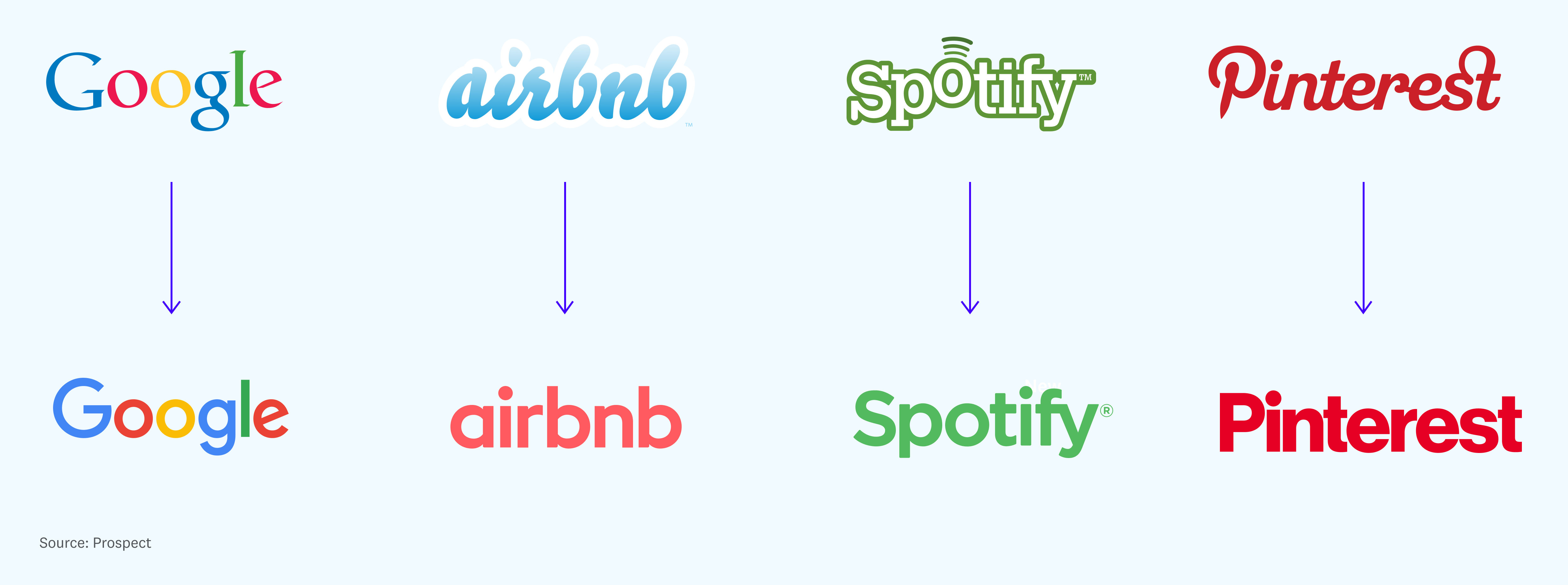
I disagree that this is a fashion -- logo design over the last 100+ years has consistantly shifted this way, while the media they are communicated in has engendered lower and lower attention span, vastly faster exposure rates per day, massive audiences.
The information in the logo is being reduced for specific reasons. I agree that this is de-facto loss of diversity and culture for delivery, somewhat analagous to factory methods of goods production.
I don't think it's just analogous, I think it's directly related. Taylorism imposed on society by the most greedy amongst us is, in my opinion, the cause of this as they've become (or perhaps, always were) the axiomatic drivers of policy and power in western society and culture.
My opinion is that this trend is due to a signal we're seeing where people are being pushed towards efficiency goals in their lives constantly due to pressures presented on them much of which flourished during the industrial revolution and carried through technology in the information age.
I used to enjoy looking at something and taking 20 minutes to explore what exactly it is and assess it, it's uniqueness or lack thereof, and so on. Now, 20 minutes is too much time, when I want or need something I just need Solution for what I need so I can move to the next step of my life. I don't have time to figure out what your product or service is, I need Solution and you either offer it or not, I don't care about your aesthetics or how nice it is (I do but thats often just a bonus anymore as long as it accomplishes the goal).
Heck, I don't have the time to check the space of Solution competitors to find what I need, I even outsource that to third parties to tell me what's good and not good. There are too many pressures in modern life for me to care and you better tell me what it is you do and better do it because it will effect my efficiency which directly impacts how much actual free/leisure time I do or don't have outside of my constant efficiency pressures at every turn, from everyone.
In a world with less pressures of efficiency and ROI, we're more willing to explore things when failure is acceptable and the risk is more worth the potential of enriching our lives by taking a chance on Solution and see what it's all about. Hyper competitive societies don't allow this slack space. If you take this path you better hope the risk was worth it or you're wasting piles of time and money you already didn't have.
While efficiency is important for healthy progress in society and a lack of pressure leads to complacency and stagnation, it's possible to go to extremes in either direction and I'd say weve crossed that point as a society on the productivity push. Some amount of leisure and excess are needed for human happiness. We see this everywhere, "does X, fast, cheap, best."
« By appealing to everyone with these clean lines, gradients, and rounded shapes, no one feels particularly compelled by them. »
To be honest, I think this bit of fashion is just a pendulum that swings back and forth every decade or two.
One curious thing I noticed on the swing back in the opposite direction around the early 90s (when many logos changed from circles and constant-width strokes to ellipses and more 'stressed' letters): the new logos somehow seemed to me to be "cleaner" than the previous ones, even though that's also what I'd felt when things were going the other way.
Going off on a tangent here but I clicked the link explaining why tower PCs used to be beige and it made me realize that my career didn't overlap with the era of cubicles - I entered the job market at a time when the norm was an open space plan.
I wonder if I would hate the cubicle as much as I hate open space offices?
Can anyone who's witnessed this transition weigh in?
yes - I worked in a computer-aided chemistry company as software engineer in California in the 90s. The culture there was from the 80s, but the scientists were very hard working! (scientists may not write very good code but you know, they can write a lot of it! athlete/scientist was common in my group). I was making pretty good money and my father wanted to see where I worked once. So I used my badge to walk in with the two of us, to a ~10 meter x 16 meter open room, with about four glass walled offices on one side and the rest of the area with cubicles.. maybe two dozen or more.. some of the cubicles were "big" with a table, some medium, and then a number of ordinary ones. I was used to it, but as a male, I could see over the cube walls while walking, whereas shorter colleagues could not. Other small things about it at another time.. (some offices at Apple Inc, Cupertino were also laid out like that -- maybe they got it from their HP-imported managers).
My father was silently aghast.. he was actually startled by seeing everyone in the room like that.. all the commotion. It had never occured to him that people could be arranged like a lab rat-maze (which it was really).
You'd have hated cubicles too, before open office became the norm. Cubicles were the open office of their day. Before them, it wasn't uncommon to have an office with your own door. Or at least sharing a larger office with another person.
> Can anyone who's witnessed this transition weigh in?
Sure.
If you don't like the way you are treated in your organization today in an open office, you probably wouldn't like the way you are treated in one with cubicles.
Cubicle environments could be soul crushing (see the movie Office Space). They offer a bit of privacy, but noise, interruptions, a boss peering over your back at your screen unannounced could all still interrupt flow and focused work.
I think this is an undergrad paper published on a blog.
It’s hard to see if this article is really making a legit point, from a confusing typos early (swapping “form” and “function”, or claiming beige was used in software, when all displays were monochrome back then) to pulling out random historical artifacts apparently without understanding them (the Star’s portrait display was not “distinct”; on the contrary the switch to landscape happened in the mid 80s; the first Mac had both a distinct physical design and graphic clues like the trash can and floppy disk; those were not introduced in the 80s, etc).
Laid upon that are a few anodyne design “observations” that have been common in graphic design articles since the early 20th century.
The claim was that beige was the color of hardware (accompanied by a link discussing this claim). Portrait displays have never been very common (TVs were always landscape). This feels like a particularly picky bit of nitpicking.
Criticizing a comment for its picayune choice of criticism is quite reasonable, but in this case I don't think applicable.
I simply picked those as examples right from the beginning of the essay: the old workstations like Alto, Dorado, Dolphin, Dandelion (Star), CADR, LMI, Explorer, PERQ, blt, and even the old AAA were all portrait. That was the context into which the Star was released. It was seemingly the workstation form factor until the arrival of the PC. Likewise the sentence reading "Early computing and software stuck to shades of black, white, and beige" (emphasis mine). I only mentioned the nonsense about the trashcan later to demonstrate that this was a pervasive problem, rather than merely one brainfart at the beginning of the essay, which could have simply been poor editing.
A deeper example (which I cited) also shows up right up front: the complete misunderstanding of form vs function that implies the author really didn't know what they were talking about (to cite that is to pull in a century of famous discussion; if you don't understand it how could your argument reply upon it?)
I could go on but this essay isn't worth my (or your) time. There is a very interesting argument to be made on this topic, but this blog post isn't it.
This article takes many words to say very little. If anything, "style" in software peaked in the public mind with the rise of Mac OS X in the early 2000s where the Aqua theme was juicy, looked like you wanted to lick it, and combined with things like the genie animation gave Mac OS X a wonderful sense of character. (Probably peaking at 10.6/Snow Leopard.)
This character has been systematically removed from the system since then, with successive updates since Apple began, lemming-like, to follow some "thought" "leader" in "design" believing that flatness in UI design was somehow "modern" and innovative. (The irony is that the flat buttons use less CPU/GPU power to render than the shaded three-dimensional ones which preceded them, something of which we now have orders of magnitude more.)
Or maybe there are few startups with real innovation that is safe from excessive competition, so now software has become merely a fashion as a substitute for innovation?
> These aesthetics were both compelling and immediately understandable to newcomers
I liked skeuomorphic and i think most people find it comfortable because it s familiar. What followed that seems (from the user perspective) like a horde of conceited designers who think that the user should suffer for their superior designs. Wasting people's time trying to find where the button is, if it's pressed , or what it means, is not cool. Bicycles for the mind should make us go faster. I don't see any return of style, i see more of the same inanity, like e.g. twitter's latest redesign
I think skeumorphism is ok as long as it doesn't forget it's software so physical limitations don't have to cripple the application. Best times is when you have a bit of skeumorphism and a bit of software extensibility / genericity.
Pascal has style, simplicity, and an elegance about it. It was roundly criticized for the small differences from C (we always complain the most about the smallest details)
So instead we now have constructor factories that turn out classes so that you can abstract away what used to be a simple Record type in Pascal, in only 5 times the number of lines of code.
I strongly suggest reconsidering, and moving to the more elegant solution.
Also - it’s a little depressing to see the Cambrian explosion of graphic style in the first 30 years of consumer software reduced to Windows and KidPix. Oh well, I guess it’s on me to “be the change I want to see in the world” and do a blog post with some other examples!
>By designing everything on the screen to be as photorealistic as possible, the software essentially negated needing to define its style or stance — it merely reflected the world outside of it.
Not even close to reality. Aqua, iOS "skeuomorphism" had a very defined and unique style.
It obviously wasn't some photograph of an actual desktop with some folders on top and a garbage can, as this makes it sound (not to mention that even if it was, there are 10000s of ways to have a unique style and stance in a photograph too).
Hell, old "photorealistic" GUIs were even MORE distinct from one another than today, with everybody having their same-looking flat UIs.
didn't Aqua introduce the dock, the most useless UI element on desktop? It baffes me that linux DEs these days have moved from some single bar that mimics the efficient Windows taskbar, to the "menubar and dock" anti-functional design copied from MacOS
The above is the kind of sentence that you'll see in almost any fashion or arts magazine.
Pretty fluffy stuff. Not really the kind of thing we're used to, in the engineering community.
That said, I firmly believe that there's always a place for good graphic and interaction design, in technology.
I don't feel that it's a problem. Some companies will stick to "the classics," while some will go overboard with the "chrome"[0], so to speak.
[0] https://www.mprove.de/script/99/kai/2Software.html